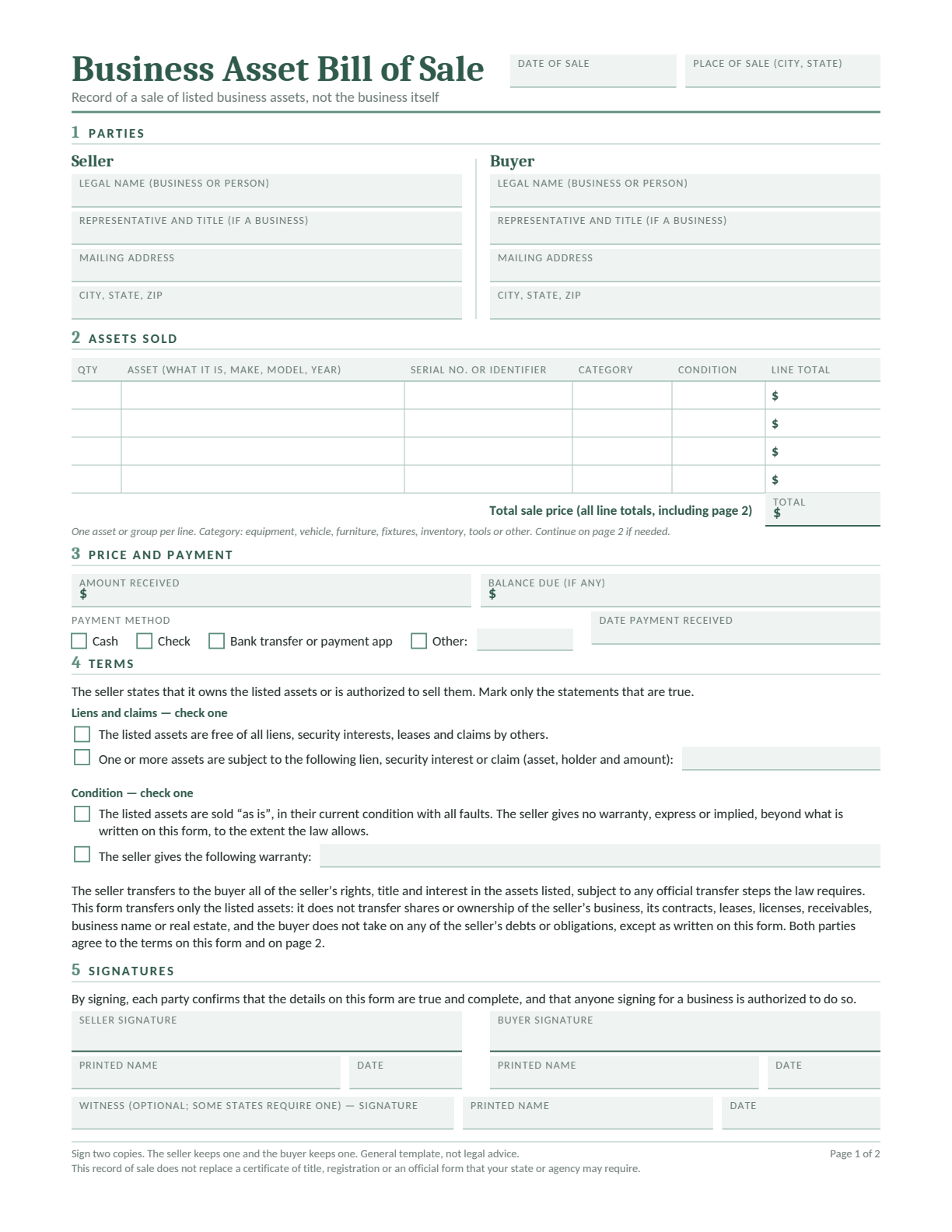
Listed Business Assets
List equipment, furniture, fixtures or inventory, with quantities, identifiers, condition and line totals. The second page gives you more rows and space for additional terms.
Download a free business asset template.
Record the equipment, furniture or inventory you’re selling. Give the seller and buyer a clear list of what changes hands.
Edit in Word or Google Docs, type into a fillable PDF, or print a blank PDF to fill in by hand.
Document the sale and agreed terms. Give both seller and buyer a signed copy.
Choose a PDF to print, a Word or Google Docs template to edit, or a fillable PDF to type into. In Google Docs, sign in and choose Make a copy to save your own version.
List equipment, furniture, fixtures or inventory, with quantities, identifiers, condition and line totals. The second page gives you more rows and space for additional terms.
Save your completed document before printing. Check both pages, sign as required for your sale, and keep a complete copy each.
This template records a sale of listed assets. A sale of the business itself, shares, real estate or other rights needs documents suited to that transaction. These are general templates, not legal advice. See our Terms and Conditions.
A business asset bill of sale records the property a business is selling, who is buying it, and the agreed price and terms. An item list helps both parties identify what will be collected and what stays with the seller.
Use it for tangible items such as bakery equipment, office furniture or counted stock. For one machine and its attachments, the equipment bill of sale templates provide fields for machine hours and included parts.
A mixer, shelving and stock can be listed and priced on an asset schedule. Selling an operating business involves more than those items. Set the scope before filling in the form.
Describe each item or group, its quantity, identifier and condition. For inventory, state how and when it was counted. Name the accessories, documents or training included in the price.
List anything the buyer should not expect to receive, such as leased equipment, the business name, website or premises lease. Company ownership interests, contracts, licenses and real estate need separate review and transfer arrangements.
For a whole-business sale, use a sale agreement prepared for the transaction. The SBA’s business sale guidance recommends attorney review and a careful account of the assets and liabilities. This template’s schedule can support that work.
Work from the actual asset list. Compare the completed form with the items before signing, and keep any continuation pages attached.
For help with the shared fields, see how to write a bill of sale.
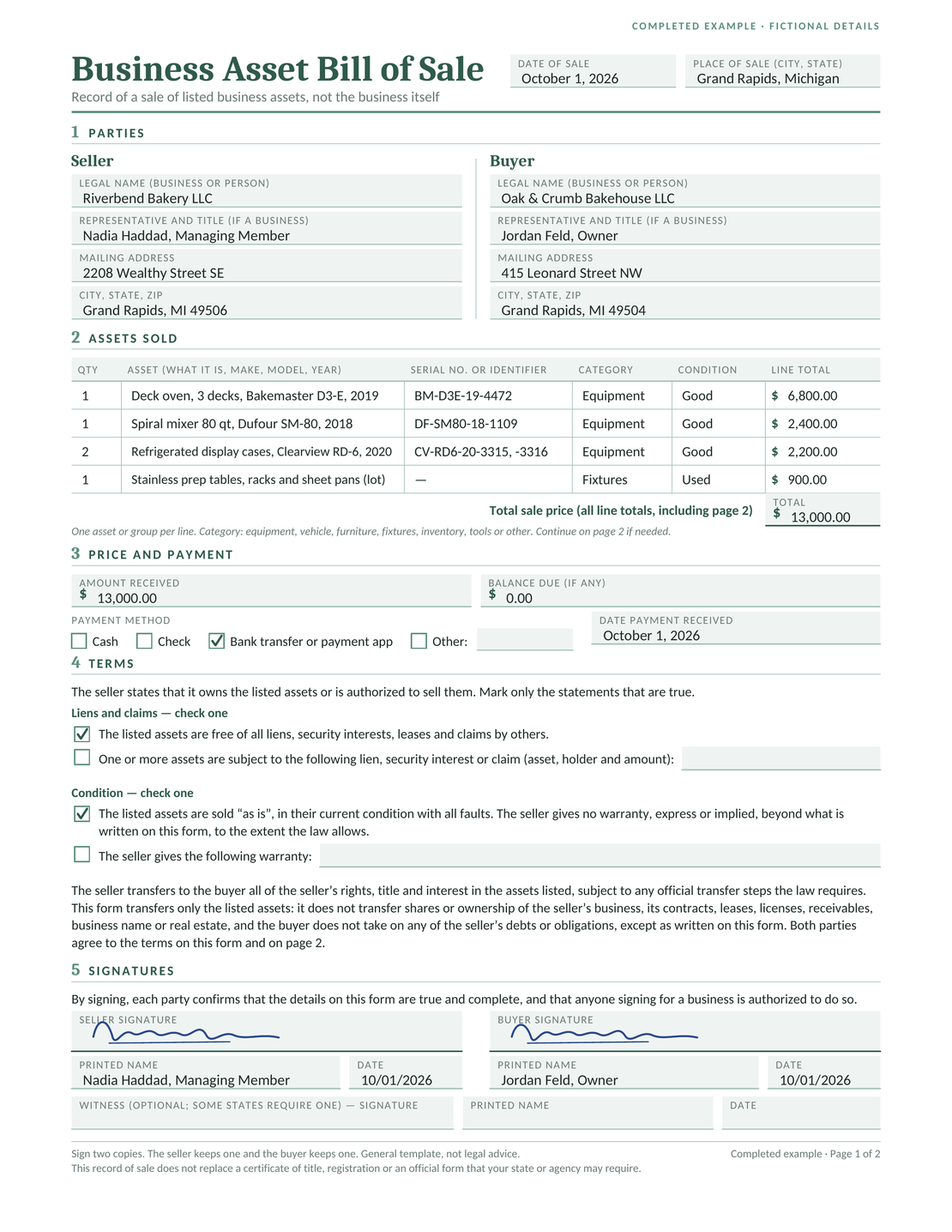
Riverbend Bakery LLC sells listed bakery equipment, fixtures and inventory to Oak & Crumb Bakehouse LLC for $13,000. The sale takes place on October 1, 2026, in Grand Rapids, Michigan. All names, businesses, identifiers and signatures in this example are fictional.
Download the Completed Example PDF
The example excludes the Riverbend Bakery name, recipes, website and premises lease. The seller delivers the equipment on October 3 and provides two hours of oven and mixer training.
Give each item or group a clear description and line total. In this example, the $2,200 display-case line includes both cases; the $900 fixtures line is one lot. The last two entries appear on the PDF’s second page.
| Qty | Asset | Identifier or reference | Category | Condition | Line total |
|---|---|---|---|---|---|
| 1 | Deck oven, 3 decks, Bakemaster D3-E, 2019 | BM-D3E-19-4472 | Equipment | Good | $6,800.00 |
| 1 | Spiral mixer 80 qt, Dufour SM-80, 2018 | DF-SM80-18-1109 | Equipment | Good | $2,400.00 |
| 2 | Refrigerated display cases, Clearview RD-6, 2020 | CV-RD6-20-3315, -3316 | Equipment | Good | $2,200.00 |
| 1 | Stainless prep tables, racks and sheet pans (lot) | — | Fixtures | Used | $900.00 |
| 1 | Point-of-sale terminal and cash drawer, Tillpoint T2 | TP2-21-77810 | Equipment | Good | $450.00 |
| 1 | Dry goods inventory as counted on October 1, 2026 | Count list attached | Inventory | New | $250.00 |
The total sale price is $13,000.00. The seller received $13,000.00 by bank transfer on October 1, 2026, leaving a balance of $0.00.
Nadia Haddad, Managing Member, signs for Riverbend Bakery LLC. Jordan Feld, Owner, signs for Oak & Crumb Bakehouse LLC. Both sign on October 1, 2026, with lien-free and as-is selected in this fictional record.
Keep the continuation page and inventory count list with both copies. For your own sale, confirm who has authority to sign and choose only the statements that are true.
Use the template to record the included property, agreed prices and collection arrangements.
Someone reading the list later should be able to match it to the property. “All kitchen equipment” leaves more room for confusion than a description and serial number for each machine.
Look for the manufacturer’s model and serial-number plate on each machine or appliance. Hobart’s manual guide, for example, lists the side, rear or inside a door panel, depending on the product. Check the maker’s manual for your item. If the business uses its own asset tags, add the tag number separately.
For furniture or stock without a serial number, use a clear description and quantity. Explain what a group includes: two display cases, one lot of shelving, or the inventory on an attached count list. Date the inventory count and agree how later changes will be handled.
Describe known faults and included parts. Name leased or borrowed property that stays behind, along with any other exclusions. Record who will disconnect, remove, load and transport the assets, and when.
Put the seller, buyer and sale date on every continuation page. Reference any attached list in the bill of sale, and check that both parties have the same version.
Check ownership as well as condition. An item on the seller’s premises may be leased, financed or owned by someone else.
Have ongoing payment plans, interest or retained ownership reviewed separately. If you are buying an operating business, get advice on the full agreement and the rights and obligations involved.
Give both parties the same complete signed record, including schedules and any payment or release documents. At collection, check the assets and included parts against the list.
Update asset and inventory records and keep the agreed prices for accounting and tax reporting. Complete any separate title or agency steps. The asset record does not itself close the seller’s company or transfer its licenses.
These sources explain questions that may arise alongside an asset sale. The documents needed depend on the property, location and scope of the transaction.
The SBA’s guidance on closing or selling a business covers the broader sale agreement and transfer of ownership. Use it when the transaction includes the business itself, rather than treating a short asset list as the complete agreement.
The IRS explanation of federal tax liens describes how a lien affects property and how a discharge can remove it from specific property. If a lien applies, confirm the required process; writing “lien-free” on the form is not a discharge.
The IRS Form 8594 instructions cover qualifying transfers of a group of assets that makes up a trade or business. Ask your tax adviser whether the form and allocation rules apply to your transaction; they are not requirements for every isolated equipment sale.
Official sources checked October 29, 2026. Check state tax and title requirements separately.
This template records listed tangible assets, such as equipment, furniture and inventory. Selling an operating business or company ownership interests needs an agreement and review suited to that transaction. The asset list can support that work, but it is not a complete business purchase agreement.
Yes. List each asset or clearly described group with its quantity, description, identifier where available, condition and price. Keep every schedule page with the signed record. Titled property may need separate transfer documents.
Name the company as the party and include the representative’s printed name and role. Confirm that the person is authorized to sign for the company. Use the legal owner’s name, not just a trading name.
Do not treat the form or the seller’s statement as a lender’s release. Identify the affected property and creditor, check the relevant records, and obtain the consent or release documents required for the transaction.
Check the rules for the location, property and any related official form. If notarization is required, use the appropriate wording and follow the notary’s instructions about when to sign.
Download the template and check it against the property being sold.
Create free business documents like invoices, estimates, quotes and receipts from these blank, printable and downloadable templates

Create and send unlimited documents. Every feature is included.
Create and send unlimited documents.
Every feature is included.
No credit card required.
After 14 days, continue for $12.99/month only if you choose to upgrade.