One Horse
Record the horse’s identity, health information shared by the seller, included tack and papers, and payment.
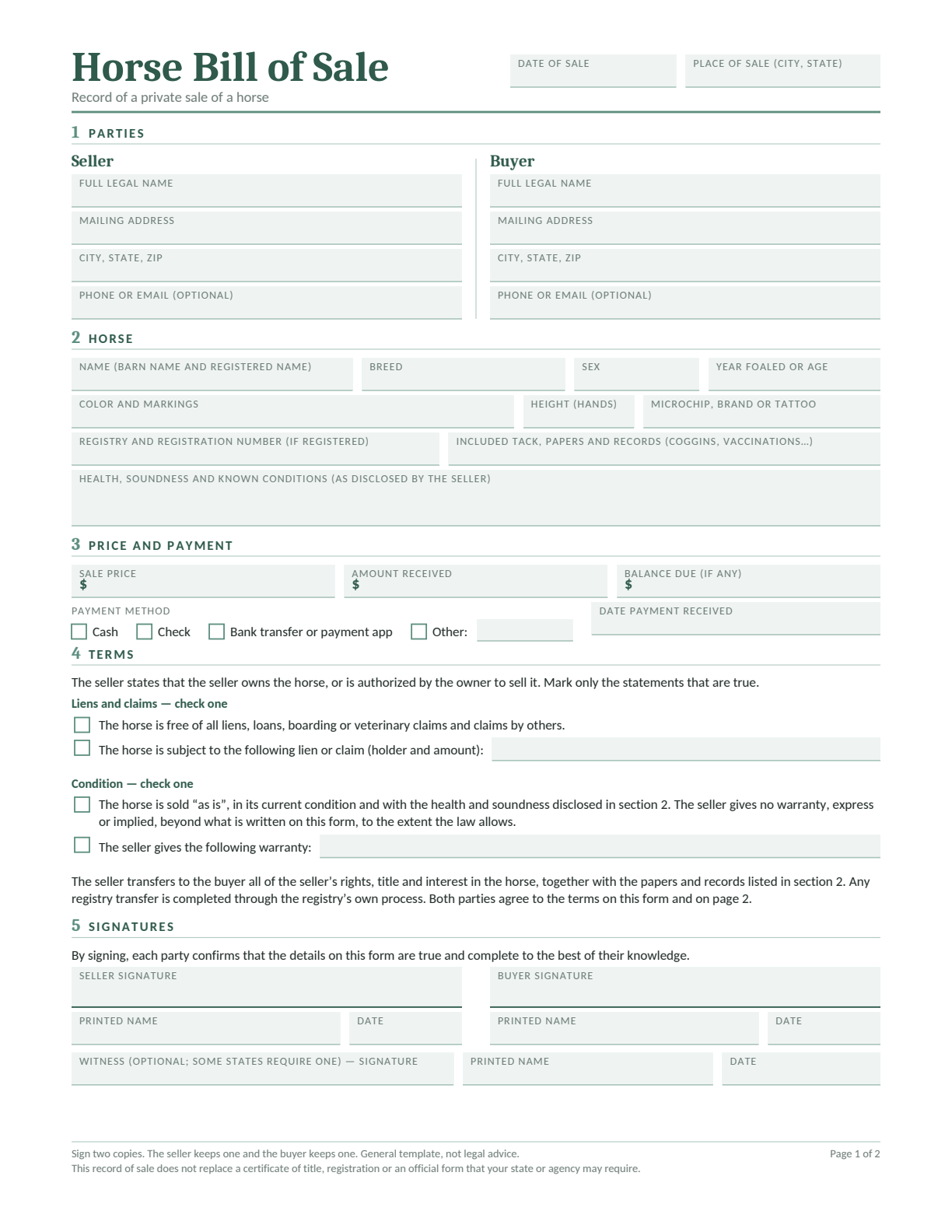
Download a free horse or livestock sale template.
Record the animal, payment and included papers. Give the seller and buyer a clear record of the sale and handover.
Edit in Word or Google Docs, type into a fillable PDF, or print a blank PDF to fill in by hand.
Document the sale and agreed terms. Give both seller and buyer a signed copy.
Choose a PDF to print, a Word or Google Docs template to edit, or a fillable PDF to type into. In Google Docs, sign in and choose Make a copy to save your own version.
Record the horse’s identity, health information shared by the seller, included tack and papers, and payment.
List animals individually or in clearly described groups, with head counts, identifiers and prices.
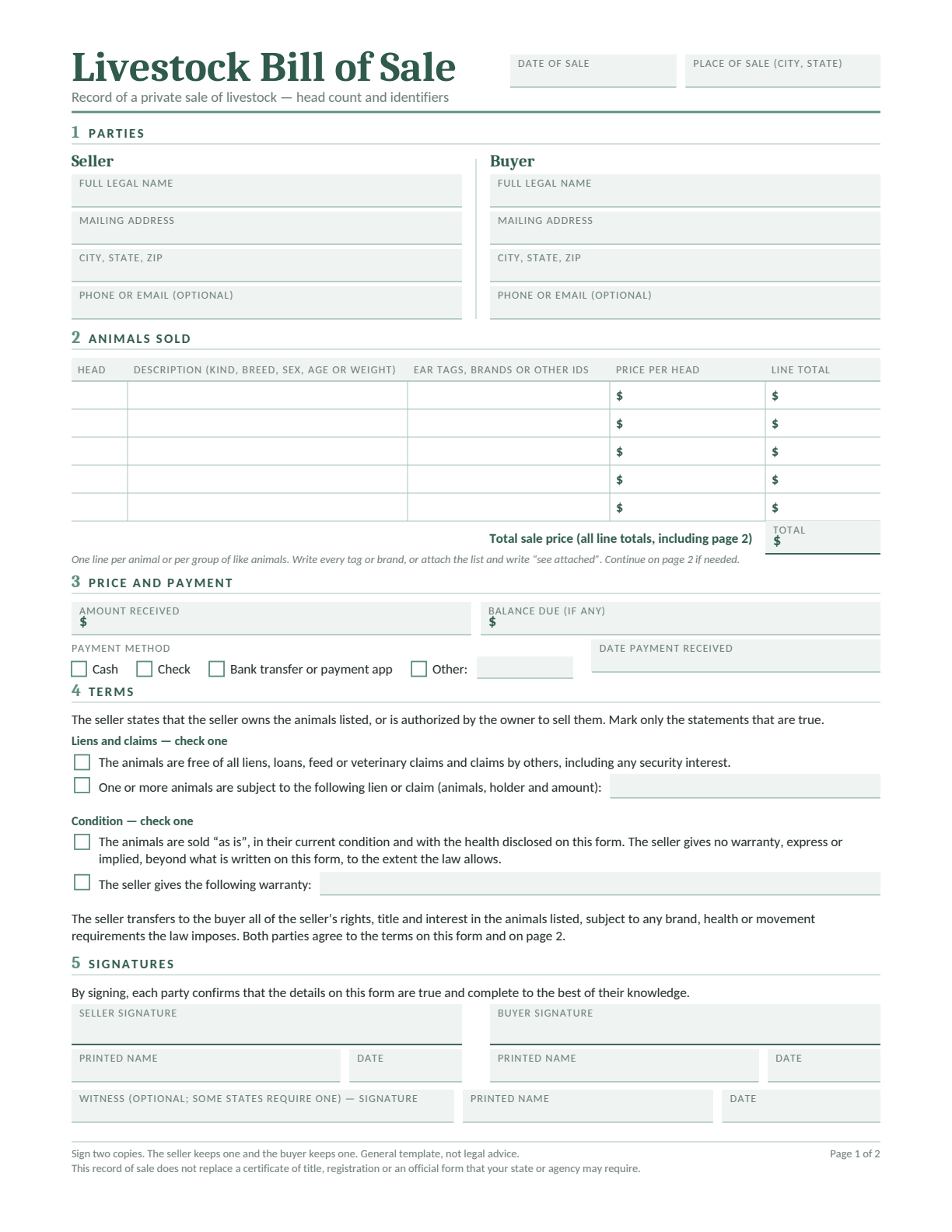
Save your completed document before printing. Check both pages, sign as required for your sale, and keep a complete copy each.
Check health, movement and inspection paperwork for the animals and their destination. Check any registry paperwork separately. These are general templates, not legal advice. See our Terms and Conditions.
A horse bill of sale records which horse is being sold, who is buying it, and the agreed price and terms. It also gives the seller and buyer space to list the papers, tack and records included in the sale.
Use the horse template for one horse. For several animals, the livestock template has a schedule for head counts and identifiers. Keep any required health certificates, test reports and ownership-inspection papers with the sale record.
Start with the horse’s barn name and registered name, if it has one. Add breed, sex, year foaled or stated age, color, markings and height in hands. Compare these details with the animal and its records.
Copy the microchip, brand or tattoo when verified. Add the registry and registration number, or explain that the horse is unregistered or papers are missing. List the papers actually included.
Write what the seller discloses about health, soundness and behavior. Identify any veterinary report by its date. Record specific promises, trial terms and the collection or delivery arrangement.
For a registered horse, copy its registered name and number from the registration certificate. Compare the description and markings with the horse; AQHA’s buyer guidance explains this check for American Quarter Horses. If the horse is unregistered or its papers are missing, say so.
For a brand or tattoo, record the visible mark and its location, then compare it with the available records. If the horse has a microchip, ask a veterinarian to scan it and compare the displayed number with its chip records. The USDA APHIS identification guide explains these identification methods.
If you cannot read a number or mark, check it with the seller and the available records before signing. Do not guess. If the horse is registered, complete the registry’s separate ownership-transfer process.
Work through the details while both parties can compare the horse, its records and the agreed terms. The bill of sale writing guide explains the fields shared by other templates.
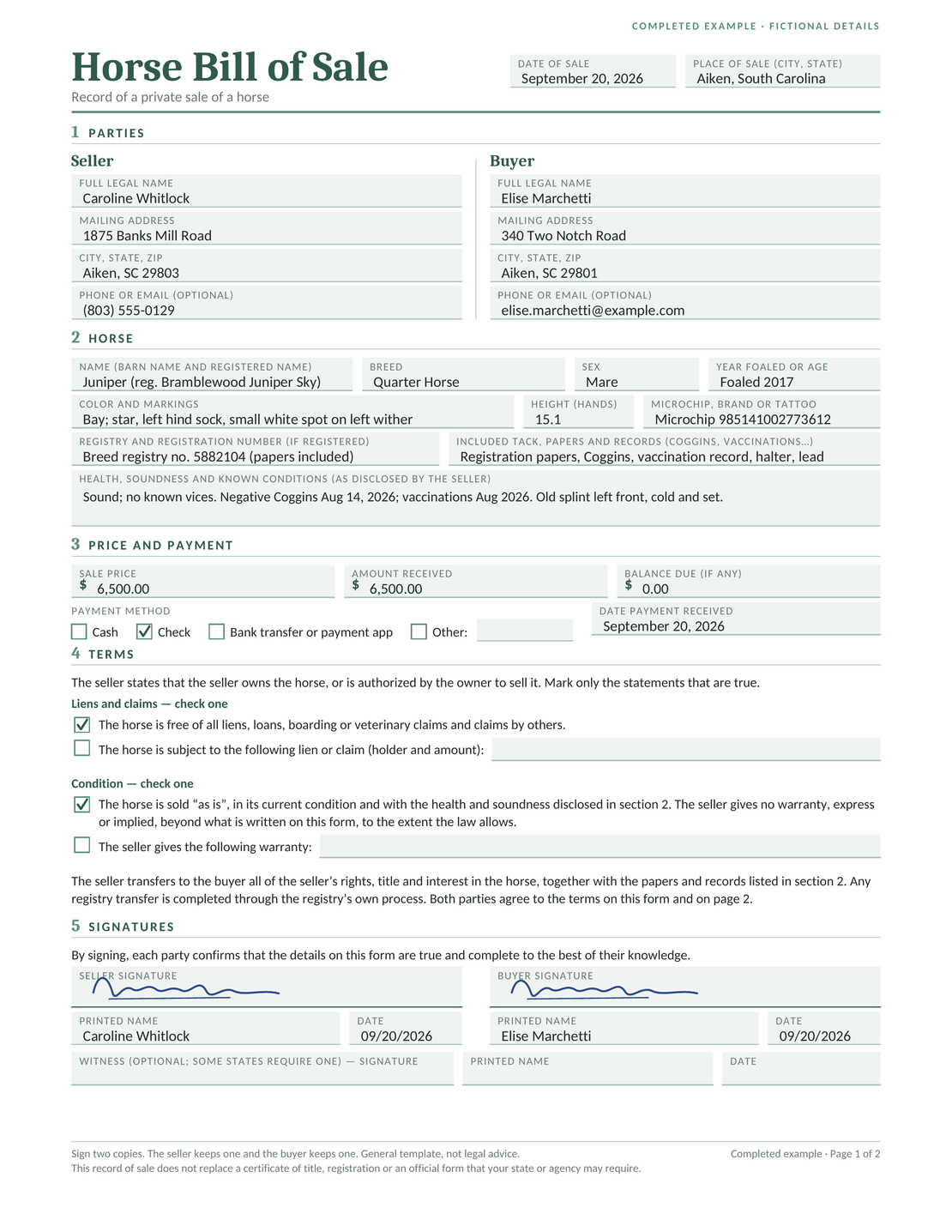
Caroline Whitlock sells Juniper, a bay Quarter Horse mare, to Elise Marchetti for $6,500 by check on September 20, 2026, in Aiken, South Carolina. All people, animal details, identifiers and signatures in this example are fictional.
Download the Completed Example PDF
| Field | Example entry |
|---|---|
| Horse | Juniper (registered name Bramblewood Juniper Sky); Quarter Horse; mare; foaled 2017 |
| Description | Bay; star, left hind sock and small white spot on left wither; 15.1 hands |
| Identification | Microchip 985141002773612; breed registry no. 5882104; papers included |
| Included | Registration papers, Coggins, vaccination record, halter and lead |
| Seller’s disclosure | Sound; no known vices. Negative Coggins August 14, 2026; vaccinations August 2026. Old splint left front, cold and set. |
| Price and payment | $6,500.00 price; $6,500.00 received by check on September 20, 2026; $0.00 balance |
| Additional terms | Pre-purchase exam completed September 15, 2026 at the buyer’s cost. The seller delivers Juniper to the buyer’s barn on September 22, 2026 and signs the registry transfer the same day. |
| Terms and signatures | Lien-free and as-is selected. Caroline Whitlock and Elise Marchetti sign on September 20, 2026. |
The health entries describe this fictional example. Use the actual records for your horse, and confirm the required tests and travel documents with your veterinarian and the destination state.
Choose the horse template or livestock schedule. Record the animal, payment, included papers and handover arrangements.
For a group of animals, record the head count, description and identifying tags or brands on each line. If several animals share a line, make the group clear and include every identifier, or attach the list.
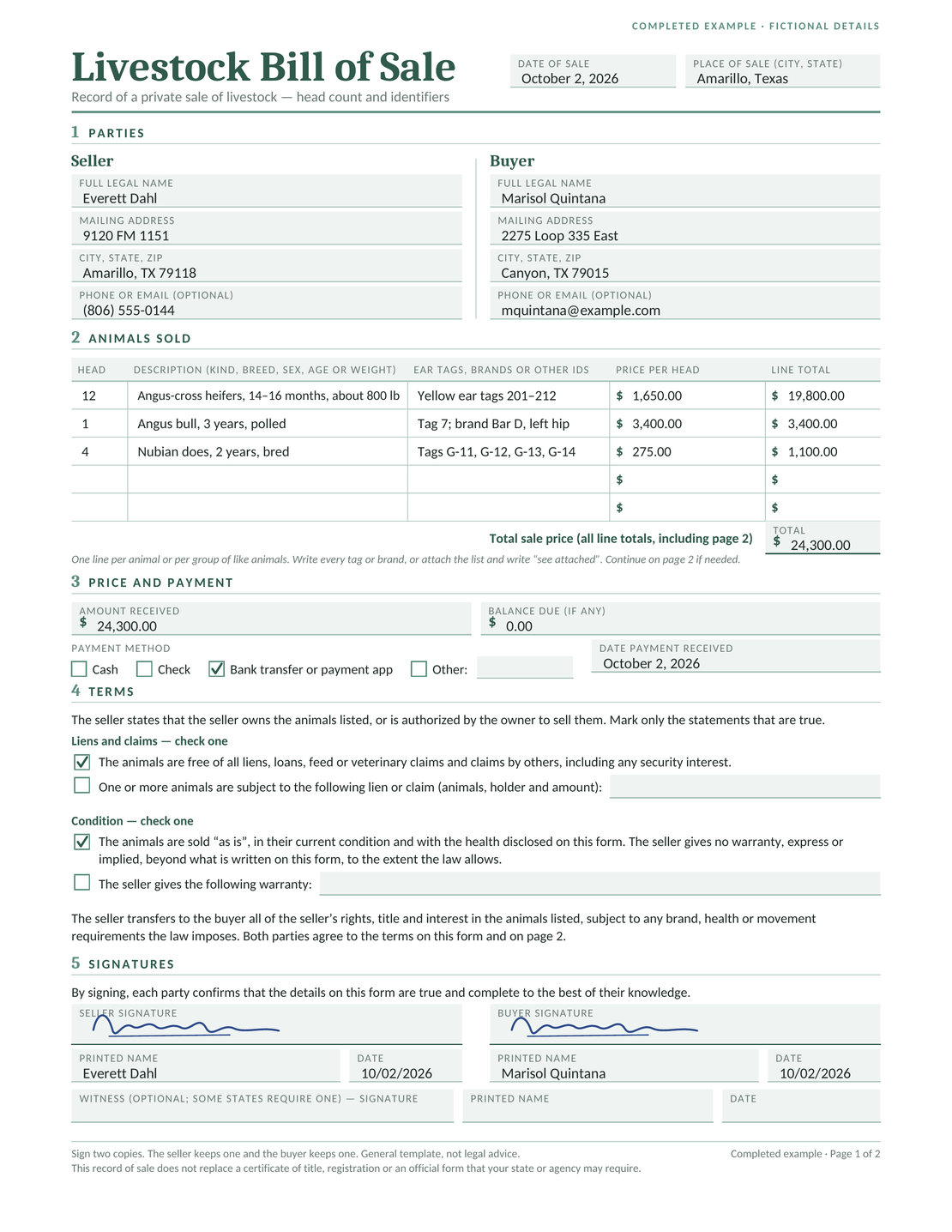
In this fictional example, Everett Dahl sells 17 animals to Marisol Quintana in Amarillo, Texas, on October 2, 2026. The three line amounts add up to $24,300.
Download the Livestock Example PDF
| Animals | Identification | Head | Price per head | Total price |
|---|---|---|---|---|
| Angus-cross heifers, 14–16 months, about 800 lb | Yellow ear tags 201–212 | 12 | $1,650.00 | $19,800.00 |
| Angus bull, 3 years, polled | Tag 7; brand Bar D, left hip | 1 | $3,400.00 | $3,400.00 |
| Nubian does, 2 years, bred | Tags G-11, G-12, G-13, G-14 | 4 | $275.00 | $1,100.00 |
The total for 17 head is $24,300.00. Everett received the full $24,300.00 by bank transfer on October 2, 2026, leaving a $0.00 balance.
Everett and Marisol sign on October 2, with lien-free and as-is selected. The additional terms record a brand inspection at the seller’s pens that day. The buyer hauls all animals on October 3, 2026, and the example says risk passes on loading.
Those are this fictional sale’s terms, not a statement of Texas requirements. Farm tags on a sale schedule do not establish compliance with official identification rules. For a sale priced by weight, also record the rate, unit, weighing method and scale ticket used.
Use the review to settle anything that would be difficult to clarify after the animals leave. Complete any agreed examination or trial conditions before treating the sale as final.
For installments, interest or continuing conditions, have an agreement reviewed for the arrangement.
Keep the complete signed bill of sale, schedule, payment record and agreed terms together. Give the buyer the listed papers, tack and care records, and note the actual handover if it happens after the sale date.
Complete the breed registry’s transfer process where relevant. Before transport, confirm that the required health and inspection documents accompany the animals.
Check the rules for the species, origin and destination before arranging transport. Your veterinarian and the destination state’s animal-health office can identify the documents needed for the journey.
The USDA APHIS equine identification guide describes ways to identify horses. Its interstate movement guidance explains that most states require individual identification and a certificate of veterinary inspection for horses crossing state lines. The receiving state sets testing and other entry requirements.
A Coggins report records equine infectious anemia testing; it is separate from the bill of sale. See USDA APHIS information on EIA and ask your veterinarian which test dates and documents fit your journey.
For cattle and bison, use the USDA APHIS movement decision tree (PDF) to understand the federal identification categories and exceptions. Species and destination rules still need a separate check. The APHIS movement-document instructions explain what must accompany animals when a certificate of veterinary inspection is required.
Washington’s livestock inspection instructions distinguish cattle ownership changes from private horse sales. Washington recommends an inspection for a private horse ownership change and generally requires one before a horse leaves the state, with a specified market exception. Eligible cattle transactions may use its electronic reporting process.
Official sources checked October 29, 2026. The Washington examples apply in Washington; check the inspection office responsible for your sale.
Say whether the horse is unregistered or its papers are missing. Record its description, markings and verified identifiers. If registration is part of the agreement, resolve missing papers with the registry before completing the sale.
No. The bill of sale records the transaction. A Coggins report records EIA testing. Check the destination state’s requirements with your veterinarian before transport.
The livestock template lets you identify animals individually or in clearly described groups. Include head counts, identifiers and the price basis. Keep all schedule pages with both signed copies and complete any required official papers separately.
Check your state’s rules and the instructions for any official form involved. Notarization, witnessing and livestock inspection are separate processes. If a notary is required, follow their instructions about when to sign.
Record the agreed price, payment received with its date and method, and the remaining balance separately. Write the payment and handover timing. A deposit alone does not establish that the sale is complete; get suitable advice for payment plans or conditions that remain open.
Download a template and work through the sale details together.
Create free business documents like invoices, estimates, quotes and receipts from these blank, printable and downloadable templates

Create and send unlimited documents. Every feature is included.
Create and send unlimited documents.
Every feature is included.
No credit card required.
After 14 days, continue for $12.99/month only if you choose to upgrade.