Free Demand Letter Template
Create a professional demand letter in minutes
Request payment of an unpaid invoice with the amount owed and a clear response date. Give your customer a practical way to pay or explain a disputed balance.
Print your letter or download it as a PDF.
14-day free trial. No credit card required.
Demand Letter Example for an Unpaid Invoice
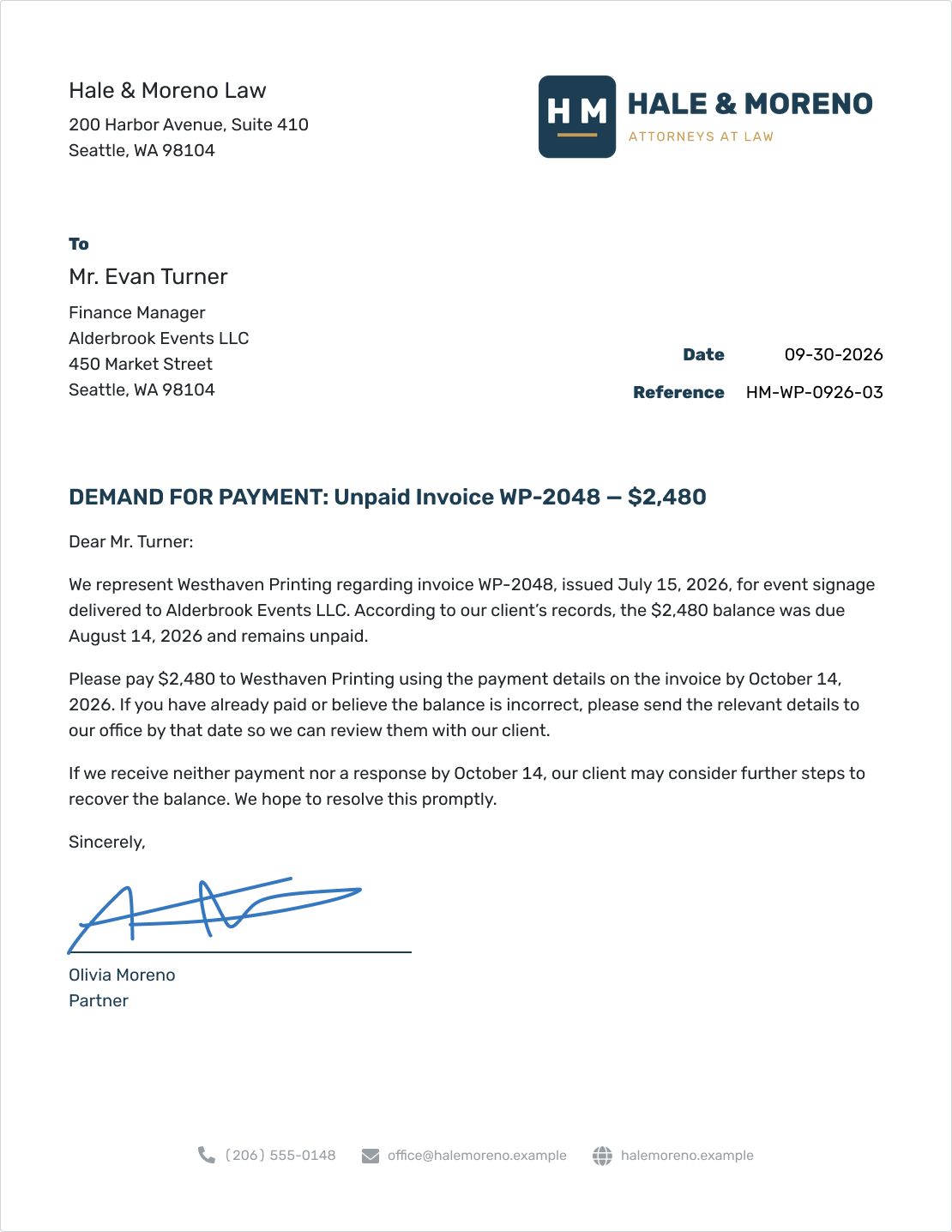
This fictional letter shows a law firm requesting payment for a client. The copy-ready template below is for a business contacting its customer directly. Use that wording when writing in your own business's name.
What Is a Demand Letter?
A demand letter sets out what happened, what you are requesting, and when you need a response. For an unpaid business invoice, it brings the balance and payment request together in one written record.
If the customer may simply have missed the invoice, start with a collection reminder. A demand letter is a firmer request after earlier contact, or when you need to set out a specific claim. It does not guarantee payment or decide whether the claim is legally valid.
This page focuses on a business requesting payment in its own name. Collection rules depend on the debt, the person collecting it, and the state involved. Review the CFPB's debt collection guidance and get advice before adapting the wording for consumer debt or collecting for another creditor.
This template is general writing guidance, not legal advice. Check the requirements for your claim and state before sending it.
Complete Demand Letter Template for an Unpaid Invoice
Replace each [placeholder] with your own details. This wording is for the business owed payment. It requests the invoice balance without adding interest, collection charges, or a promise to file a claim.
Unpaid Invoice Payment Demand
[Your business name]
[Street address]
[City, State ZIP]
[Email address and phone number]
[Month Day, Year]
Reference: [Invoice number]
[Recipient name and title]
[Customer business name]
[Street address]
[City, State ZIP]
Subject: Demand for payment of invoice [Invoice number] — [Unpaid balance]
Dear [Recipient name]:
I am writing on behalf of [Your business name] about invoice [Invoice number], issued on [Invoice date] for [Products or services provided]. Our records show that the remaining balance of [Unpaid balance] was due on [Original due date] and has not been paid.
Please pay [Unpaid balance] by [Response date] using [Payment instructions]. I have included [Invoice and supporting documents] so you can review the request.
If you have already paid or believe the balance is incorrect, please send the relevant payment or dispute details to [Reply email or mailing address] by [Response date]. We will review the information and respond.
If we receive neither payment nor a response by that date, we may consider further steps to recover the balance. We would prefer to resolve this directly. Please contact [Contact name] at [Phone number or email address] with any questions.
Sincerely,
[Signature]
[Your name]
[Your title]
[Your business name]
Enclosures: [List the documents included]
If you are not including documents, remove the sentence beginning “I have included” and the enclosure line. Remove the sentence about further action if you are not considering it. If you offer to discuss a payment arrangement, explain that you must agree to it before it takes effect.
How to Write a Demand Letter
Have the invoice, agreement, and payment record beside you. Use these six steps to put your request into a clear letter.
- Your Business: Enter the name and contact details of the business requesting payment.
- Your Logo: Add your own business logo if you use one.
- Recipient: Add the customer's business name, the person handling payment, and their address.
- Date and Reference: Set the letter date. Use the invoice or case reference to identify the matter.
- Your Request: Explain the unpaid balance or loss. State the amount or remedy and a response date.
- Closing and Signature: Add a reply contact, courteous closing, and your name. Review, then email, print, or download a PDF.
Before You Send Your Demand Letter
Check the records once more so the letter asks for the right amount and gives the customer a useful way to respond.
- The recipient and business names match your agreement and invoice.
- The balance allows for payments, credits, or refunds already recorded.
- The invoice dates, requested amount, and response date are correct.
- The facts are supported, and you have included the documents you mention.
- Your payment and reply details are clear, and any required notice or delivery rules have been checked.
After You Send Your Demand Letter
- For a letter emailed from Docelf, check its document history for delivery and opened information.
- Keep a copy of the letter, supporting records, and any postal delivery record.
- After the response date, check for payment or a reply before following up.
If the customer disputes the balance, review the details before repeating the request. Refer to the invoice and explain what you still need. Email history can help with follow-up, but it does not by itself establish legally sufficient notice.
Put Your Payment Request in Writing
Add your wording to the business letter layout in Docelf. Keep the invoice reference and response date easy to find. Review the letter, then print it or download a PDF.
Make the Amount and Requested Action Easy to Check
Give enough detail for the customer to find the invoice and check the amount. Briefly explain what the payment covers and identify the records you are including.
- Basis of the request: Identify the work, order, agreement, or event behind the amount.
- Balance or remedy: State the unpaid amount, account for payments, or describe the action requested.
- Supporting records: Identify the invoice, delivery confirmation, receipt, or repair estimate.
- Response date: Use a specific date and explain where payment or a reply should go.
- Next step: Explain what you plan to do next without exaggerating the consequences.
The fictional law-firm preview concerns Westhaven Printing's $2,480 invoice WP-2048, issued July 15, 2026, and due August 14. It requests payment or relevant details by October 14. These dates and names illustrate a complete letter; they are not a standard notice period or a finding that the money is legally owed.
Choose Wording That Fits the Situation
An Unpaid Business Invoice
Name the invoice and the work it covers. If earlier reminders have not resolved the balance, mention the dates of that contact without retelling every conversation. Include the invoice so the customer can pass it to the person who handles payment.
An Invoice with a Partial Payment or Dispute
Subtract payments and credits before writing. For example, an invoice of $2,480 with a $1,000 payment leaves $1,480. If the customer disputes part of the work, identify the issue and ask for the details you need to review it.
Damage or a Requested Repair
Describe the event and the loss separately from an invoice debt. Use repair estimates or receipts to explain a reimbursement request. If you want a repair instead of money, describe the result you need and ask for a proposed completion date.
Separate Wording for Damage Reimbursement
A damage claim needs its own facts and supporting records. Do not copy an overdue-invoice paragraph when there was no invoice debt. Use this starting point after checking the basis for your request.
Documented Loss and Requested Remedy
[Your business name]
[Street address]
[City, State ZIP]
[Email address and phone number]
[Month Day, Year]
Reference: [Incident or project reference]
[Recipient name and title]
[Recipient business name]
[Street address]
[City, State ZIP]
Subject: Request for reimbursement — [Brief description of damage]
Dear [Recipient name]:
I am writing about [Event] on [Event date] at [Location]. [Explain what happened and the facts supporting your request]. The damage to [Property or item] is described in [Photos, report, or other record].
I am requesting reimbursement of [Amount] for [Repair or replacement cost]. The amount is based on [Estimate or receipt], which I have included for your review.
Please respond by [Response date] to [Reply email or mailing address]. You can arrange payment using [Payment instructions] or send the information you would like us to consider. We would prefer to resolve this directly.
Sincerely,
[Signature]
[Your name]
[Your title]
[Your business name]
Enclosures: [List the documents included]
For a repair request, replace the reimbursement paragraph with the specific work you want done. Replace the payment sentence with a request for a proposed completion date. Keep the response date and reply details. Avoid speculative costs or a statement of legal liability you have not checked.
Choose a Delivery Method and a Realistic Next Step
Check whether your agreement or applicable rules require a particular notice address or delivery method. Email can be useful for routine contact, but it may not satisfy every formal notice requirement.
For a mailed letter, USPS Certified Mail gives a record of mailing and delivery or attempted delivery. Adding Return Receipt gives you a signature record. Keep these records with a copy of the letter; they do not prove the recipient read or agreed with your request.
If the matter remains unresolved, consider a conversation, mediation, or legal advice. Small claims may be an option depending on the claim and local rules. Check the court's amount limits, filing deadlines, and any steps required before filing. The California Courts guide to asking for payment is one state-specific example, not a rule for every US claim.
Keep the Letter Firm and Factual
You can make a clear request without insults or dramatic language. The recipient needs the facts and a way to respond.
- Request the current balance rather than the original total after a partial payment.
- Replace vague wording such as “immediately” with a realistic response date.
- Do not add unsupported interest, fees, or damages.
- Do not imply attorney representation or threaten steps you cannot or do not intend to take.
- Tell the customer how to question the balance or point out an error.
A demand is a request to resolve the matter. If the issue is a supplier's incorrect delivery and you are asking them to put it right, a complaint letter may fit better.
Use a Readable Business Letter Format
Docelf uses a slightly modified block format. The date and reference sit to the right, while the recipient details and body start on the left. Keep the request in short paragraphs so the amount and response date are easy to find.
For a US letter, use US Letter paper, readable type, a written-out date such as September 30, 2026, and clear space between paragraphs. Use a suitable greeting and closing, and leave signature space. A subject and invoice reference are useful here even though they are optional parts of a general business letter.
Need help with the layout? Read the business letter format guide or the guide to greetings and sign-offs.
Letter Wording and Format Resources
Use the copy icon above your chosen letter to copy its wording. Add your details in the generator, then print the finished letter or download a PDF. You can also paste the wording into one of the Word or Google Docs templates linked below.
Demand Letter Questions
-
What is a demand letter?
A demand letter states a claim, the payment or remedy requested, and a response date. For an unpaid invoice, identify the work, the invoice, and the balance shown in your records. The letter gives the customer a clear way to respond.
-
How much time should I give the recipient to respond?
Use a specific calendar date that allows time for delivery and a reasonable response. Check your agreement and applicable notice rules before choosing it. The October 14 date in the fictional preview is an example, not a required notice period.
-
Do I have to send a demand letter by certified mail?
There is no single mailing rule for every demand letter. Follow any delivery requirements that apply to your agreement or claim. USPS Certified Mail records mailing and delivery or attempted delivery; adding Return Receipt provides a signature record.
-
Can I write a demand letter myself?
You can write a letter in your own business's name. Describe the facts and your request without suggesting that a lawyer sent it. Get legal advice if you are unsure about your rights, required notices, or a disputed claim.
-
Can I add interest or collection fees?
Do not add a fee simply because an invoice is overdue. Check that any interest or charge is supported by your agreement and applicable law, and explain the calculation. The payment template on this page requests the unpaid invoice balance only.
-
What if the customer does not reply?
After the response date, check for payment and any reply before following up. You can consider discussion, mediation, legal advice, or the appropriate small claims process. Check local court rules and filing deadlines; silence does not automatically prove your claim.
-
Can I print the letter or download a PDF?
Yes. Write the letter in Docelf, review the names, amount, and response date, then print it or download it as a PDF. You can also email the letter from Docelf and view its delivered and opened history. That history does not by itself establish legally sufficient notice.
Write Your Demand Letter in Docelf
Give your customer a written request they can match to the invoice and act on.
- Add your business and the recipient.
- State the balance and response date.
- Review, print, or download a PDF.