Free Letter of Intent Template
Create a professional letter in minutes
Outline a proposed business purchase, lease, or partnership with the terms you want to discuss. Give the other party a clear starting point for the next conversation.
Print your letter or download it as a PDF.
14-day free trial. No credit card required.
Business Purchase Letter of Intent Example
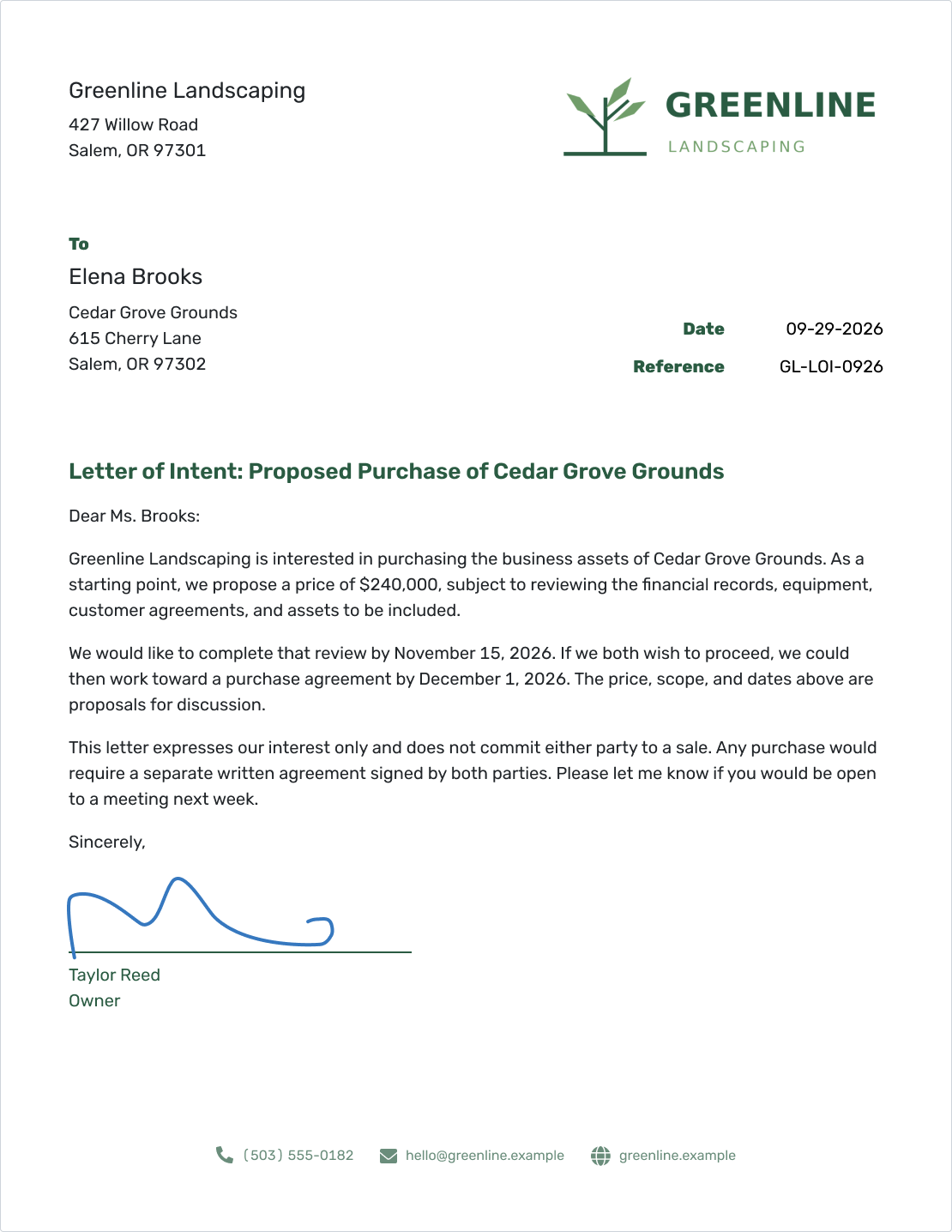
Greenline Landscaping proposes a business purchase, including a price and a timetable for reviewing the details. Use the wording below to adapt your letter for a purchase, lease, partnership, or supplier arrangement.
What Is a Letter of Intent?
A letter of intent, or LOI, outlines a proposed business arrangement before the parties work out a final agreement. It explains what you want to do, the main terms you want to discuss, and the next step.
For a business purchase, that might mean a proposed price and time to review the assets. For a lease, it might mean rent, premises, and a start date. An LOI gives the other party something specific to consider.
Use the wording below with a business letter template. If you are ready to record final obligations, use an agreement prepared for that purpose.
This page offers general writing guidance, not legal advice. Have a qualified lawyer review a letter that could create obligations before you send or sign it.
Letter of Intent to Purchase a Business: Wording to Use
Replace every [placeholder] with your own details. This example proposes an asset purchase; describe the actual transaction if you intend to buy shares or ownership interests instead.
The price and dates are starting points for discussion. Remove the optional reference line and any excluded-assets clause that you don’t need.
Business Purchase Letter of Intent
[Your business name]
[Your street address]
[Your city, State ZIP code]
[Phone number] · [Email address]
[Month Day, Year]
Reference: [Optional reference]
[Recipient name]
[Recipient title]
[Seller business name]
[Recipient street address]
[Recipient city, State ZIP code]
Letter of Intent: Proposed Purchase of [Seller business name]
Dear [Recipient name]:
[Your business name] is interested in purchasing [specific business assets] from [Seller business name]. As a starting point, we propose a purchase price of [amount and currency], subject to reviewing [financial records, equipment, customer agreements, and other relevant information]. The proposed price would cover [assets included]; [assets excluded] would remain outside the proposed purchase.
We would like to complete that review by [review deadline]. If both parties wish to proceed, we propose working toward a separate purchase agreement by [target agreement date], with a proposed completion date of [completion date]. These terms and dates are proposals for discussion.
Our intention is to explore the purchase without committing either party to complete it through this letter. Any purchase would require a separate written agreement signed by both parties.
Please let me know by [response date] whether you would be open to a meeting to discuss the proposal. You can reach me at [Phone number] or [Email address].
Sincerely,
[Signature]
[Your full name]
[Your title]
[Your business name]
What to Include in Your Letter of Intent
Give the reader enough detail to decide whether to discuss your proposal. Label terms that are still open for discussion so neither party mistakes them for an agreement.
- The parties: Identify the businesses and the people discussing the arrangement.
- The proposal: Say what you want to buy, lease, supply, or do together.
- The main terms: State the proposed price or pricing basis, scope, and timetable.
- The review: Identify information, inspections, financing, or approvals needed before moving ahead.
- The intended obligations: Distinguish discussion points from any clauses intended to bind the parties.
- The next step: Request a meeting or reply by a specific date and give your contact details.
Keep the dates separate: the response date is for a reply, the review deadline is for completing the checks, and the proposed completion date is when the deal might go ahead.
How to Write a Letter of Intent in Docelf
The purchase example shows where each part belongs. Follow the numbers, adapting the message to the arrangement you want to discuss.
- Your Business: Enter your business name, address, and contact details.
- Your Logo: Add your logo if you use one on business letters.
- Recipient: Add the name, business, and address of the person considering your proposal.
- Date and Reference: Use the letter date and an optional reference for the proposed arrangement.
- Your Proposal: Add a greeting, proposed terms, review dates, and the next step you want to discuss.
- Closing and Signature: Add your closing and name, leaving signature space. Review the letter before sharing it.
Before You Send Your Letter of Intent
Read the letter from the other party’s point of view. They should be able to identify the proposal and know what you want them to do next.
- Business names, recipient details, and the arrangement are correct.
- The proposed price includes a currency and says what it covers.
- Review, response, and proposed completion dates leave enough time for the next steps.
- Unresolved terms and any intended obligations are clearly identified.
- Every placeholder is replaced, and any document described as enclosed is included.
- A qualified lawyer has reviewed any terms that could create obligations.
After You Send Your Letter of Intent
- Check the document history in Docelf to see when your emailed letter is delivered and opened.
- If it has not been delivered, check the recipient’s email address before sending it again.
- If you have not received a reply, follow up after the response date you requested.
Mention the original proposal and ask whether the other party would like to discuss it. Delivered or opened history helps you plan the follow-up; it does not show that they agreed to your terms.
Put Your Proposal in Writing
Use your proposed terms as the starting point. Docelf gives your letter a ready-made layout. Review the wording, then print it or download a PDF to share.
Binding and Non-Binding Terms: Keep the Difference Clear
You may want to discuss a deal without agreeing on the price or timetable yet. A promise to keep information confidential or to negotiate only with each other is a separate commitment.
Writing “non-binding” at the top does not decide whether a clause is enforceable. The wording, circumstances, and applicable law matter. Have any intended commitments reviewed rather than adding them to a general sample.
| Part of the Letter | What to Clarify |
|---|---|
| Proposed deal terms | Which price, scope, dates, and conditions are still being discussed? |
| Separate obligations | Are any confidentiality, exclusivity, costs, or negotiation terms intended to create obligations? |
| Next agreement | What agreement and approvals would be needed before the purchase, lease, or work could proceed? |
Keep the letter focused on the decision you are asking for now. It can invite a discussion without trying to fit the entire final agreement onto one page.
Adapt the Letter to Your Business Proposal
Keep the sender, recipient, greeting, and signature from the template above. Adapt the main paragraphs to the arrangement you want to discuss; these four situations show where to focus.
Buying a Business
Name the business and say whether you want to buy its assets or ownership interests. Include a proposed price and what you need to check before signing a purchase agreement.
In the illustrated example, Greenline Landscaping proposes a $240,000 purchase of Cedar Grove Grounds’ business assets. It proposes a review by November 15, 2026, and work toward a purchase agreement by December 1, 2026. The price and dates remain discussion points.
Leasing Commercial Premises
Identify the premises, proposed rent, lease length, and intended use. Mention any inspection or improvements you want to discuss before a lease is signed.
Example wording: “We are interested in leasing [premises address] for [business use]. We propose a [lease length] term starting on [date], at a base rent of [amount and currency] per month. We would like to discuss [additional charges and required improvements] and arrange [inspection or viewing] before moving ahead. These are proposed terms for a separate lease agreement. Please let us know by [response date] whether you would like to discuss them.”
Exploring a Partnership
Explain the shared goal and each business’s proposed contribution. Identify decisions that still need agreement, such as responsibilities, costs, and how the businesses would work together.
Example wording: “We would like to explore a partnership with [business name] to [shared goal]. We propose contributing [your contribution], with your business providing [proposed contribution]. Before any work begins, we would need to agree on [roles, costs, and how decisions will be made] in a separate agreement. Please let us know by [response date] whether you would be open to a meeting.”
Discussing a Supplier Arrangement
Describe the products or services, expected quantities, and timing. Make it clear whether volumes and prices are estimates for discussion or commitments you want reviewed.
Example wording: “We are interested in discussing a supply arrangement for [products or services]. We expect to need [quantity] over [period]. This is an estimate for discussion, not an order or a minimum purchase commitment. Please let us know by [response date] whether you can meet this requirement, and share your proposed specifications, pricing, and delivery terms.”
Format Your Letter for a US Business
Use US Letter paper, a readable 11- or 12-point font, and clear spacing between paragraphs. Write out the date, as in September 30, 2026. Address a named recipient when possible, and leave space to sign above your typed name and title.
Docelf uses a slightly modified block format. The date and reference sit to the right, while the recipient details and body start on the left. The purchase example above shows that layout; its displayed date uses a numeric format.
Use a short subject or reference when it helps the reader identify the proposal. For more guidance, see US business letter formatting and how to start and end a business letter.
Common Letter of Intent Mistakes
Small wording choices can change how the proposal reads. Check these points before asking the other party to respond.
- A vague proposal: Replace “We would like to work together” with the arrangement you want to discuss.
- An unclear price: State the currency and what is included, especially in an asset purchase.
- Dates without labels: Distinguish the requested reply from a review deadline or proposed completion date.
- Commitments mixed with proposals: Have intended obligations reviewed and identify discussion points clearly.
- No next step: End with a practical request, such as a meeting or a reply by a particular date.
Use the Wording in Word, Google Docs, or Online
Use the copy icon above to copy the complete purchase letter into a Word or Google Docs letter template. Replace the placeholders and check the layout before sharing it.
To create a PDF, write your letter in the business letter generator, review it, then download the PDF or print it. Choose an editable template from the Word or Google Docs pages below, or compare the business letter formats.
Letter of Intent Template FAQ
-
Is a letter of intent a contract?
A letter of intent usually starts a discussion about a proposed arrangement. It may also contain binding obligations. The wording, circumstances, and applicable law matter, so ask a qualified lawyer to review any terms you intend to rely on.
-
How long should a letter of intent be?
A straightforward proposal may fit on one or two pages. Include enough detail to explain the arrangement and the next step. Put lengthy asset lists or technical information in a separate document rather than crowding the letter.
-
Should a letter of intent include a purchase price?
Include a proposed price or pricing basis when it helps the discussion. State the currency, what the price covers, and any review or financing conditions. Label it as proposed rather than describing it as an agreed amount.
-
Do both parties need to sign a letter of intent?
That depends on the purpose and wording. A letter inviting a discussion can include only the sender’s signature. If you want signatures to confirm obligations, have the wording and signing process reviewed before using it.
-
Can I email my letter of intent?
Yes. Email the letter from Docelf and check the document history to see when it is delivered and opened. You can also download a PDF to attach to your own email. Delivery or opening does not mean the recipient agreed to the proposal.
-
Can I print my letter of intent or download a PDF?
Yes. Create your letter in the business letter generator, review the terms and names, then print it or download it as a PDF. The generator opens the general letter editor; add your own proposal wording.
-
Can I use this wording in Word or Google Docs?
Yes. Use the copy icon above, then paste the wording into a Word or Google Docs letter template. Replace the placeholders and check the US Letter page layout, paragraph spacing, and signature space before sharing it.
Ready to Write Your Letter of Intent?
Give the other party a proposal they can read and discuss. Start your letter in Docelf.
- Add the business and recipient details
- Write your proposed terms and requested next step
- Review the letter, then print or download a PDF