Free Engagement Letter Template
Create a professional letter in minutes
Agree on the work before you begin. Describe the accounting or consulting services, fees, and responsibilities so your client knows what is included and how to confirm.
Print your engagement letter or download it as a PDF.
14-day free trial. No credit card required.
Engagement Letter Example
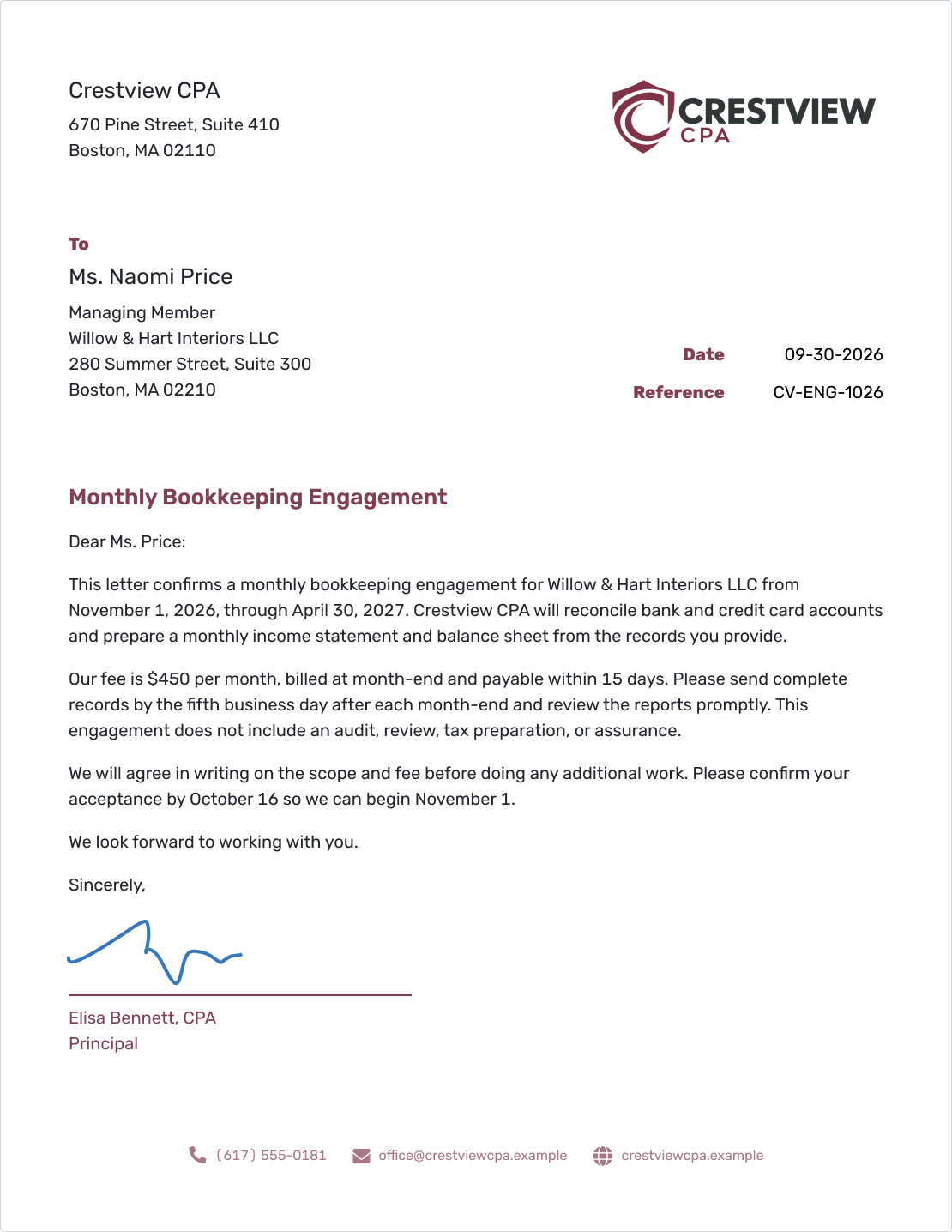
Crestview CPA confirms the monthly bookkeeping work, fee, and records deadline. Use the template below to describe your own service, then adapt the scope and payment wording to the engagement.
What Is an Engagement Letter?
An engagement letter, also called a letter of engagement, sets out the professional services you will provide to a client. It records the work, fees, responsibilities, and service period so you can both check the details before work starts.
An accountant might use it for monthly bookkeeping or a defined tax engagement. A consultant might use it for a project or ongoing advice. Name the actual work rather than relying on a broad phrase such as “professional services.”
Send the letter when you have discussed the scope and fees and are ready to ask the client to confirm. If the client is still comparing services or prices, start with a proposal or an estimate.
This template is general information, not legal advice. Have the wording checked for your service, location, and applicable professional requirements before using it.
Engagement Letter Wording You Can Adapt
Replace every [placeholder] with your agreed details. This example uses a fixed fee; the situations below show how to adapt the fee paragraph for monthly or hourly work.
List the work clearly so the client can tell what is included. If a separate service agreement contains terms you have already had reviewed, identify its name, date, or version and provide it with the letter.
Example: Professional Services Engagement
[Your Business Name]
[Street Address]
[City, State ZIP Code]
[Email Address] | [Phone Number]
[Month Day, Year]
Reference: [Engagement or Project Reference]
[Client Name]
[Client Business Name]
[Street Address]
[City, State ZIP Code]
Subject: Engagement for [Services or Project]
Dear [Client Name]:
Thank you for choosing [Your Business Name] to provide [Services] for [Project or Accounting Period]. This letter sets out the work and what each of us will do.
We will provide [Specific Services and Deliverables] by [Delivery Dates]. This engagement does not include [Excluded Services]. The engagement starts on [Start Date] and ends on [End Date or Completion Event].
Our fixed fee is [Amount] for the work described above, payable [Agreed Payment Timing]. Expenses will be handled as follows: [Agreed Expense Treatment].
You will provide [Records, Information, or Approvals] by [Dates] and name [Client Contact] as our contact. We will [Provider Responsibilities] and let you know if missing information affects the timetable.
We will agree on any changes to the scope, fee, or dates in writing before additional work begins. Either party may end the engagement by giving [Notice Period] written notice. If the engagement ends, these payment and handover arrangements will apply: [Agreed Arrangements].
Please confirm your agreement using [Confirmation Method] by [Response Date] so we can begin. If you have any questions, contact [Name] at [Email Address or Phone Number].
Sincerely,
[Signature]
[Your Name]
[Your Role]
[Your Business Name]
What to Include in an Engagement Letter
Start with what you discussed with the client. An engagement letter is easier to confirm when it turns that conversation into clear working arrangements.
- Scope: Name the services, deliverables, and work excluded from this engagement.
- Fees: State whether the price is fixed, hourly, or monthly, when payment is due, and how you treat expenses.
- Responsibilities: Say what you will do and what records, access, or approvals the client must provide.
- Term: Give the start date, end date or completion event, and any agreed renewal, notice, or handover arrangements.
- Changes: Explain how both parties will confirm extra work, a revised fee, or a new timetable.
- Confirmation: Name the person who can agree to the engagement, the confirmation method, and the requested response date.
If the fee comes from an estimate, include its date or reference and check that the two documents describe the same work.
How to Write an Engagement Letter
Keep the agreed scope and fee beside you while you write. Work through the letter in this order, then check it before you send it.
- Your Business: Add your business name, address, and contact details.
- Date and Reference: Write out the date. Add a project or service-period reference for follow-ups.
- Your Client: Name the client and the person who can confirm the work. Add a greeting.
- Services and Period: Describe the services and exclusions. Give the service period and delivery dates.
- Fee and Client Inputs: State the fee and payment timing. Give deadlines for client records or approvals.
- Changes and Reply Date: Explain how you will agree on extra work. Set a date for the client to confirm.
- Closing and Signature: Add a closing, your name and role, and signature space. Check the letter before sending.
Before You Send the Engagement Letter
Read it against your client’s request. A small mismatch in scope or dates is easier to fix now than after the work has started.
- The services and exclusions match what you discussed.
- The fee, payment dates, and any referenced estimate agree.
- The client’s records and approval deadlines leave enough time for delivery.
- The term, changes, and ending arrangements are specific to this engagement.
- The recipient can confirm the arrangement, and the response date is clear.
- Any separate terms mentioned in the letter are included and have been reviewed for your work.
After You Send the Engagement Letter
- For a letter emailed from Docelf, check its document history to see when it was delivered and opened.
- Follow up after the requested response date if the client has not confirmed.
- Keep the client’s confirmation with the letter and any referenced agreement.
In your follow-up, use the engagement reference and ask whether the client has any questions about the scope or fee. An opened letter does not confirm agreement; use the confirmation method stated in your letter.
Put Your Engagement in Writing
Add your agreed wording in Docelf’s business letter layout. Review the finished letter, then print it or download a PDF to share with your client.
Adapt the Letter to the Service
How you charge and what you need from the client will depend on the work. Describe this engagement rather than listing every service you offer.
Monthly Bookkeeping
Name the monthly tasks, reporting dates, and records deadline. Be clear about whether payroll, tax returns, or an audit are outside the agreed scope.
For example: “Our monthly fee is [Amount] for [Listed Services]. Please provide [Records] by [Day] each month so we can deliver [Reports] by [Day].”
Fixed-Fee Consulting Project
Describe the deliverables and review points. If your work is advice and recommendations, say whether implementation is included.
For example: “The fixed fee of [Amount] covers [Deliverables], payable [Payment Schedule]. Implementation and additional revisions are outside this scope unless we agree to include them in writing.”
Hourly Advisory Work
State the hourly rate, when you will bill, and any included hours or spending limit. Explain when you will ask for approval to continue.
For example: “Our rate is [Amount] per hour, billed [Billing Schedule]. We will ask for written approval before exceeding [Agreed Hours or Fee Limit].”
Tax or Annual Accounting Work
Identify the period and services covered, such as specified tax returns or annual financial statements. Explain which records the client supplies and by when. Use wording tailored to the actual engagement and applicable professional standards.
Scope Changes, Ending the Work, and Liability
If the client asks for more work, refer to the original letter and set out the change, revised fee, and new dates. Get written confirmation before starting the additional work. Name the original letter by date or reference so the client can see which arrangement is changing.
Agree on the notice period for ending the work. Set out how completed work will be billed, how outstanding fees will be paid, and how client materials will be returned or handed over. If you are ending an existing agreement, check its terms and use the contract termination guidance.
A limitation of liability clause is intended to limit responsibility for losses if something goes wrong. Ask a qualified advisor to review any proposed clause for your services, location, and professional rules. Do not insert a generic fee cap or exclusion just because it appears in another firm’s letter. The example above does not supply a liability clause.
Format the Engagement Letter for a US Client
Docelf uses a slightly modified block format. The date and reference sit on the right; the recipient details and body sit on the left. Keep the service details in short paragraphs so the client can review them easily.
Use US Letter paper, readable type, a written-out date such as September 30, 2026, and clear spacing. Start with “Dear [Client Name]:” and finish with a suitable closing and room for your signature.
If you request a client signature, leave space for their name, role, signature, and date. See the business letter format guide for spacing and layout details.
Engagement Letter Text and File Formats
Use the copy icon above to copy the wording into a Word or Google Docs template from the pages below. You can also create the letter online, then print it or download a PDF.
Engagement Letter Mistakes to Avoid
- A vague scope: Name the deliverables and exclusions so a new request does not look like work already included.
- An unexplained fee: State the billing basis and payment timing, not just a dollar amount.
- Missing client inputs: Give records and approval deadlines instead of assuming the client knows what you need.
- Conflicting documents: Check the letter against any estimate, proposal, or separate agreement it refers to.
- Unreviewed clauses: Have liability and other service terms checked for your actual work.
Engagement Letter FAQs
-
What is an engagement letter?
An engagement letter, also called a letter of engagement, sets out the professional services you will provide to a client. It usually covers the work, fees, each party’s responsibilities, the service period, and how changes or an ending will be handled.
-
What should an accountant include in an engagement letter?
Name the accounting services and period covered, the records the client must provide, delivery dates, fees, and responsibilities. Identify excluded services. Tax preparation, bookkeeping, and audit work need different wording, so adapt the letter to the actual service and applicable professional requirements.
-
How is a consultant engagement letter different from a proposal?
A proposal presents the work you are offering. An engagement letter records the scope and working arrangements the client is being asked to confirm. If you refer to a proposal or estimate, identify its date or reference and check that the scope, price, and timetable agree.
-
Should I include a limitation of liability?
A limitation of liability is not a standard sentence to copy into every engagement. Ask a qualified advisor to review any proposed clause for your services and location, including relevant professional rules. If reviewed terms sit in a separate agreement, identify that agreement clearly.
-
Does the client need to sign the letter?
Use the confirmation method agreed for the engagement and check any requirements that apply to your work. If you request a signature, leave room for the client’s name, role, signature, and date. Delivery or an opened email does not confirm acceptance.
-
How do I change the scope after the letter is sent?
Refer to the original engagement and describe the added or removed work, the revised fee, and any new dates. Ask the client to confirm the change in writing before you begin the additional work. Keep that confirmation with the original agreement.
-
Can I print the engagement letter or download a PDF?
Yes. Create your letter in the business letter generator, review the wording and layout, then print it or download it as a PDF. You can also use the copy icon above the letter wording to paste it into your own Word or Google Docs document.
Ready to Confirm the Work?
Give your client an engagement letter they can review before work starts.
- Describe the agreed scope and fee
- Set responsibilities and the confirmation date
- Print the letter or download a PDF