Free Authorization Letter Template
Create a professional letter in minutes
Give someone permission to collect named documents or complete a specific task for you. Make it clear who may act, what they may do, and when the permission ends.
Create your letter online, then print it or download it as a PDF.
14-day free trial. No credit card required.
Authorization Letter Example
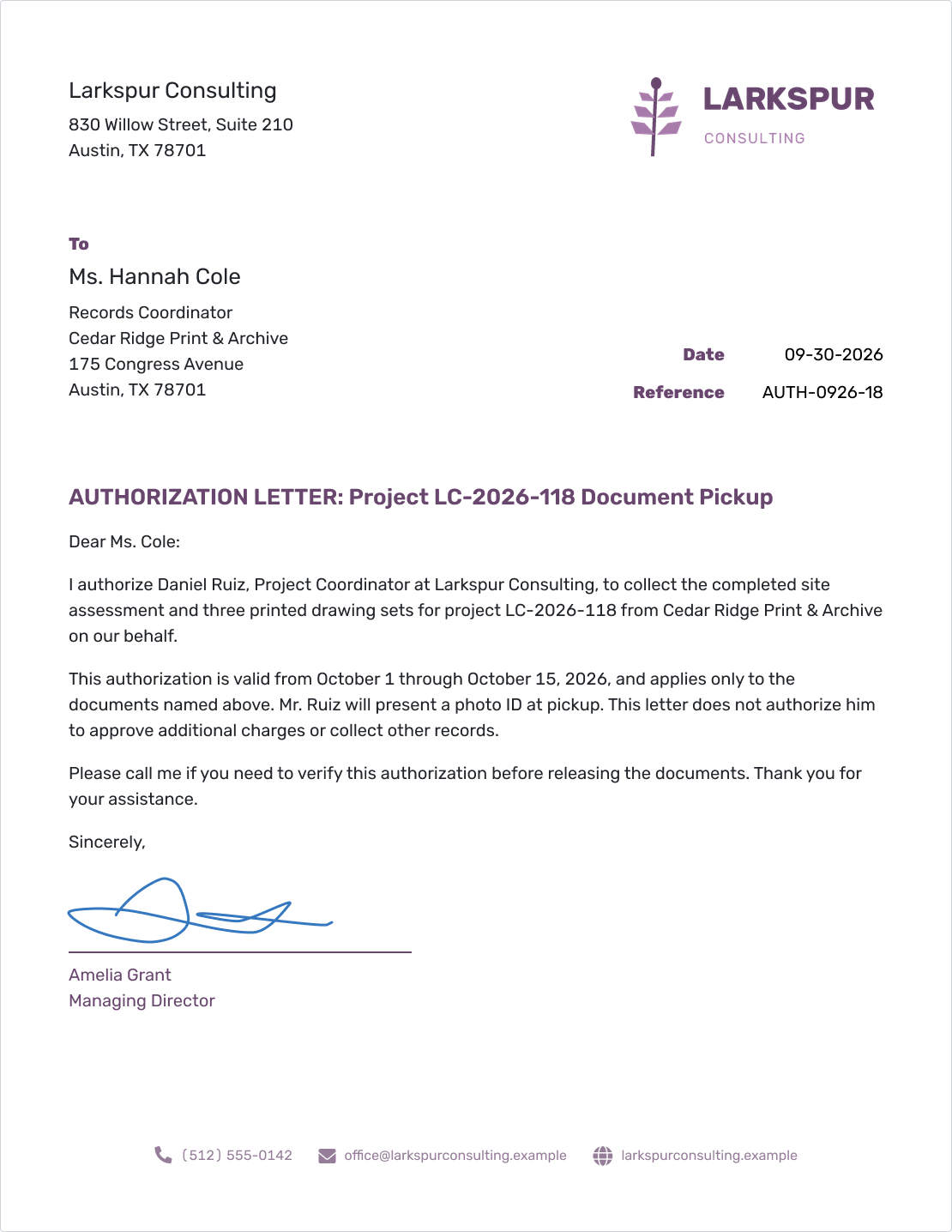
Amelia Grant authorizes Daniel Ruiz to collect specified project documents. The letter sets out the task, dates, and limits. Use the wording below to describe the permission you need to give.
What Is an Authorization Letter?
An authorization letter gives a named person permission to carry out a specific task on your behalf. It tells the recipient who may act, what they may do, and when the permission starts and ends.
Use one for a limited request, such as collecting project documents while you are away. Address it to the office or business that will release the documents, rather than only to the person doing the pickup.
Check the recipient's requirements first. A bank, records office, or other party to an agreement may need its own form, proof of authority, or a different legal document. For broader powers or ongoing financial decisions, get advice on the appropriate authorization.
These samples are general writing guidance, not legal advice. Confirm the requirements for your situation before signing or relying on the letter.
Copy-and-Paste Authorization Letter Template
Replace every bracketed placeholder with your own details. Keep the task narrow, and delete any optional line you do not need.
Authorization for a Specific Task
[Your Name]
[Your Title, if writing for a business]
[Business Name, if applicable]
[Street Address]
[City, State ZIP Code]
[Phone Number]
[Email Address]
[Month Day, Year]
Reference: [Project or Record Reference, optional]
[Recipient Name]
[Recipient Title or Department]
[Organization Name]
[Street Address]
[City, State ZIP Code]
Subject: Authorization for [Specific Task]
Dear [Recipient Name]:
I authorize [Authorized Person's Full Name], [Role or Relationship], to [Exact Action] for [Named Documents, Order, or Project] on [my behalf / behalf of Business Name].
This authorization is valid from [Start Date] through [End Date] and applies only to the task described above. It does not authorize [Excluded Actions]. [Authorized Person's Full Name] will present [Identification Required by the Recipient] when completing the task.
Please contact me at [Phone Number] or [Email Address] if you need to verify this authorization before acting. [Please confirm receipt and any additional requirements by Response Date, if needed.]
Thank you for your assistance.
Sincerely,
[Signature]
[Your Printed Name]
[Your Title, if applicable]
How to Write an Authorization Letter
The document pickup example shows where the important details belong. Follow the numbers, then adapt the permission to your own task.
- Identify the Sender: Add your name, business, and contact details. State your role if you are authorizing someone for a business.
- Address the Recipient: Name the person or organization that will receive the letter and carry out the request.
- Add the Date and Reference: Date the letter and add a useful project or document reference.
- Set the Permission: Name the authorized person, exact task, limits, and start and end dates.
- Give Verification Details: Give a phone number or email the recipient can use to confirm the permission before acting.
- Sign and Share: Follow the recipient's signing requirements. Review the letter, then email it, print it, or download a PDF.
Before You Send Your Authorization Letter
Check the permission itself, not just the spelling. The recipient should be able to match the letter to the person and the task.
- You have authority to give the permission described.
- The authorized person's name matches the identification the recipient requires.
- The documents or task, limits, and valid dates are specific.
- Your contact details work, and any required supporting documents are included.
- The form and signature meet the recipient's requirements, including any required witnessing or notarization.
After You Send Your Authorization Letter
For letters emailed from Docelf, check the document history to see when the letter is delivered and opened. Ask the recipient to confirm that the letter meets its requirements before the authorized person visits or acts. An opened letter does not confirm that the permission was accepted.
If you requested a reply by a particular date, follow up after that date. Choose a response date before the planned task so there is time to resolve any questions.
Keep the follow-up practical: mention the letter's reference, confirm the planned task and date, and ask whether anything else is needed. Give the authorized person the final letter and the recipient's instructions.
Put Your Permission in Writing
Add your authorization wording to Docelf's business letter layout. Keep the person, task, and limits easy to find. Review the finished letter, then print it or download a PDF.
What to Include in a Letter of Authorization
“Act on my behalf” leaves too much open. Name the action and the items involved so the recipient does not have to guess.
- The sender: Your name, business, role, and a phone number or email for checking the permission.
- The recipient: The person, department, or organization receiving the request.
- The authorized person: Their full name and a useful role or relationship.
- The task: The exact documents, order, meeting, or action covered.
- The limits: Actions outside the permission, such as approving extra charges or agreeing to new terms.
- The dates: A clear start and end date, plus a response date if you need confirmation.
- The signature: The signature and any supporting evidence the recipient requires.
Use a project or order reference instead of putting unnecessary sensitive information in the letter. Ask the recipient how to provide identification or account details securely.
Choose Wording That Fits the Task
The person you authorize may need permission for just one part of the job. These situations show how to keep that boundary clear.
1. Authorize Someone to Collect Documents
List the documents and the collection location. In the example below, Daniel Ruiz may collect the named project documents from October 1 through October 15, 2026. He may not approve extra charges or collect other records.
Project LC-2026-118 Document Pickup
Larkspur Consulting
830 Willow Street, Suite 210
Austin, TX 78701
September 30, 2026
Reference: AUTH-0926-18
Ms. Hannah Cole
Records Coordinator
Cedar Ridge Print & Archive
175 Congress Avenue
Austin, TX 78701
AUTHORIZATION LETTER: Project LC-2026-118 Document Pickup
Dear Ms. Cole:
I authorize Daniel Ruiz, Project Coordinator at Larkspur Consulting, to collect the completed site assessment and three printed drawing sets for project LC-2026-118 from Cedar Ridge Print & Archive on our behalf.
This authorization is valid from October 1 through October 15, 2026, and applies only to the documents named above. Mr. Ruiz will present a photo ID at pickup. This letter does not authorize him to approve additional charges or collect other records.
Please call me if you need to verify this authorization before releasing the documents. Thank you for your assistance.
Sincerely,
[Amelia Grant's Signature]
Amelia Grant
Managing Director
(512) 555-0142
office@larkspurconsulting.example
larkspurconsulting.example
2. Ask About a Limited Bank Request
Contact the bank before authorizing someone to collect bank documents or take another action. Ask what form, identification, and proof of authority it needs for that specific request. For example, Chase's power of attorney process involves reviewing authority and identification; a generic letter is not a substitute for that process.
For a document pickup the bank has agreed to handle by letter, wording could be: “I authorize [Full Name] to collect [Specified Documents] from [Branch] between [Start Date] and [End Date]. This permission is limited to collection and does not authorize withdrawals, transfers, or changes to the account.”
If you need someone to manage money or make continuing decisions, ask about the appropriate legal arrangement. The CFPB's guidance on bank acceptance of a power of attorney explains that state law matters when a bank questions an existing POA.
3. Allow One Specific Signature
Name the document and what the signature confirms. Keep permission to collect an order separate from permission to sign a new agreement.
For a collection receipt, wording could be: “I authorize [Full Name] to sign the collection receipt for [Named Documents or Order] on [Date]. This authorization does not permit approval of additional charges or changes to the agreed terms.” Confirm that you have authority to let someone sign for you and that the recipient accepts the arrangement. Get legal advice before extending the permission to contracts or financial commitments.
4. Have Someone Submit Named Paperwork
A representative might deliver a project submission while you are away. List the exact paperwork and distinguish delivery from permission to change it.
For example: “I authorize [Full Name] to submit [Document Names and Reference] to [Office] on [Date]. The authorization is limited to submitting these documents as prepared and does not permit changes or additional commitments.” Ask the office whether it needs its own submission or representative form.
When Does an Authorization Letter Need a Notary?
Check the requirements for the task and the receiving organization before signing. Ask whether it needs an original signature, witnesses, notarization, its own form, or another document. The requirements can depend on the action and applicable state law.
Notarization does not guarantee acceptance or expand the permission written in the letter. For example, California's acknowledgment guidance distinguishes checking the signer's identity from establishing the document's validity.
If a notary is required, confirm the signing procedure before you sign and ask what identification to bring. For account management, sensitive records, or significant signing powers, get advice on the right document as well as the signing process.
Common Authorization Letter Mistakes
- Giving open-ended permission: Replace “handle all matters” with the exact action you want completed.
- Leaving the dates unclear: State when the permission begins and ends.
- Naming the wrong recipient: Address the office that must release the records or accept the request.
- Combining pickup and spending authority: Say separately whether approving charges or signing a document is permitted.
- Sending before checking requirements: Confirm the form, identification, and signature process first.
Choose a Clear Authorization Letter Format
Use US Letter paper, readable type, and space between paragraphs. Write out the date, such as October 1, 2026, and leave room for the signature the recipient requires. A short subject or reference helps identify the task.
Docelf uses a slightly modified block format. The date and reference sit to the right, while the recipient details and body start on the left. The business letter format guide explains US layout conventions, and the block format guide compares other layouts.
Add your wording to the online business letter template, then print the letter or download a PDF. Choose a template from the Word or Google Docs pages below if you prefer to edit the letter in one of those apps.
Authorization Letter FAQs
-
What is an authorization letter?
An authorization letter names someone who may carry out a specific task on your behalf. It identifies the person, describes the task, and sets the limits and dates of the permission.
-
How do I write a letter of authorization?
Identify yourself and the recipient, then name the person you authorize. Describe the exact action, any limits, and the start and end dates. Add verification contact details and follow the recipient's signing requirements.
-
What should an authorization letter to collect documents include?
Name the authorized person and list the documents, project or record reference, collection location, and valid dates. State any limits and provide a verification contact. Ask the receiving office which identification and release documents it requires.
-
Does an authorization letter need to be notarized?
The answer depends on the task, the receiving organization, and applicable law. Check the form and signing requirements before signing. Notarization does not guarantee that the recipient will accept the letter or that it grants the powers you intend.
-
Can I use an authorization letter for a bank?
Ask the bank what it requires for the exact action. A letter for collecting specified documents should not be treated as permission to withdraw money or manage an account. The bank may require a different authorization process or a power of attorney.
-
Can I authorize someone to sign for my business?
For a specific signature, name the document and what the person may sign. Confirm that you have authority to let them sign for you. Ask the recipient whether the letter is sufficient. Get legal advice for contracts, financial commitments, or broader signing powers.
-
Can I print or download an authorization letter as a PDF?
Yes. Add your own authorization wording to the online business letter template, then print the finished letter or download it as a PDF.
-
Does an opened letter mean the authorization was accepted?
No. For letters emailed from Docelf, document history shows delivery and opening. Ask the recipient to confirm that the letter meets its requirements before the authorized person acts.
Ready to Write Your Authorization Letter?
Give the recipient a clear description of the permission you intend.
- Name the person and exact task
- Set the limits and valid dates
- Review, print, or download your PDF