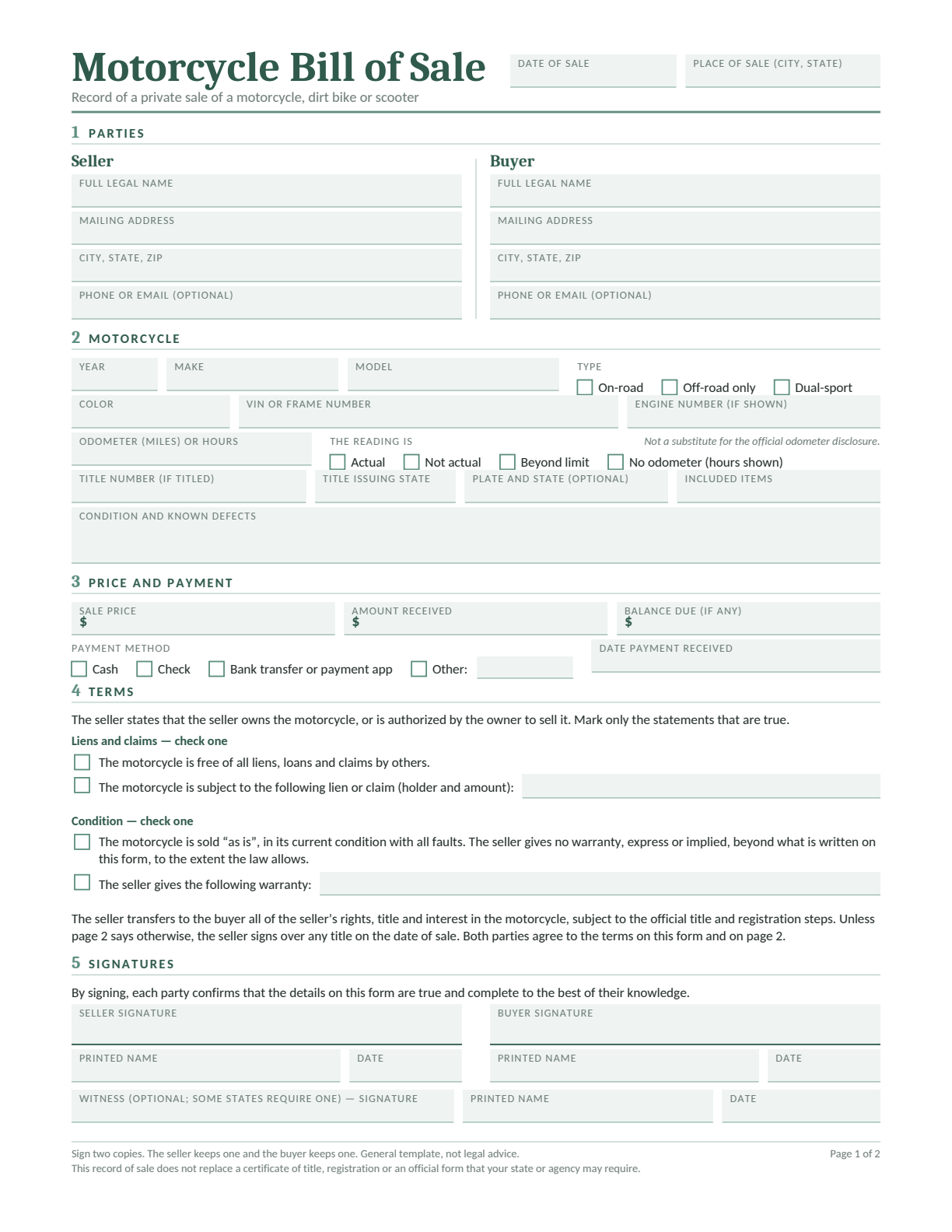
Motorcycle Bill of Sale
Record the VIN or frame number, engine number if shown, mileage or hours, condition, price and payment.
Download a free template for your motorcycle sale.
Record the sale of a motorcycle, dirt bike or scooter. Add the bike’s identification, condition and payment details so the seller and buyer can check them.
Edit in Word or Google Docs, type into a fillable PDF, or print a blank PDF to fill in by hand.
Document the sale and agreed terms. Give both seller and buyer a signed copy.
Use one form for on-road, off-road-only and dual-sport bikes. Select the right type and record miles or engine hours as applicable.
Choose Word or Google Docs to edit the wording, a fillable PDF to type into, or a blank PDF to print. In Google Docs, sign in and choose Make a copy to save your own version.
Record the VIN or frame number, engine number if shown, mileage or hours, condition, price and payment.
The template has on-road, off-road-only and dual-sport options. Choose the one that describes the motorcycle, then enter the identification and usage details shown on the bike and its paperwork.
A dirt bike’s engine hours are different from road mileage. A scooter or moped may also have its own state classification. Describe the vehicle accurately before checking which transfer and registration steps apply.
This is a general template, not legal advice. It does not replace required title, registration or odometer paperwork. Check the rules for the bike’s classification and intended use; a bill of sale does not by itself authorize road use.
Use the “Vehicle Identification” section of the owner’s manual for your model and year. It should show the stamped VIN or frame number and the separate engine number.
A place to check is the steering head, where the front fork turns in the frame. For example, the 2015 Honda Stateline and Interstate manual shows the VIN stamped on the right side of the steering head and repeated on a label on the left frame down tube. Other models can use a different side or location.
The same Honda manual locates the engine number on top of the crankcase. Check your own model’s diagram before copying it. Enter the frame or VIN number and engine number in their separate fields, and compare the VIN with the title or other ownership record.
If a number is unreadable, has been altered or does not match the paperwork, ask the manufacturer or the office handling the transfer to help identify the bike.
Have the ownership records, bike and payment details available so you can check each entry.
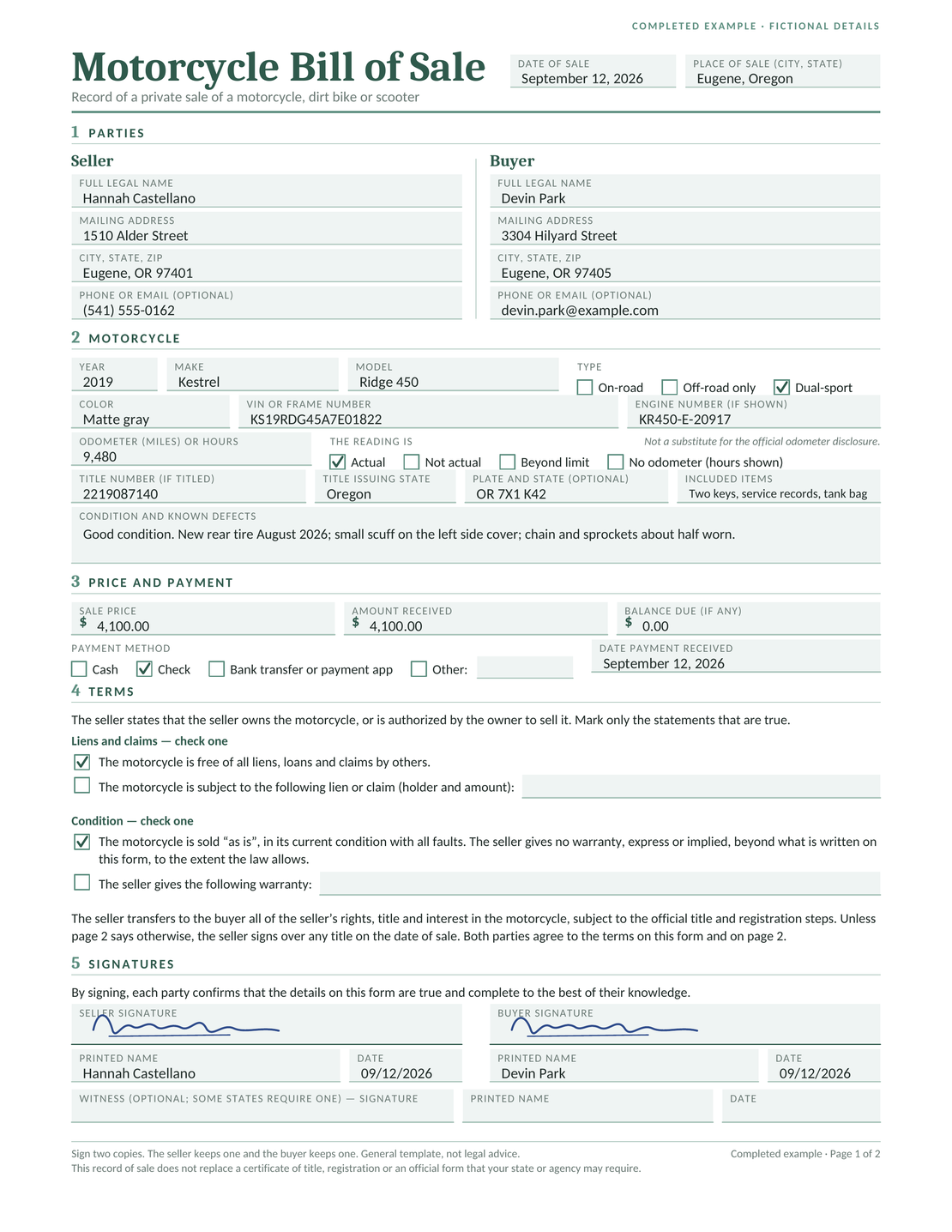
In this fictional example, Hannah Castellano sells a matte gray 2019 Kestrel Ridge 450 dual-sport motorcycle to Devin Park in Eugene, Oregon, on September 12, 2026. The price is $4,100, received by check that day, with no balance due.
| Detail | What the example records |
|---|---|
| VIN or frame number | KS19RDG45A7E01822 |
| Engine number | KR450-E-20917 |
| Odometer | 9,480 miles, marked as actual |
| Included items | Two keys, service records and a tank bag |
| Condition | New rear tire in August 2026; left side-cover scuff; chain and sprockets about half life |
| Sale terms | Free of liens and sold as is |
The mileage and engine number go in different fields. The type is marked dual-sport, and the included tank bag is listed so there is no doubt it comes with the bike.
Download the Completed Example (PDF)
The example contains fictional details and specimen signatures. Use the bill of sale examples for guidance, then fill in a blank template with your own sale details.
Compare the VIN or frame number on the bike with the ownership paperwork. The engine may have a different number. If an engine has been replaced or a number is unclear, check the transfer requirements with the responsible office.
Record visible damage, known mechanical faults and useful service information. Name any included luggage or spare parts. Put repair promises in writing rather than leaving them to a conversation.
For a road motorcycle, the mileage entry may need a separate official odometer disclosure. Follow the title or agency’s instructions; the bill of sale field does not replace them. NHTSA’s odometer advice also explains how to compare a reading with maintenance and ownership records.
Fill in the bike’s identifying details, explain its condition and record the payment before you sign.
The seller and buyer should each keep the signed bill of sale, any additional terms and proof of payment. Complete the required title or off-highway transfer, registration and sale-reporting steps.
Selling another type of vehicle? See the car bill of sale templates or ATV bill of sale template. For more help with the wording, read how to write a bill of sale.
Check the rules for the bike’s classification in the state where the buyer will use and register it. These official sources explain common differences:
Choose your state for templates and official instructions. The examples above do not determine the rules elsewhere.
Yes. Select off-road only when that describes the bike. Record the VIN or frame number and any engine hours, then check your state’s off-highway ownership and registration requirements.
First confirm what ownership documents the state requires for that bike. If a required title is missing, ask about the replacement or transfer process before paying. The bill of sale alone does not resolve missing ownership evidence.
It can record the sale details, but the vehicle’s classification controls its official paperwork. Describe the actual model and check your state’s moped or scooter requirements; do not assume they match motorcycle rules.
Enter the hour reading and mark “No odometer (hours shown)” where appropriate. Label the reading as hours. Do not turn hours into an estimated mileage or mark them as actual miles.
Check the official instructions for the state and document. A title and a bill of sale can have different signing requirements. Follow any required witness or notary steps before signing.
Yes. The template has an as-is condition option and space for known defects. Describe those defects and any written promises accurately. As-is wording does not remove every responsibility or replace required disclosures.
Choose your format and create a clear record for the seller and buyer.
Create free business documents like invoices, estimates, quotes and receipts from these blank, printable and downloadable templates

Create and send unlimited documents. Every feature is included.
Create and send unlimited documents.
Every feature is included.
No credit card required.
After 14 days, continue for $12.99/month only if you choose to upgrade.