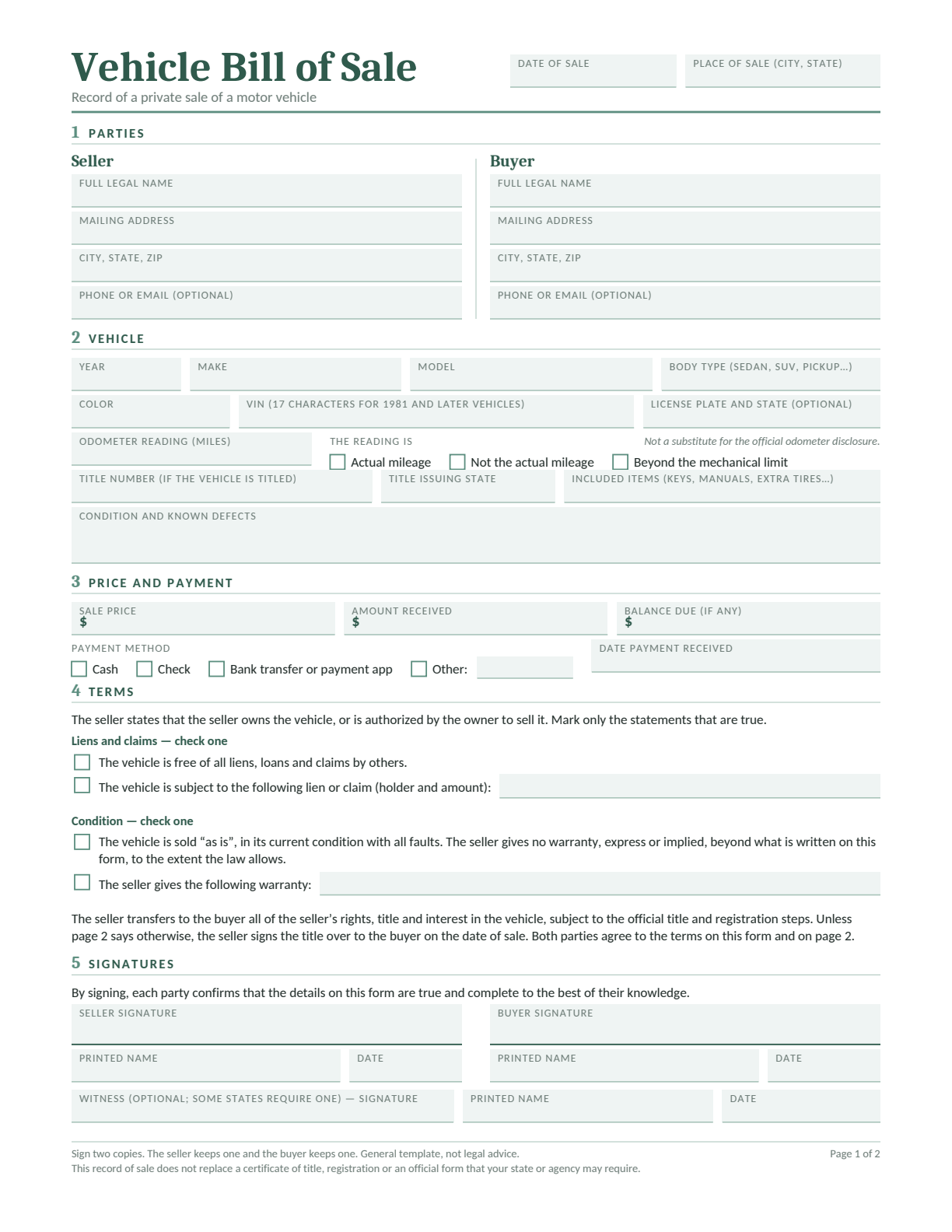
Record the vehicle’s VIN, mileage, price and payment, then describe known defects and included items. Use the second page for a remaining payment, collection date or other agreed terms. Keep both pages with the ownership papers.
Edit in Word or Google Docs, type into the fillable PDF, or print the blank PDF to complete by hand.
In Google Docs, sign in and choose Make a copy. Use page 2 for extra terms, then keep both pages together.
A bill of sale records who sold the property, who bought it, the sale date and the agreed price. Payment fields show how much the seller has received and whether any balance remains. Both people keep a signed copy.
This page covers private vehicle, boat and trailer sales in Minnesota. Keep the sale record with the title or registration documents that apply to the property. For furniture, tools or other personal property, see the general bill of sale templates.
Use the title for a titled vehicle’s transfer
For an ordinary Minnesota-titled car, the title is the ownership-transfer document. Complete its assignment, actual selling price and applicable mileage and damage disclosures. The bill of sale gives both parties a separate record of payment, condition and agreed handover terms.
For a vehicle that is genuinely non-titled, DVS accepts an ownership assignment on the registration card, an application or a bill of sale identifying the vehicle, sale date and buyer. The DVS buying and selling fact sheet explains the documents for each route.
Seller: complete the title and report the sale
All named sellers complete the title assignment and sign. Give the buyer the original title and the required lien releases. A condition description on the sale record does not replace an official damage disclosure.
For an ordinary private sale, send the title’s Notice of Sale or report the details electronically within 10 days. Minnesota’s transfer law treats this as the seller’s step, separate from the buyer’s title application.
Buyer: apply within 20 calendar days
The current statute requires the buyer to apply for a new title within 20 calendar days after title assignment. Take the assigned ownership document and supporting papers to a deputy registrar promptly.
DVS’s March 2025 fact sheet still says ten days for transfer. The current statute, section 168A.10 subdivision 2, states 20 calendar days for the buyer’s application. The seller’s separate 10-day notice remains applicable.
Check liens and plates before collection
DVS calls for a signed lien-release card or a notarized lien-release form for secured parties. That notarization instruction concerns the lien release; it is not a general requirement to notarize the sale record.
Ordinary Minnesota plates and the remaining registration stay with the vehicle under the DVS fact sheet. Check any special-plate circumstances separately and arrange the buyer’s insurance before road use.
Minnesota Boat Bill of Sale Templates
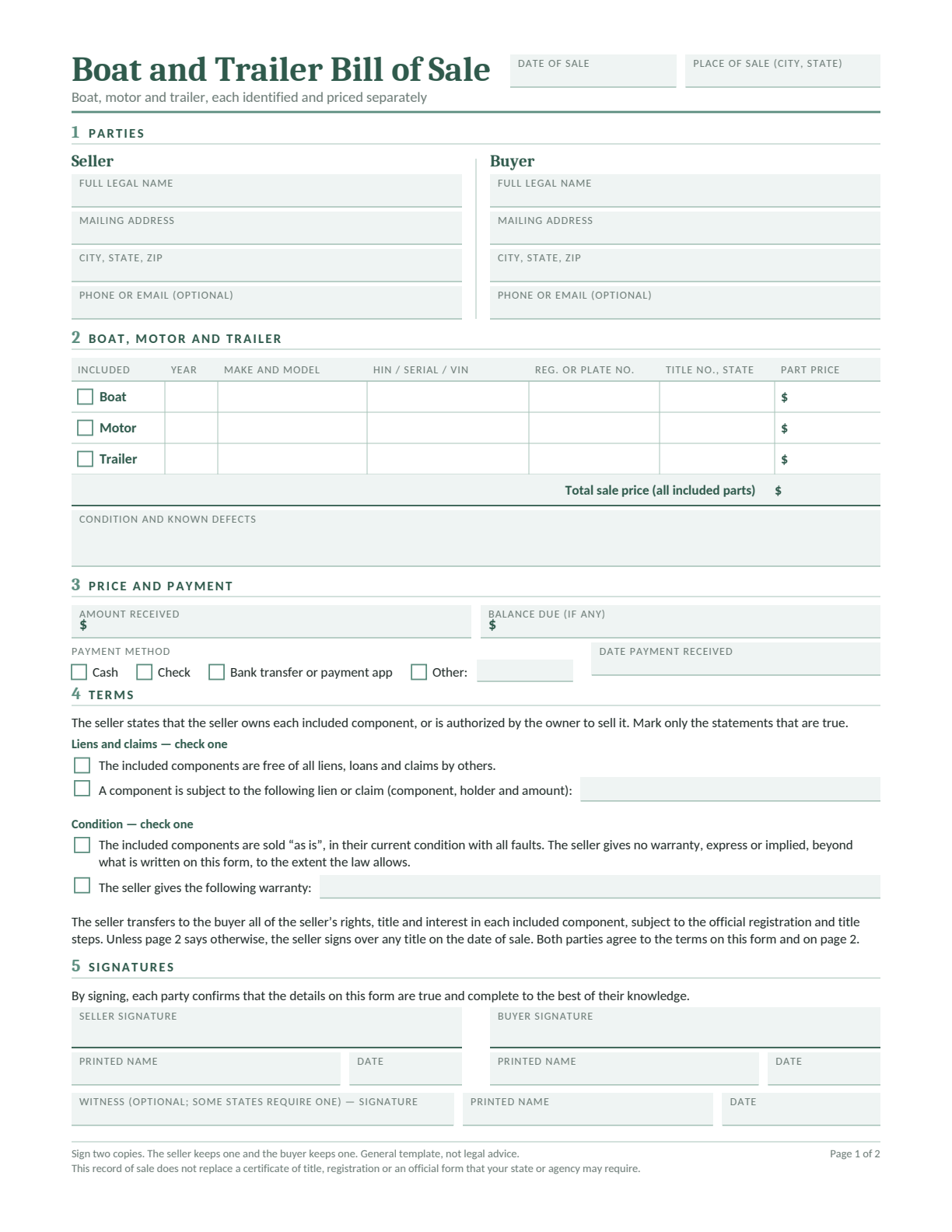
For a Minnesota-registered boat without a title, the bill of sale is part of the DNR transfer paperwork. Record the hull’s year, make and HIN, and identify the motor and trailer separately if they are included.
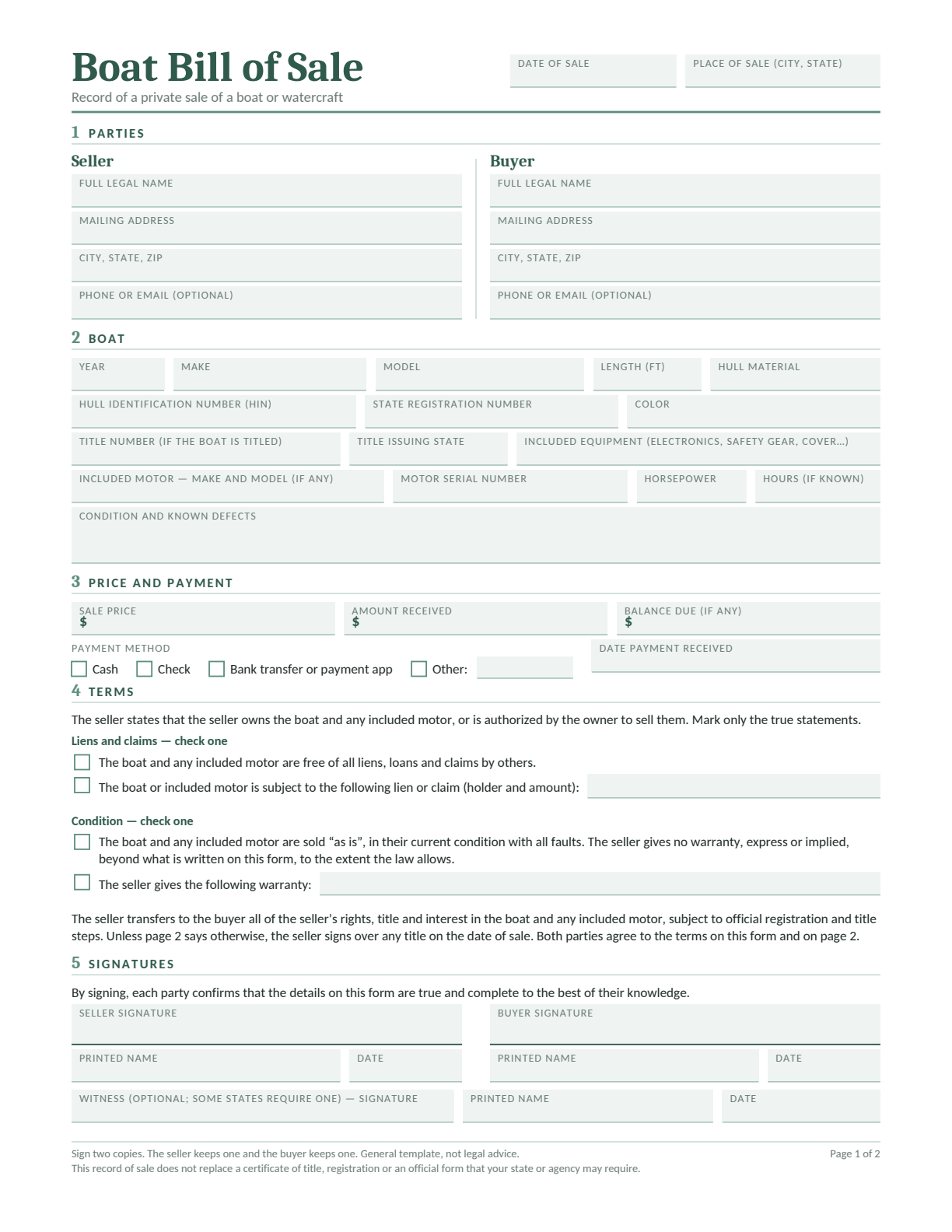
Boat Bill of Sale
Record the boat, included equipment, condition, price and payment.
Most motorized boats and nonmotorized boats longer than 10 feet need a watercraft license. Title rules are different: many boats longer than 16 feet need a title, with exceptions for certain boat types and older vessels. Previously titled boats need their title transfer even if they might otherwise fit an exemption.
For a Minnesota-titled boat, the seller signs the front of the title and the buyer completes and signs the back. For a Minnesota-registered non-titled boat, DNR asks for the seller’s printed name and signature on a bill of sale listing the year, make and HIN, plus a completed Universal Registration Form.
Use the DNR private-sale checklist for out-of-state boats and lien releases. A required title application is due within 15 days after delivery under section 86B.840. The owner must also give written notice of a licensed boat’s ownership change within 15 days under the licensing law.
Minnesota Trailer Bill of Sale
Record gross weight as well as the VIN. Minnesota’s title threshold and permanent-registration threshold serve different purposes, so a registration sticker does not tell you by itself whether a title is required.
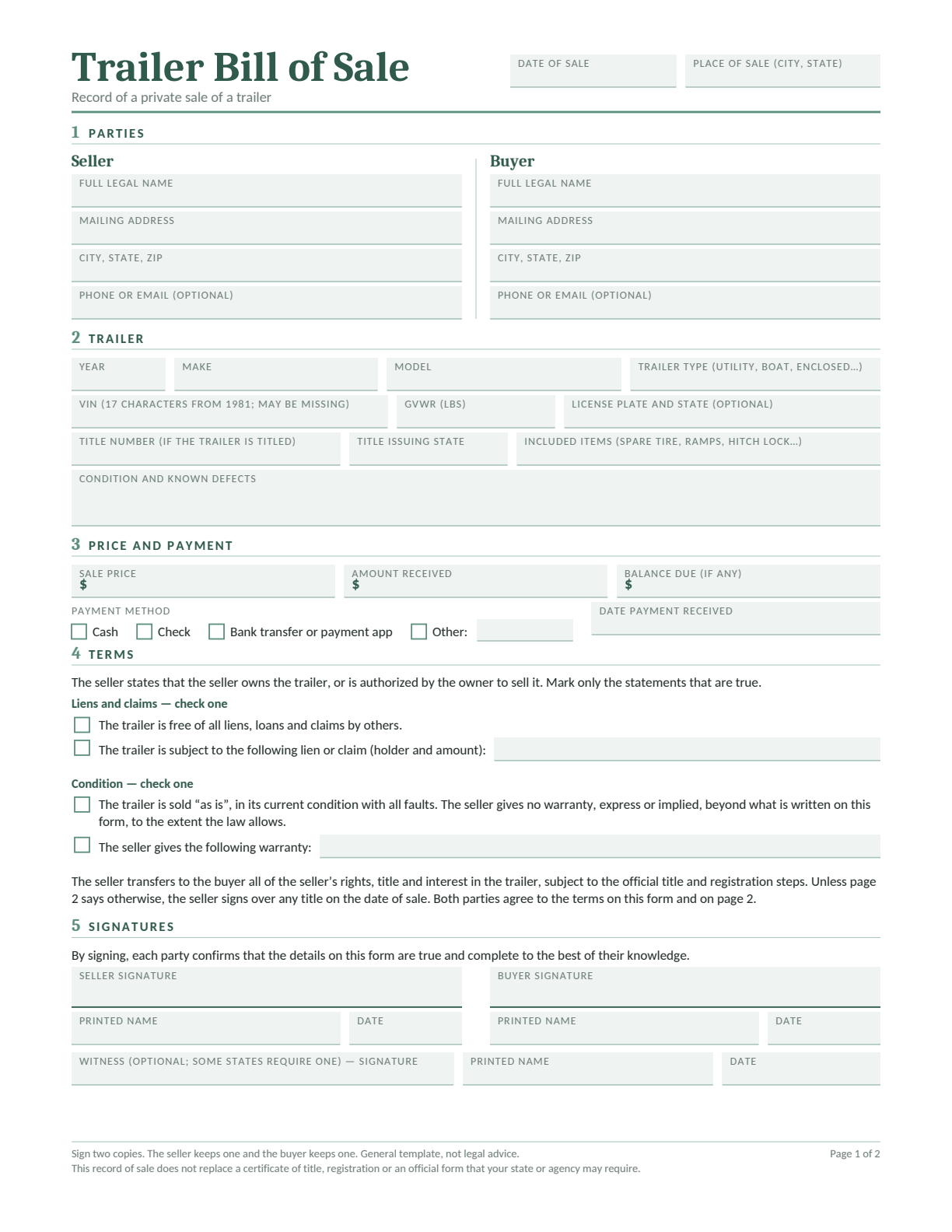
Trailer Bill of Sale
Describe the trailer and included equipment, then record the price, payment and any remaining balance. Use page 2 for extra terms, such as collection arrangements.
Edit in Word or Google Docs, type into the fillable PDF, or print a blank copy. Complete both pages and keep them with the ownership papers.
Section 168A.03 exempts ordinary trailers with a gross weight of 4,000 pounds or less unless a secured party holds an interest or Minnesota or another state has already issued a title. Recreational vehicles and manufactured homes have separate treatment; do not apply the utility-trailer shortcut to a camper.
For a non-titled trailer, obtain its registration card and a signed ownership assignment or suitable bill of sale. A titled trailer needs the assigned title. Bring the ownership evidence to the deputy registrar for transfer and registration.
The one-time registration category for qualifying trailers at 3,000 pounds or less is a separate rule in the registration statute. Use the gross weight and intended use to select the correct registration, even when no title is required.
Completed Minnesota Bill of Sale Example
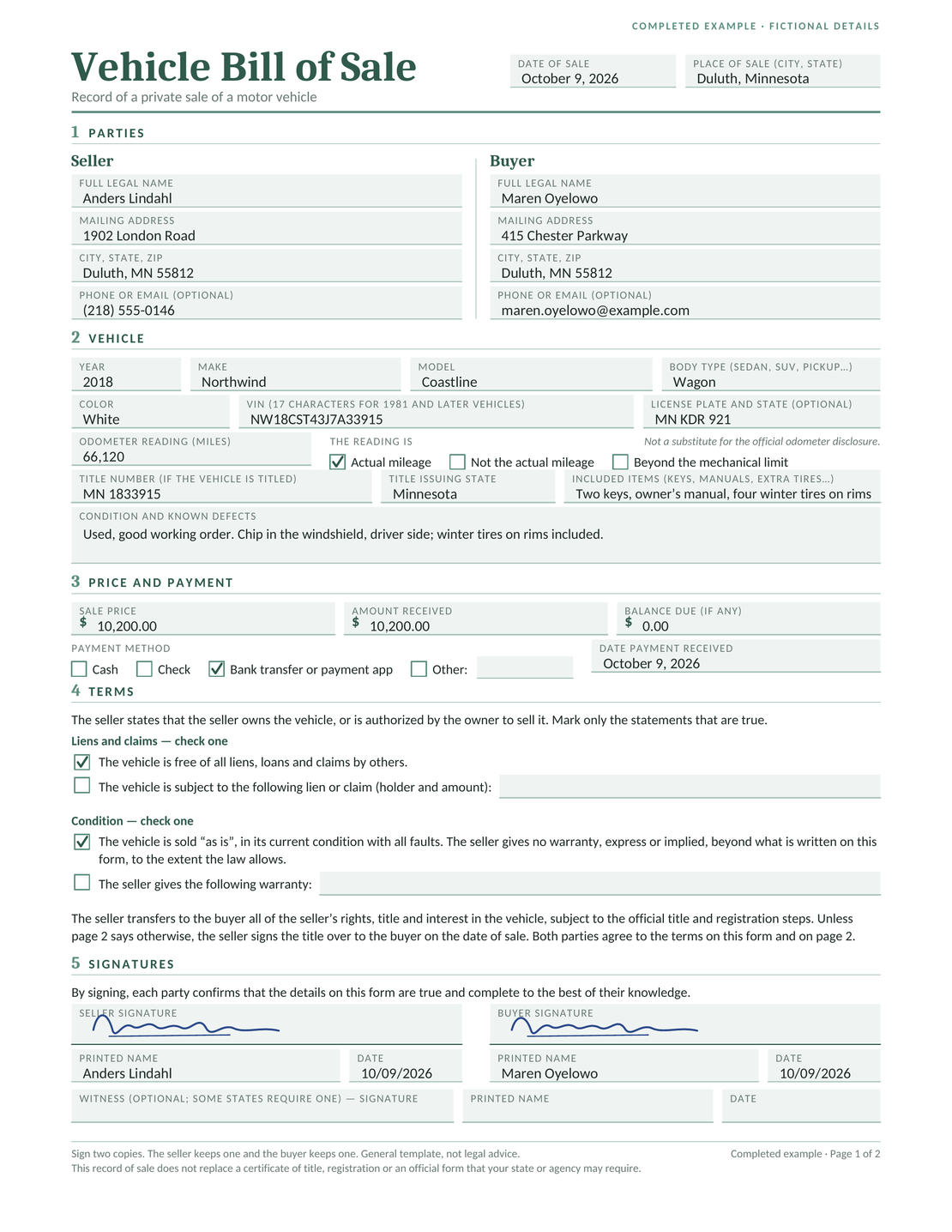
This fictional Duluth example records Anders Lindahl selling Maren Oyelowo a white 2018 Northwind Coastline wagon on October 9, 2026. The $10,200 price is paid in full, leaving a $0 balance.
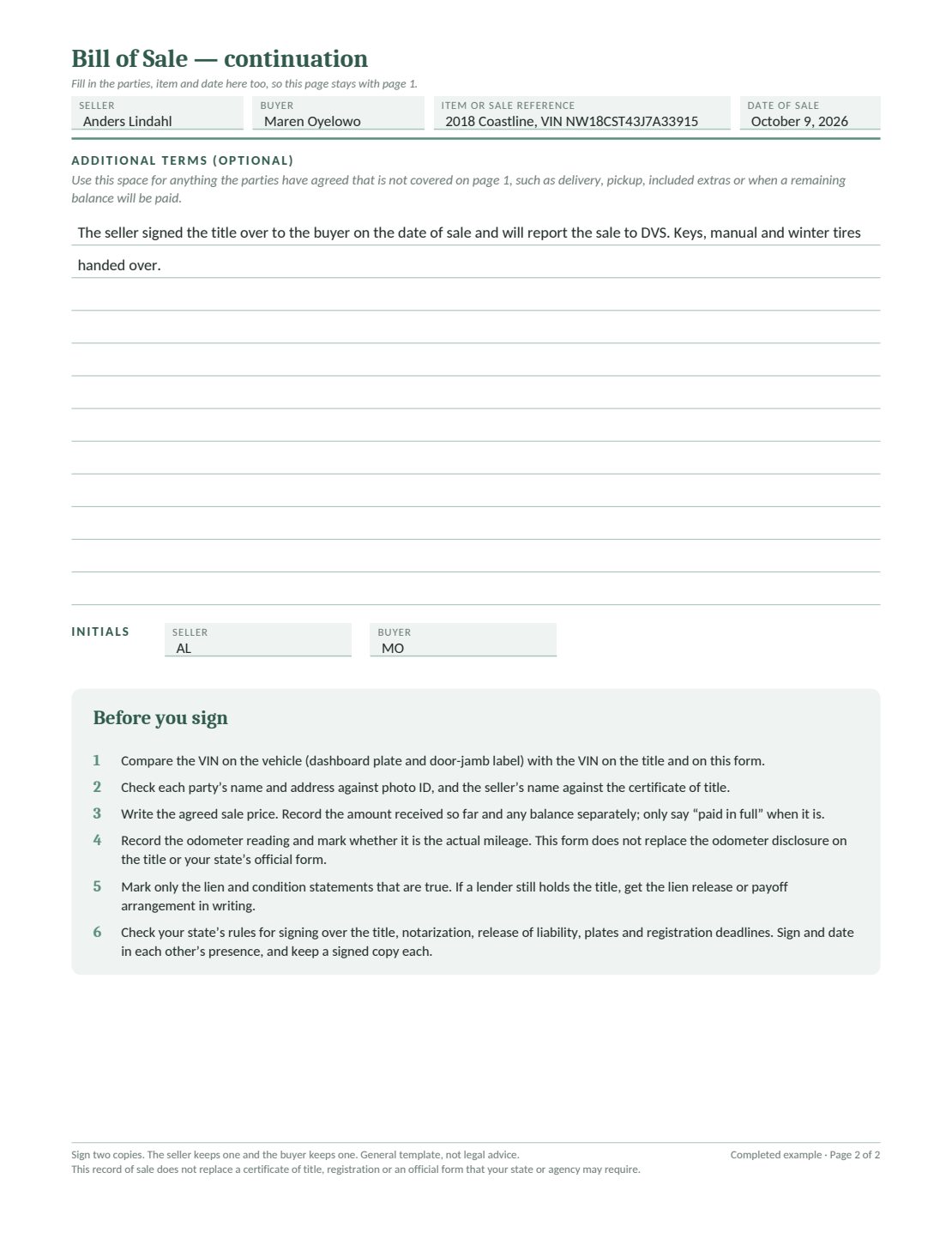
The description notes 66,120 miles and a chip in the windshield on the driver’s side. Four winter tires on rims are included along with two keys and the owner’s manual; page 2 confirms those items were handed over.
Anders has signed the title over and plans to report the sale to DVS. That future-tense promise is not a filing confirmation, and the example does not show Maren’s title application being processed.
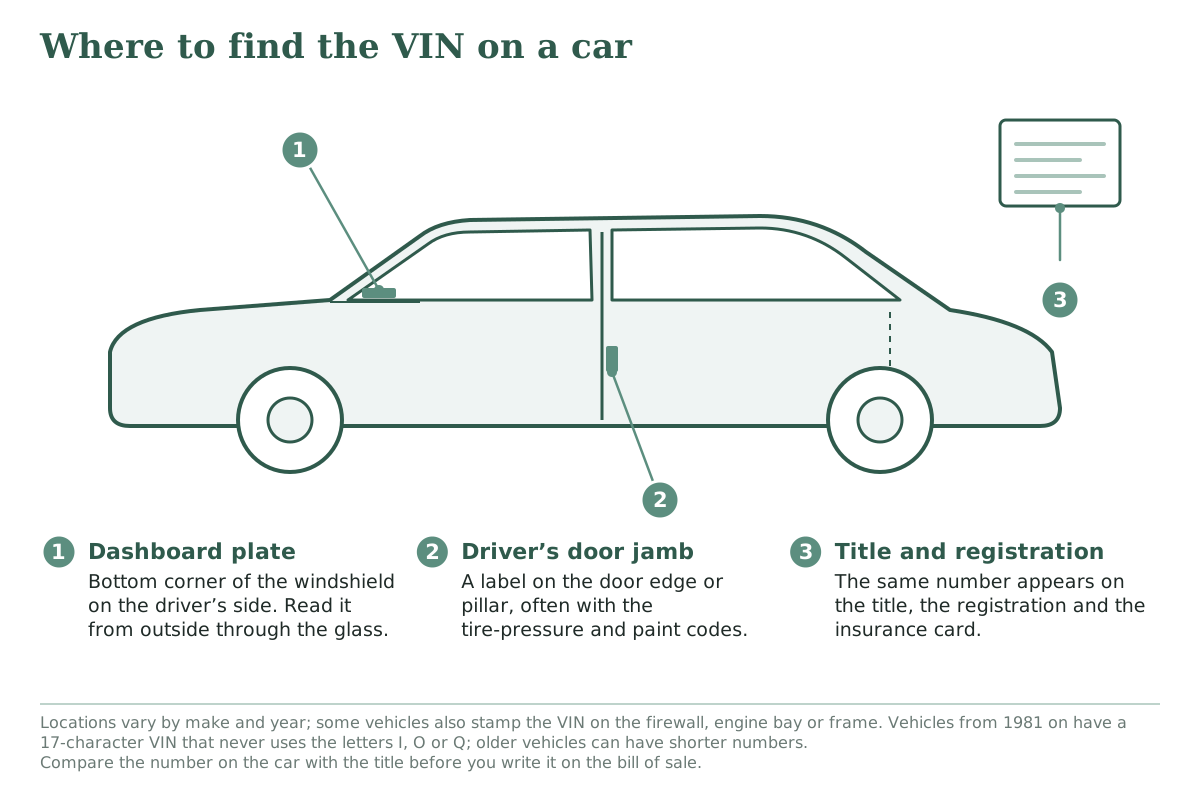
Compare the identifying number on the property with the ownership papers before copying it into your sale record.
Look through the windshield at the driver-side dashboard. Also check the label inside the driver’s door opening. Locations vary, so consult the vehicle’s manual if needed.
Resolve a missing or mismatched number with the agency handling the transfer. Do not guess from an unclear label.
Compare the seller’s name and all co-owners with the ownership document.
Match the VIN or HIN on the property to the papers before copying it.
Record known defects and anything included in the price.
Separate the agreed price, money received and balance still owed.
Resolve any lien and check which title, registration or disclosure signatures are required.
Keep the Sale Record with the Transfer Papers
Keep both signed pages together with a copy of the assigned ownership document and proof of payment. Save any filing receipt separately: a promise in the sale agreement to apply or report the sale does not show that the agency received it.
The current statute gives the buyer 20 calendar days after title assignment to apply. The seller has a separate 10-day duty to report an ordinary private sale. A DVS fact sheet still uses older ten-day transfer wording; applying promptly avoids confusion.
The ordinary transfer instructions do not call for notarization of the bill of sale or title assignment. A lien-release form may need notarization, so read that document’s requirements separately.
Yes. DVS says the plates and remaining registration pass with the vehicle. Special plates can involve separate arrangements, and the buyer still needs the proper ownership transfer and insurance.
DNR specifies the boat’s year, make and HIN, plus the seller’s printed name and signature. Include the buyer, date, price and payment too, and submit the signed Universal Registration Form with the required sale record.
An ordinary trailer at that gross weight can fall within the 4,000-pound exemption, but an existing title or secured interest changes the result. Its registration category is a separate question.
After 14 days, continue for
$12.99/month
only if you choose to upgrade.
We use cookies to provide you with the best possible experience. Cookies also help us analyze user behaviour so we can continue to improve our website. View our cookie policy.