Choose a West Virginia template to record a vehicle, boat or trailer sale, including payment and the property’s condition.
Check whether your transfer needs the notarized DMV-7-TR. A signed private agreement supports the sale, while the title and registration paperwork complete the agency transfer.
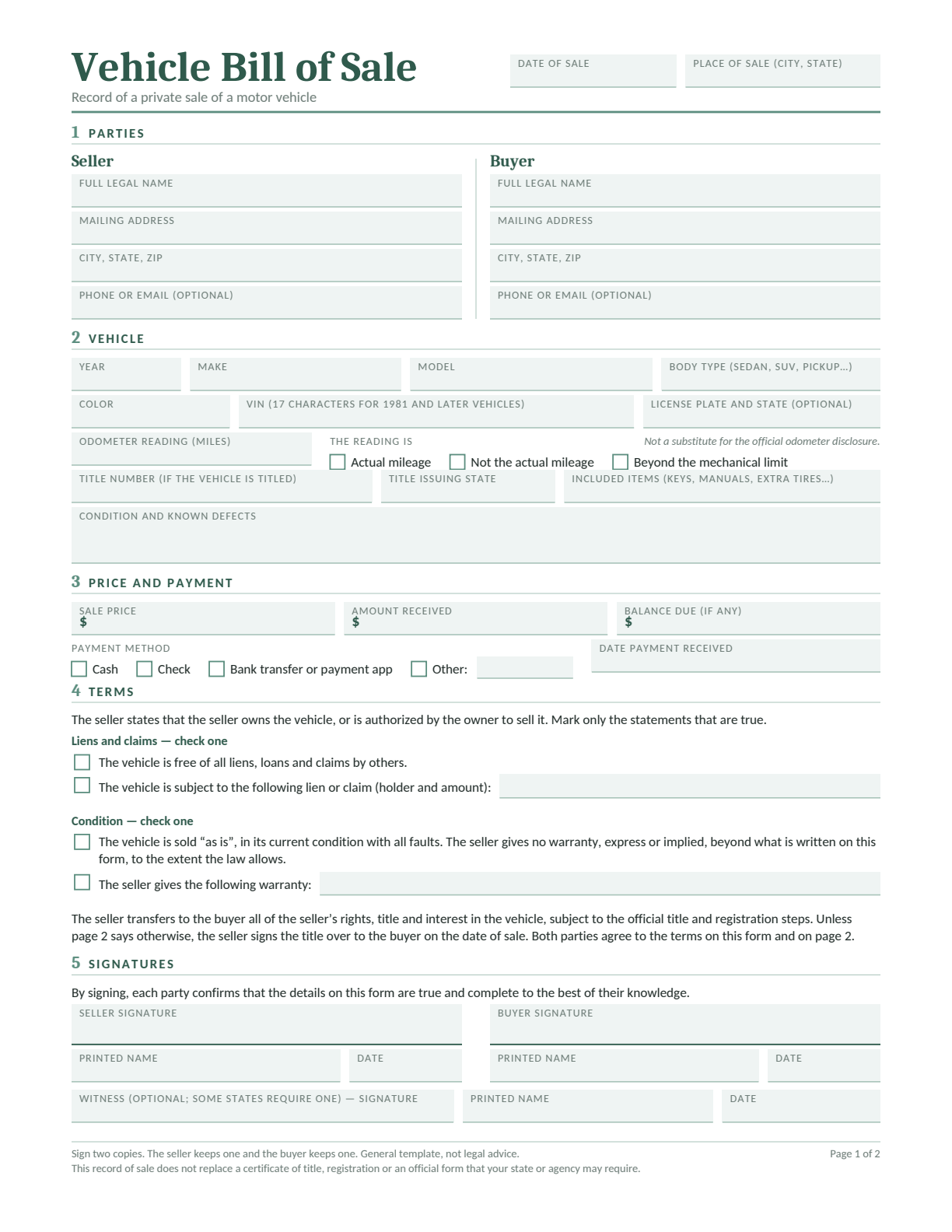
Use the vehicle template for payment, condition and handover terms. Copy the VIN and vehicle description from the vehicle and title, and record what ownership documents the buyer receives. When DMV requires a notarized sale record, complete its official form as well; the general template has a different purpose.
Edit in Word or Google Docs, type into the fillable PDF, or print the blank PDF to complete by hand.
In Google Docs, sign in and choose Make a copy. Use page 2 for extra terms, then keep both pages together.
A West Virginia bill of sale records the property, buyer, seller, price and sale date. It can also document a deposit, a remaining balance or an agreed handover of keys and equipment.
The official DMV-7-TR covers a motor vehicle, trailer or boat and requires notarization. That does not mean every ordinary titled-vehicle sale needs a separate notarized bill of sale. The document required depends on the property’s ownership history and the transaction.
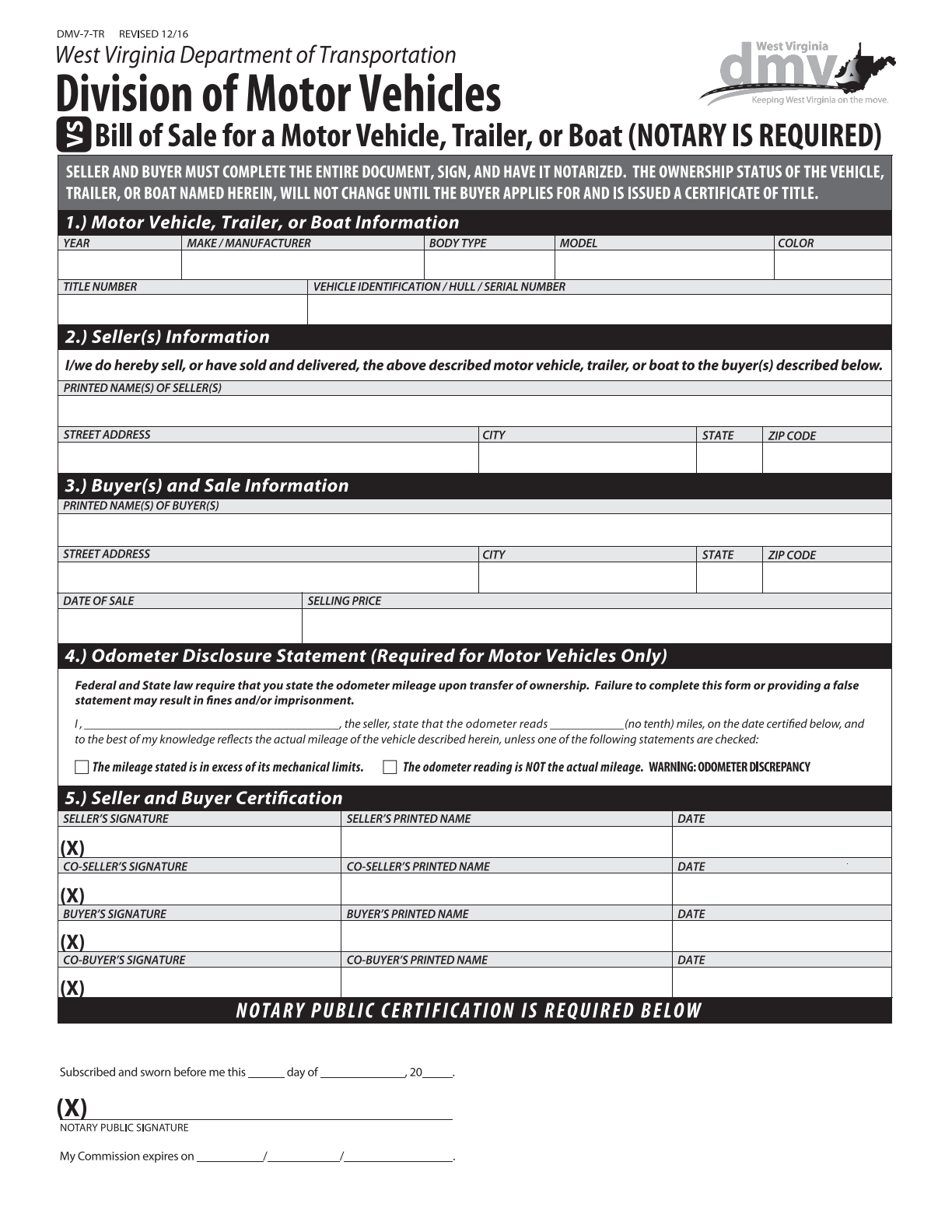
West Virginia Bill of Sale (DMV-7-TR)
DMV identifies DMV-7-TR as its bill of sale for a motor vehicle, trailer or boat. Both parties complete the form, and notarization is required.
What to Fill In
Property and title: Enter the year, make, body type, model, color, title number and VIN, HIN or serial number.
Parties and price: Complete the seller and buyer names and addresses, sale date and actual selling price.
Motor vehicle odometer: Complete the vehicle mileage statement and applicable discrepancy box. The form marks this section for motor vehicles only.
Signatures and notarization: Complete the required seller, co-seller, buyer and co-buyer signature lines with the notary. Leave the notary certificate for the notary to complete.
For a vehicle title application, DMV requires legible copies of both parties’ driver’s licenses with a notarized bill of sale.
Preview of the official form. 12/16. Open its PDF for the complete form and instructions.
Check the title and the need for DMV-7-TR
For an ordinary used vehicle, obtain the seller’s title properly assigned to the buyer. Under DMV’s title guidance, a private sale below 50% of the current NADA Clean Loan Book value needs a notarized bill of sale signed by both parties to support the lower price. Include legible copies of both driver’s licenses. For vehicles two years old or newer, a private-sale bill does not lower DMV’s book-value assessment.
Do not alter a title’s price or use a conflicting bill of sale to correct it. Resolve a title error with DMV and the titled owner before submitting the application.
Seller: assign the title and retain your plates
Complete the title assignment and required mileage disclosure, arrange any lien release and give the buyer the original ownership papers. Check how joint owners’ names are connected so the required owners sign.
West Virginia’s transfer law requires the seller to retain the plates and notify DMV immediately. Keep a dated sale copy. DMV lists a Sold Vehicle or Watercraft Notice, DMV-1-S, in its forms directory; confirm the submission procedure with DMV when reporting the transfer.
Buyer: arrange title and registration before road use
Check that the seller is the titled owner, the VIN matches and the assignment is complete. Submit the assigned title with the required title application and any supporting price or lien documents.
The new-owner statute generally requires registration before highway operation, with only specific exceptions. Do not treat a ten-day reference as a general title-filing deadline or permission to drive on the seller’s plates. Arrange valid registration, insurance and transport before pickup.
West Virginia Boat Bill of Sale Templates
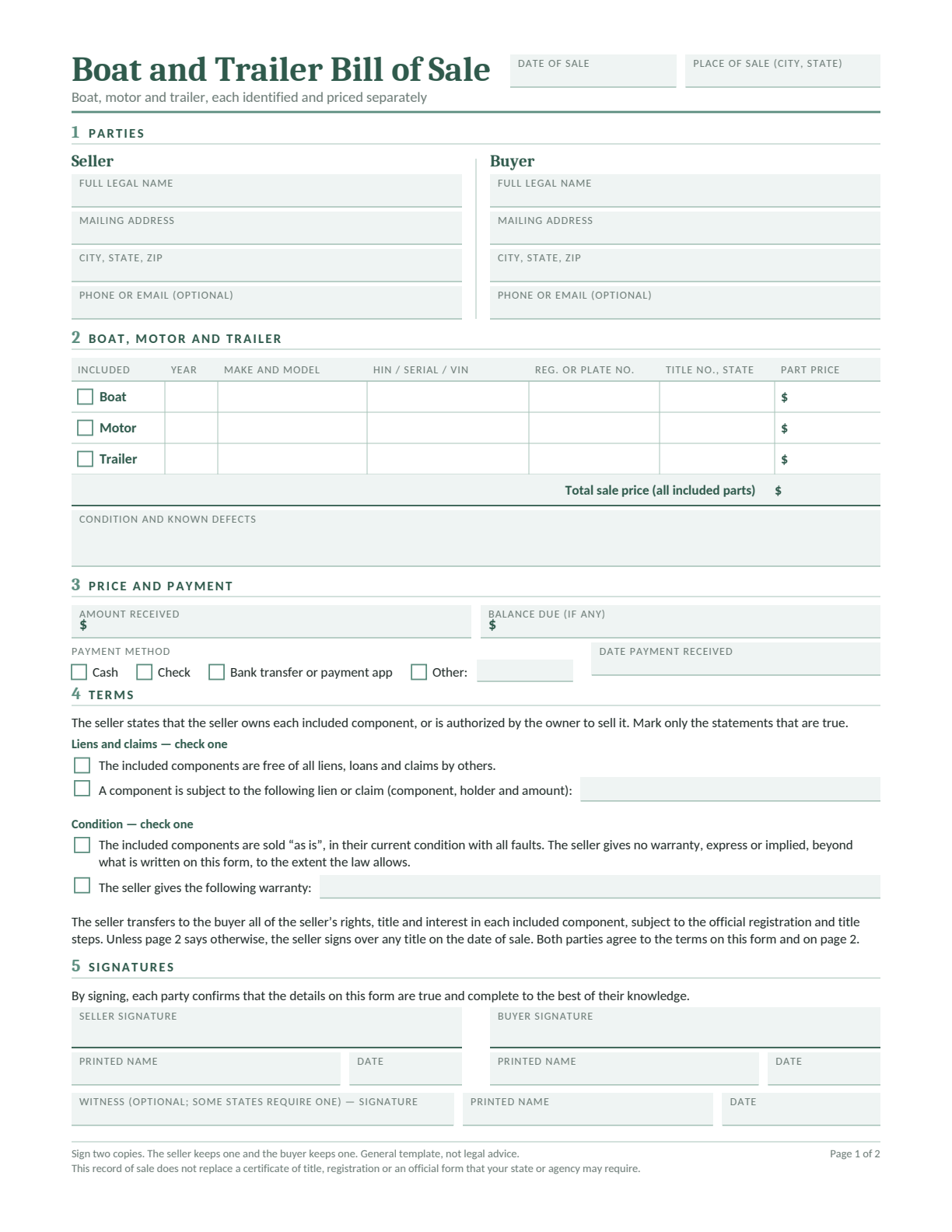
A boat, motor and trailer can share one purchase agreement while retaining separate identifiers and ownership documents. Use the combined template when the deal includes all three, and agree how the price is divided.
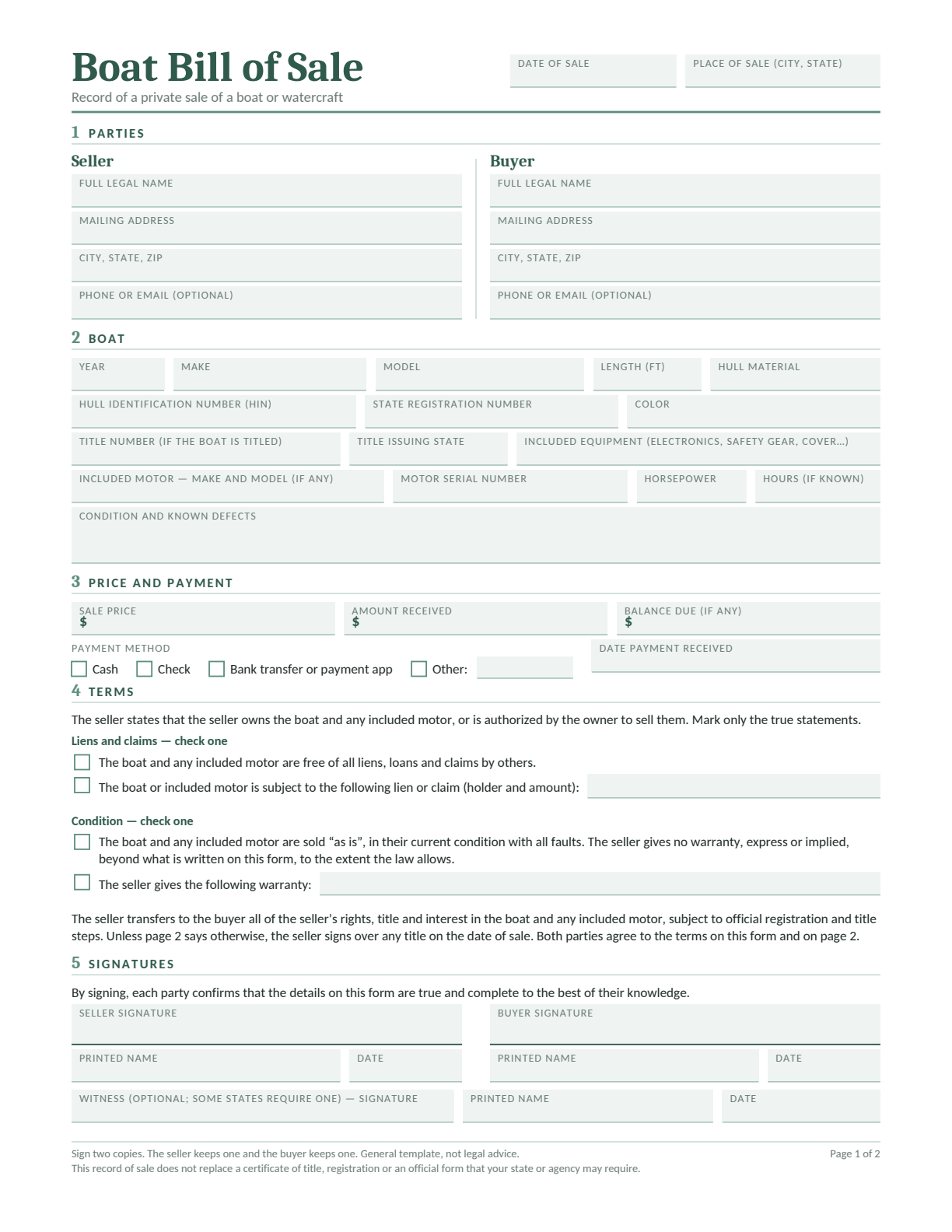
Boat Bill of Sale
Record the boat, included equipment, condition, price and payment.
Choose the motorboat checklist for its ownership history
West Virginia DMV handles motorboat titles and registration. An already-titled boat needs the assigned title; a notarized bill of sale is required when its price is below 50% of book value. A boat previously registered in West Virginia but never titled needs a notarized bill of sale regardless of that price threshold, plus the application, ownership evidence and hull identification certification in DMV’s motorboat checklist.
A boat arriving from a registration-only state follows a different checklist. Obtain the seller’s registration and arrange the required HIN verification and application. If the boat has never been registered or titled anywhere, resolve its ownership evidence before assuming that an ordinary sale receipt will be accepted.
The buyer must apply for a new certificate of number; the previous owner’s registration does not transfer. The motorboat law exempts very small motors from a registration fee, not from the numbering requirement. Check registration before using a motorboat on public waters.
West Virginia Trailer Bill of Sale
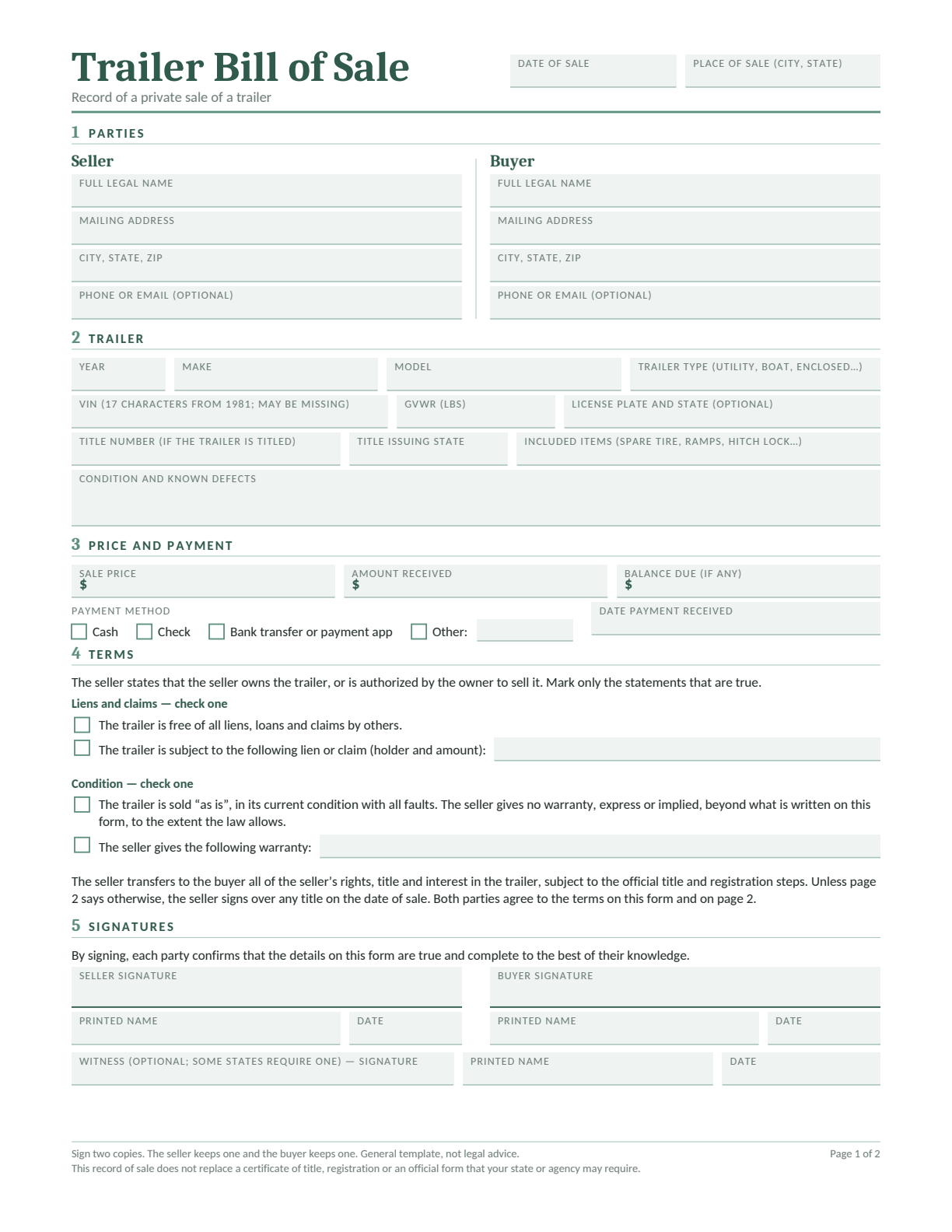
Give the trailer its own description, VIN and price. Record its weight and type accurately so DMV can determine the appropriate registration class; a light utility trailer still needs ownership paperwork.
Trailer Bill of Sale
Describe the trailer and included equipment, then record the price, payment and any remaining balance. Use page 2 for extra terms, such as collection arrangements.
Edit in Word or Google Docs, type into the fillable PDF, or print a blank copy. Complete both pages and keep them with the ownership papers.
West Virginia’s registration guidance includes trailers among the vehicles that must be titled and registered when driven or moved on a highway. A boat’s registration does not cover its trailer, and a low weight alone does not establish a title exemption.
For an assembled trailer, DMV lists Form DMV-62-TR, Construction of an Assembled Trailer, to accompany the title application. Keep the build and purchase records, and ask DMV to identify the required evidence before the sale if the trailer has no assigned identification number or title.
Completed West Virginia Bill of Sale Example
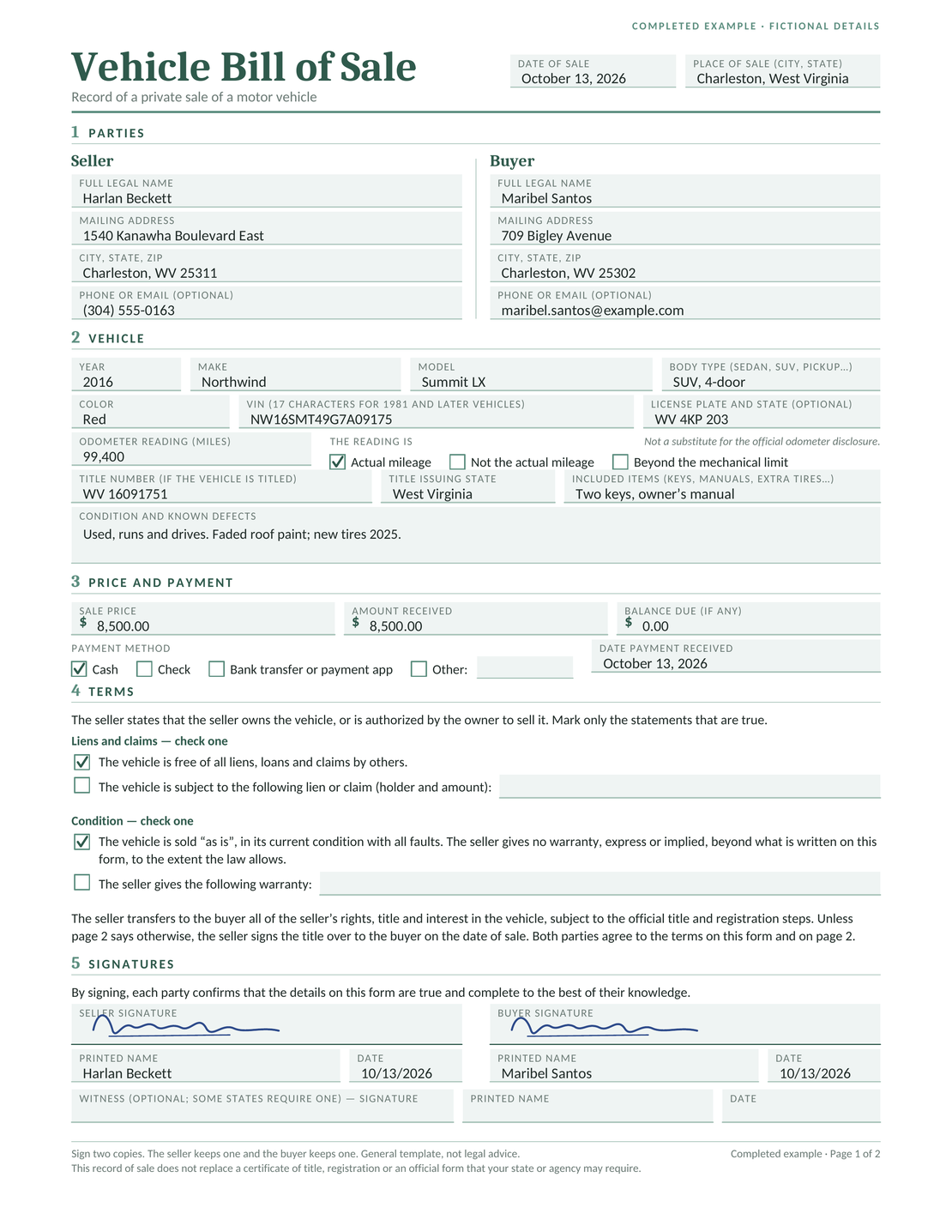
In this fictional sale in Charleston, West Virginia, Maribel Santos buys a 2016 Northwind Summit LX from Harlan Beckett for $8,500.00. The seller records the full $8,500.00 received, leaving a $0.00 balance.
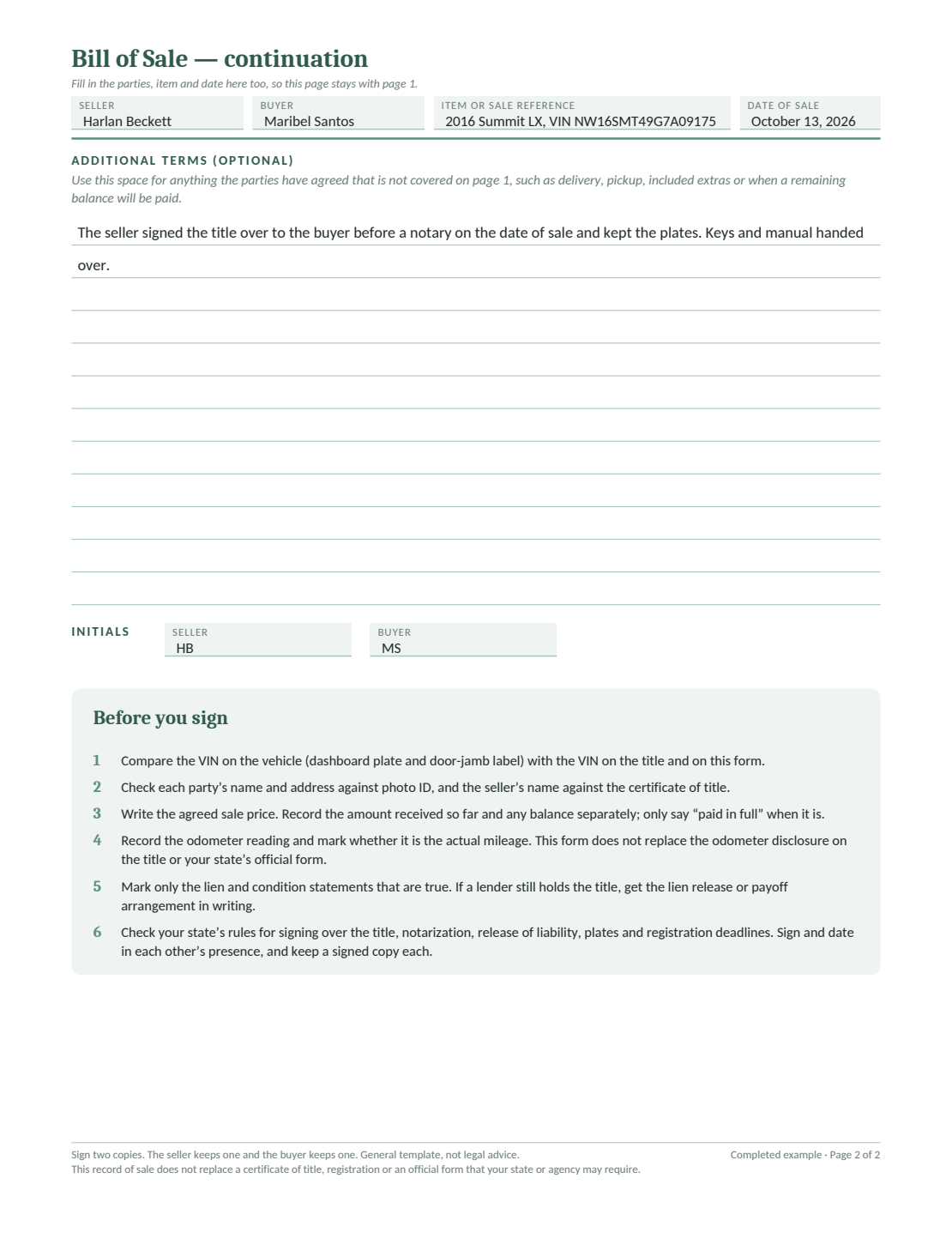
The condition notes disclose faded roof paint and record the 2025 tire replacement. The fictional handover includes signing the title before a notary, keeping the plates and giving Maribel the keys and manual; the private example itself is not a notarial certificate.
The names, identifiers and signatures are fictional. This completed sale record does not show that a title application, registration or seller notice has been accepted by the relevant agency.
Page 1: Parties, vehicle, payment and signatures
Page 2: Agreed handover terms and signing checklist
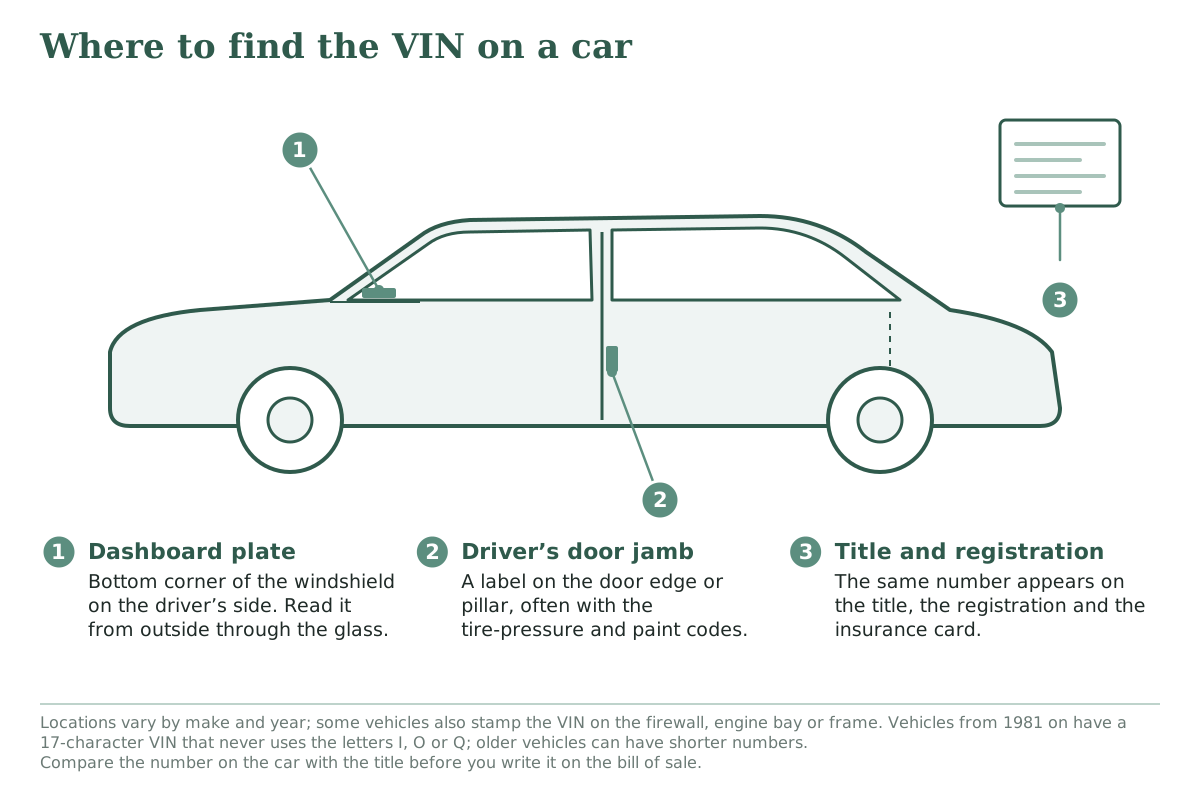
Compare the identifying number on the property with the ownership papers before copying it into your sale record.
Look through the windshield at the driver-side dashboard. Also check the label inside the driver’s door opening. Locations vary, so consult the vehicle’s manual if needed.
Resolve a missing or mismatched number with the agency handling the transfer. Do not guess from an unclear label.
Compare the seller’s name with the ownership record and check every required owner’s signature.
Match the VIN or HIN on the property to the title, registration and sale record.
Record the agreed price, money actually received and any remaining balance separately.
Describe known defects and the equipment included in the price.
Confirm the ownership papers and transport arrangements before handover.
DMV-7-TR requires notarization and completion by buyer and seller. Follow the separate title’s signing instructions as well. Notarizing a general receipt does not supply a missing title or establish that DMV has accepted the transfer.
Keep the Sale Record with the Transfer Papers
Give each party a signed copy of both pages. Keep payment evidence, lien releases and copies of the ownership papers with it. If pickup or a final payment happens later, add a dated receipt or acknowledgment that refers to the same vehicle or vessel.
Keep the agency’s receipt when you submit a title application or seller report. Signing a private form and submitting official paperwork are separate actions.
A separate notarized bill of sale is not listed for every ordinary titled-vehicle transfer. It is needed in specified situations, including supporting a qualifying private purchase price below 50% of book value.
Yes. DMV-7-TR expressly requires notarization and completion by both parties. Keep the notary section blank until the notary completes it.
For an ordinary titled vehicle, obtain the properly assigned title. Have the titled owner resolve a missing title with DMV before treating the transfer paperwork as complete.
Yes. DMV’s transfer checklist for that ownership history requires a notarized bill of sale, application and hull identification certification, along with verification of the seller’s registration.
DMV’s highway-use guidance includes trailers without a general light-trailer title exemption. Check the trailer’s registration class and obtain its assigned title or complete the applicable assembled-trailer process.
After 14 days, continue for
$12.99/month
only if you choose to upgrade.
We use cookies to provide you with the best possible experience. Cookies also help us analyze user behaviour so we can continue to improve our website. View our cookie policy.