Record your Indiana vehicle sale with the price, payment, condition and handover terms. Keep a signed copy with the title so each person has the same record.
Download a vehicle, boat or trailer template, and check when Indiana’s official bill of sale form applies.
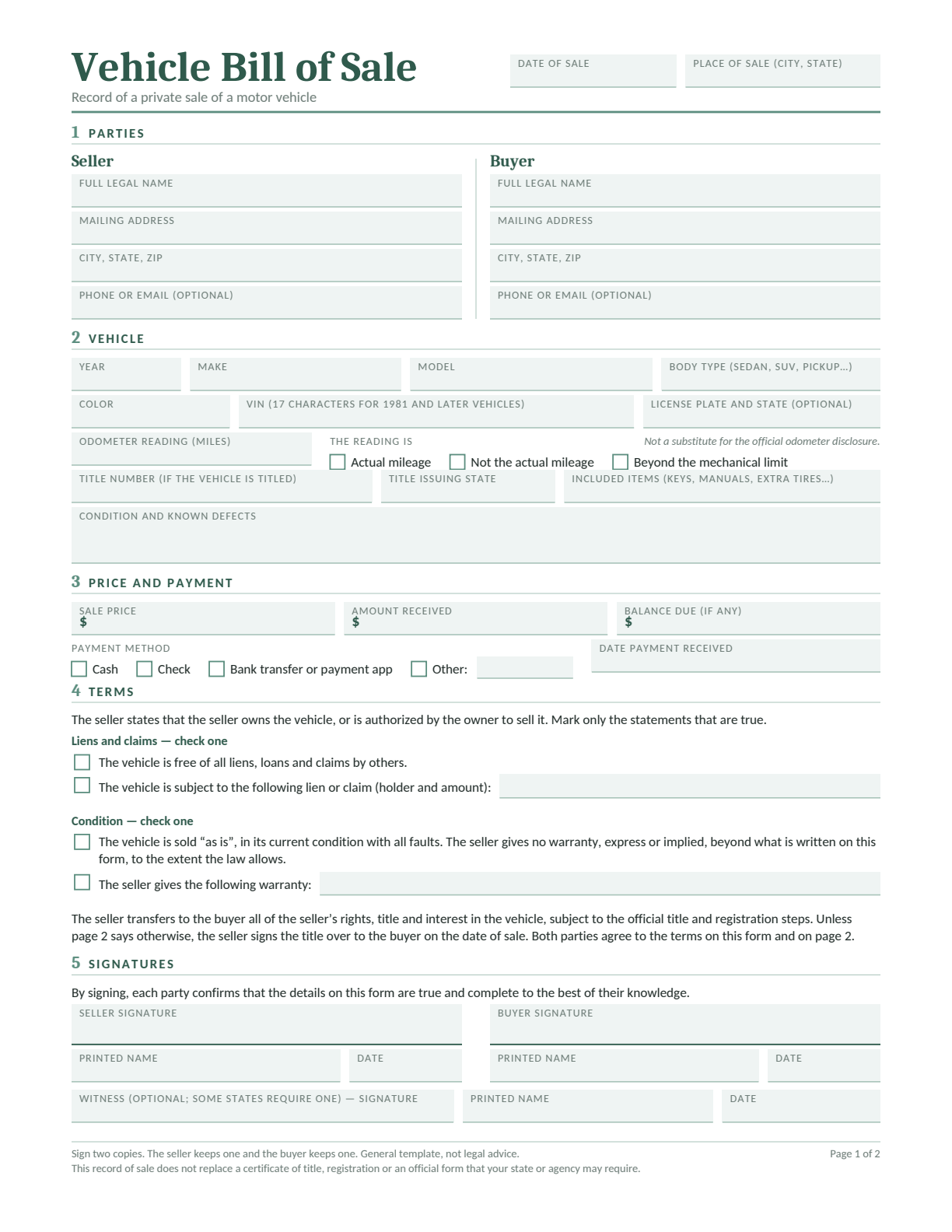
Record the vehicle’s VIN, mileage, price and payment, then describe known defects and included items. Use the second page for a remaining payment, collection date or other agreed terms. Keep both pages with the ownership papers.
Edit in Word or Google Docs, type into the fillable PDF, or print the blank PDF to complete by hand.
In Google Docs, sign in and choose Make a copy. Use page 2 for extra terms, then keep both pages together.
A bill of sale records who sold the property, who bought it, the sale date and the agreed price. Payment fields show how much the seller has received and whether any balance remains. Both people keep a signed copy.
This page covers private vehicle, boat and trailer sales in Indiana. Keep the sale record with the title or registration documents that apply to the property. For furniture, tools or other personal property, see the general bill of sale templates.
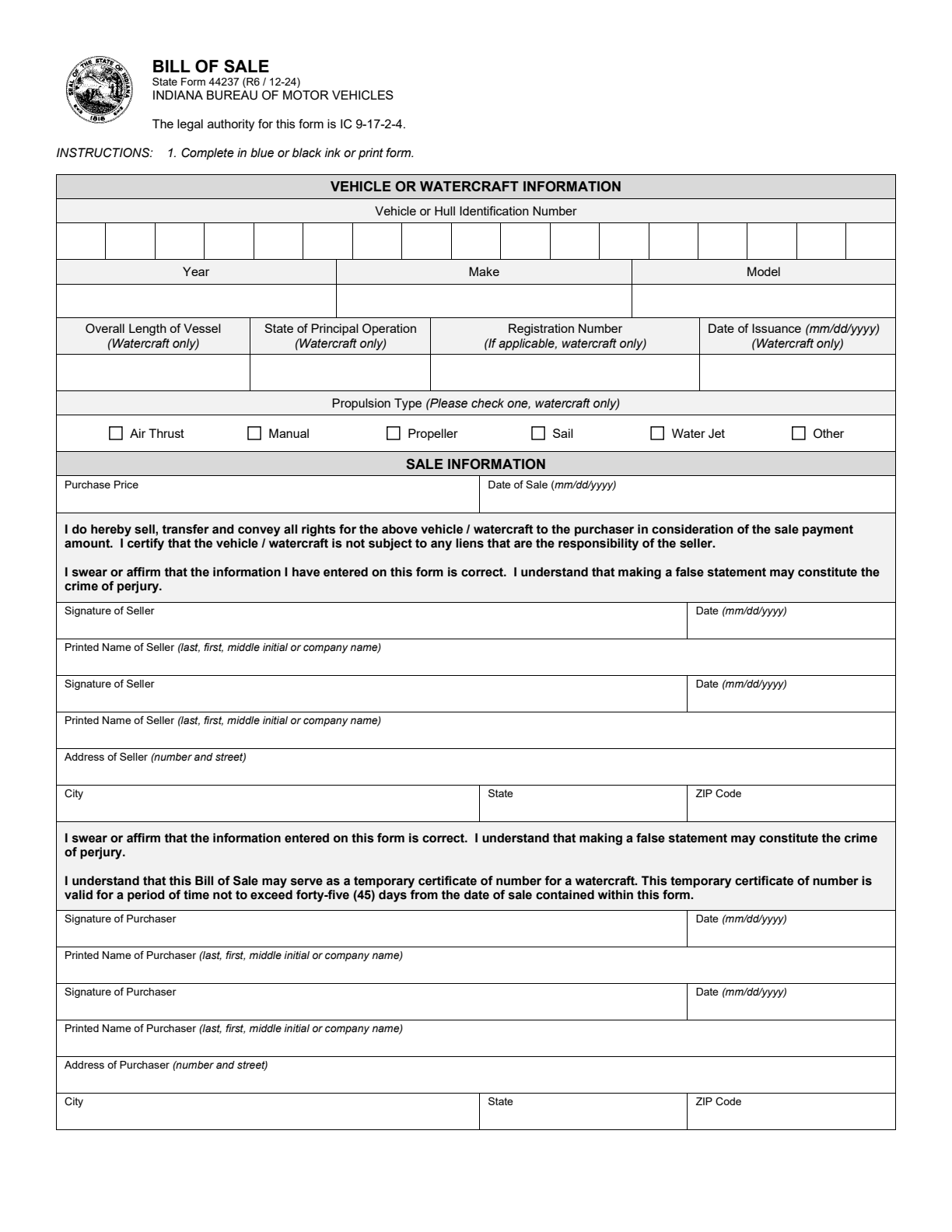
Indiana Bill of Sale — State Form 44237
BMV publishes State Form 44237 for vehicle and watercraft sales. It also accepts a similar document with the required information. The form supports the transaction; it does not create an exception to a title requirement.
What to Fill In
Vehicle or watercraft: Enter the VIN or HIN, year, make and model. For a watercraft, also complete its length, principal state of operation, registration and propulsion details.
Price and date: Enter the purchase price and sale date. Check these against the title; a conflicting bill of sale cannot override an entry already on it.
Seller: Read the ownership, lien and perjury statements before signing. Each seller prints their name, signs and dates, and provides their address.
Purchaser: Each purchaser prints their name, signs and dates, and provides their address.
BMV’s ordinary bill-of-sale guidance does not require notarization. A special ownership or title application may have its own certification requirements.
Preview of the official form. R6 / 12-24. Open its PDF for the complete form and instructions.
Use the Title for a Titled Vehicle
Indiana BMV accepts a bill of sale as the main ownership document only in limited cases. A normal titled vehicle needs its assigned title. The sale record can supply a missing purchase price or date, but it cannot override a different entry already on the title. See BMV’s bill-of-sale guidance.
Seller: Complete the Title and Keep the Plate
Complete the title’s seller and buyer details, including the required odometer disclosure, before the buyer applies. All owners who must transfer their interest should sign.
Remove the plate at the sale. BMV does not require you to return it; you may transfer it to another vehicle you own under its buying and selling instructions.
Buyer: Apply Within 45 Days
Apply for the new title within 45 days of purchase. For a private purchase, pay the applicable sales tax at the BMV branch when applying.
An out-of-state vehicle needs a VIN inspection. Complete title and registration arrangements before relying on the vehicle for everyday travel; a signed sale record alone is not a license plate.
Correct the Title Through the BMV Process
If the title has the wrong date or price, do not write a conflicting bill of sale to “fix” it. BMV directs buyers to its title-correction affidavit. Check the original document together before signing so the transfer file does not contain two competing versions of the sale.
Indiana Boat Bill of Sale Templates
Indiana’s BMV handles boats as well as road vehicles. Use the boat template to describe the hull and equipment; use the package version when a motor and trailer are included in the same deal.
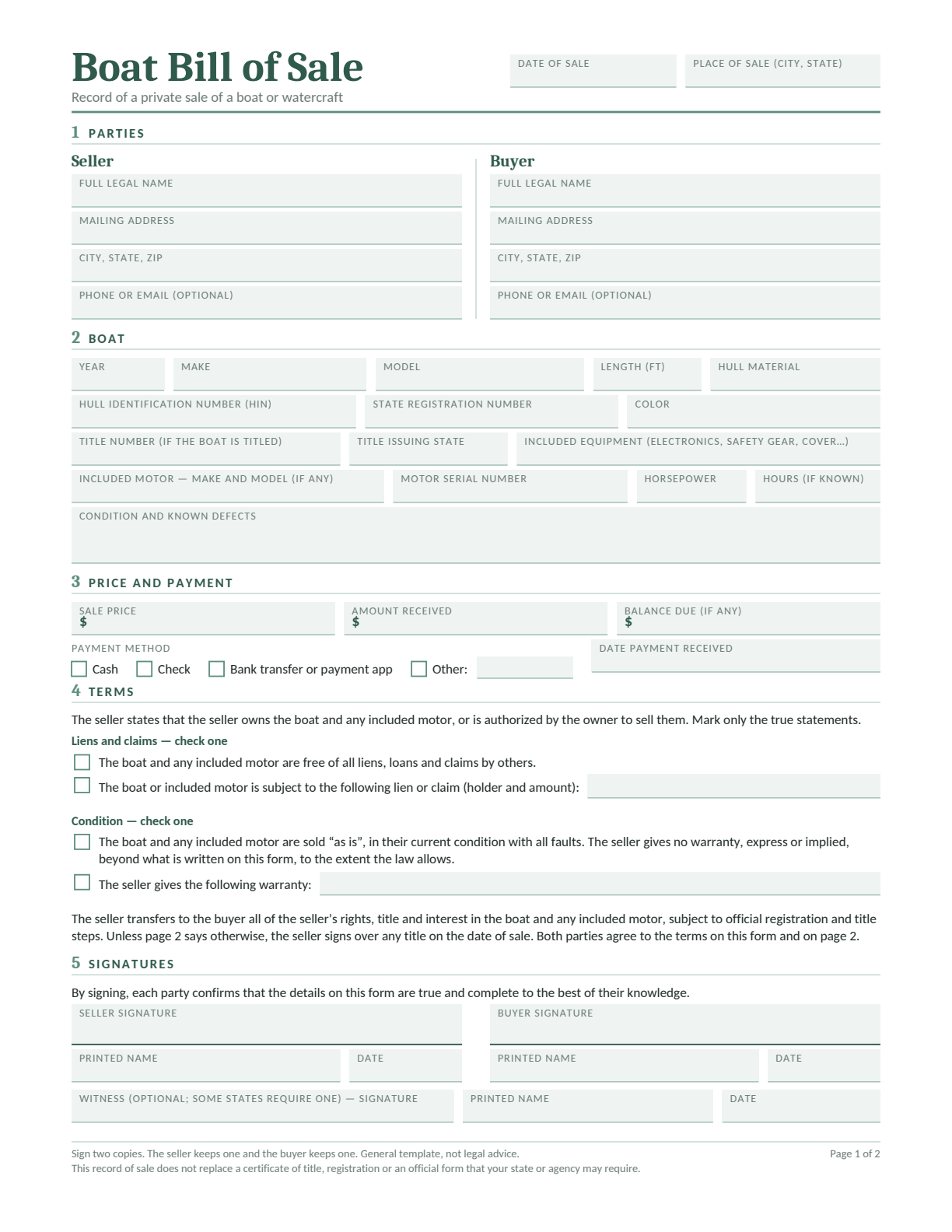
Boat Bill of Sale
Record the boat, included equipment, condition, price and payment.
Indiana residents generally apply for a watercraft title within 45 days of purchase unless the craft is specifically exempt. The watercraft title rules explain that several older exemptions have ended. A seller who owned a boat under an earlier exemption may provide a bill of sale without first obtaining a title; the buyer must follow the current application process.
BMV’s registration instructions allow a limited temporary exception when the operator carries a bill of sale within the 45-day purchase period. It must identify the purchaser and address, purchase date, make, model and manufacturer’s identification number. Keep that document aboard when relying on the exception.
A nonmotorized sailboat is not treated like an exempt paddleboat: it needs the applicable decals and registration steps. A boat with no HIN needs BMV’s identification-number process rather than an invented number in the sale form.
Indiana Trailer Bill of Sale
A trailer’s age and ownership history can affect which papers BMV accepts. Record the VIN and description, but obtain the existing title whenever the trailer has one.
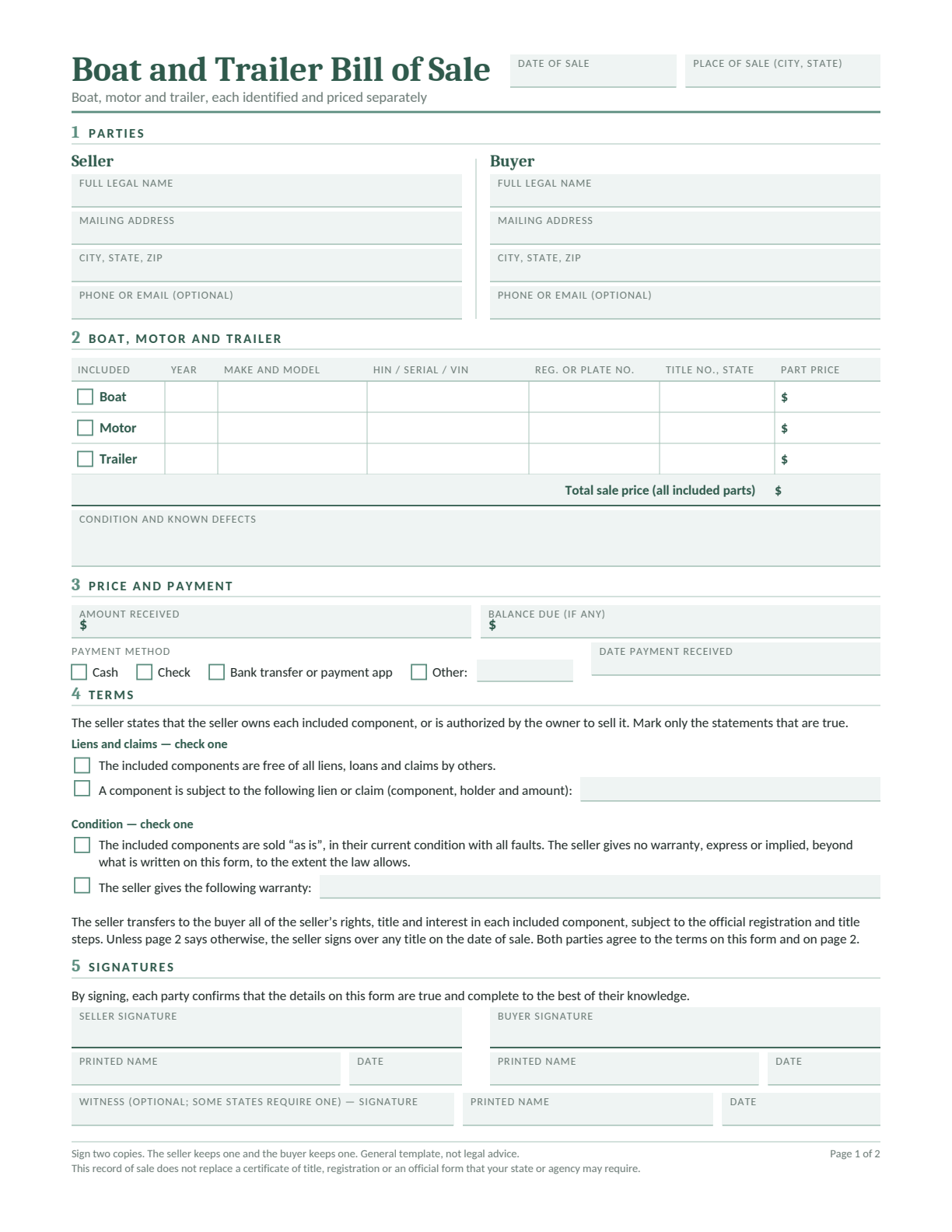
Trailer Bill of Sale
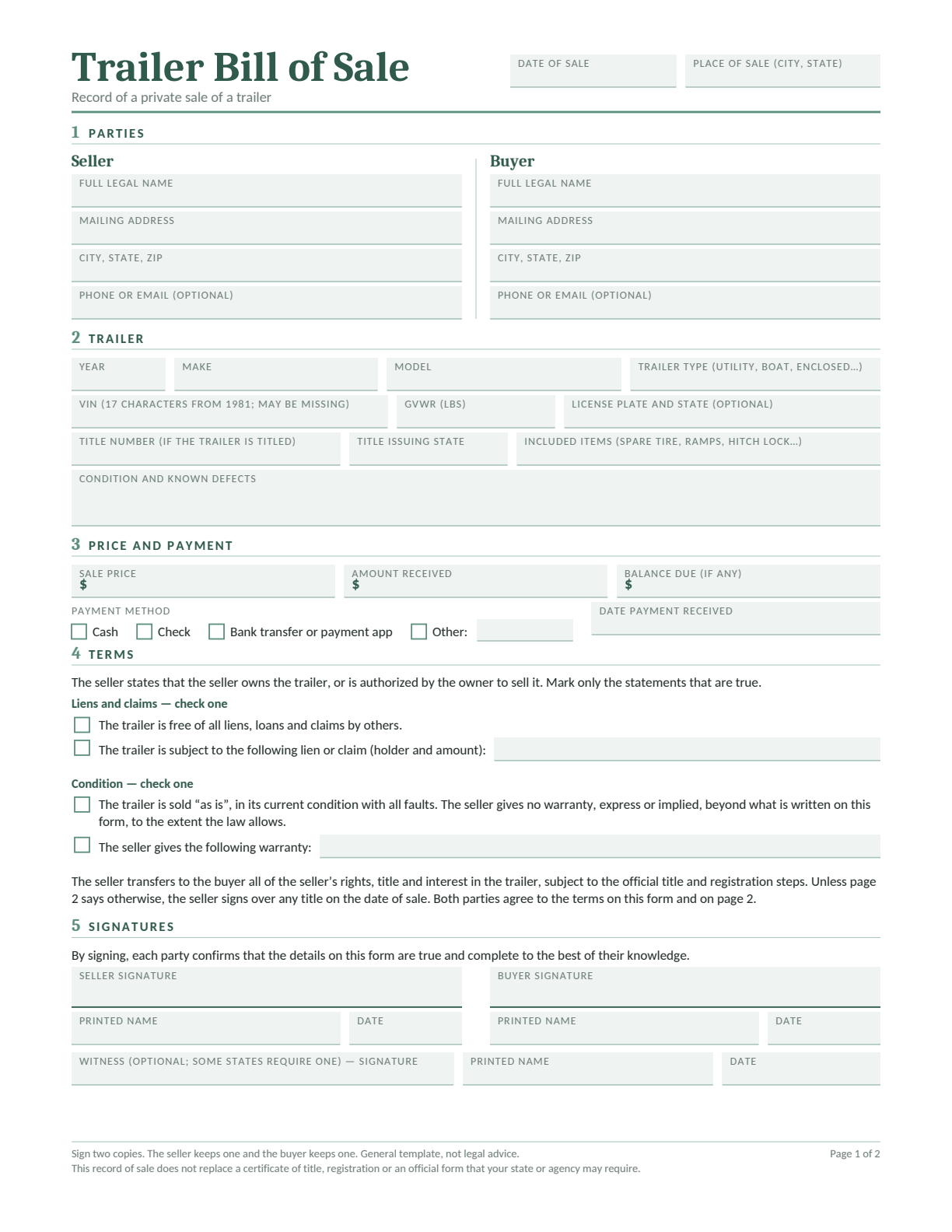
Describe the trailer and included equipment, then record the price, payment and any remaining balance. Use page 2 for extra terms, such as collection arrangements.
Edit in Word or Google Docs, type into the fillable PDF, or print a blank copy. Complete both pages and keep them with the ownership papers.
BMV lists specific historical cases where a bill of sale may establish ownership, including a utility trailer purchased before January 1, 1990 and a pop-up trailer purchased before July 1, 2016. These are not general weight exemptions for a trailer bought today.
For missing papers on an eligible trailer, consult the BMV title forms and Trailer Ownership Affidavit, State Form 43753. Its categories include certain privately assembled trailers and trailers from states that did not require a title. Ask BMV which application and inspection documents fit the actual history before completing the sale.
Completed Indiana Bill of Sale Example
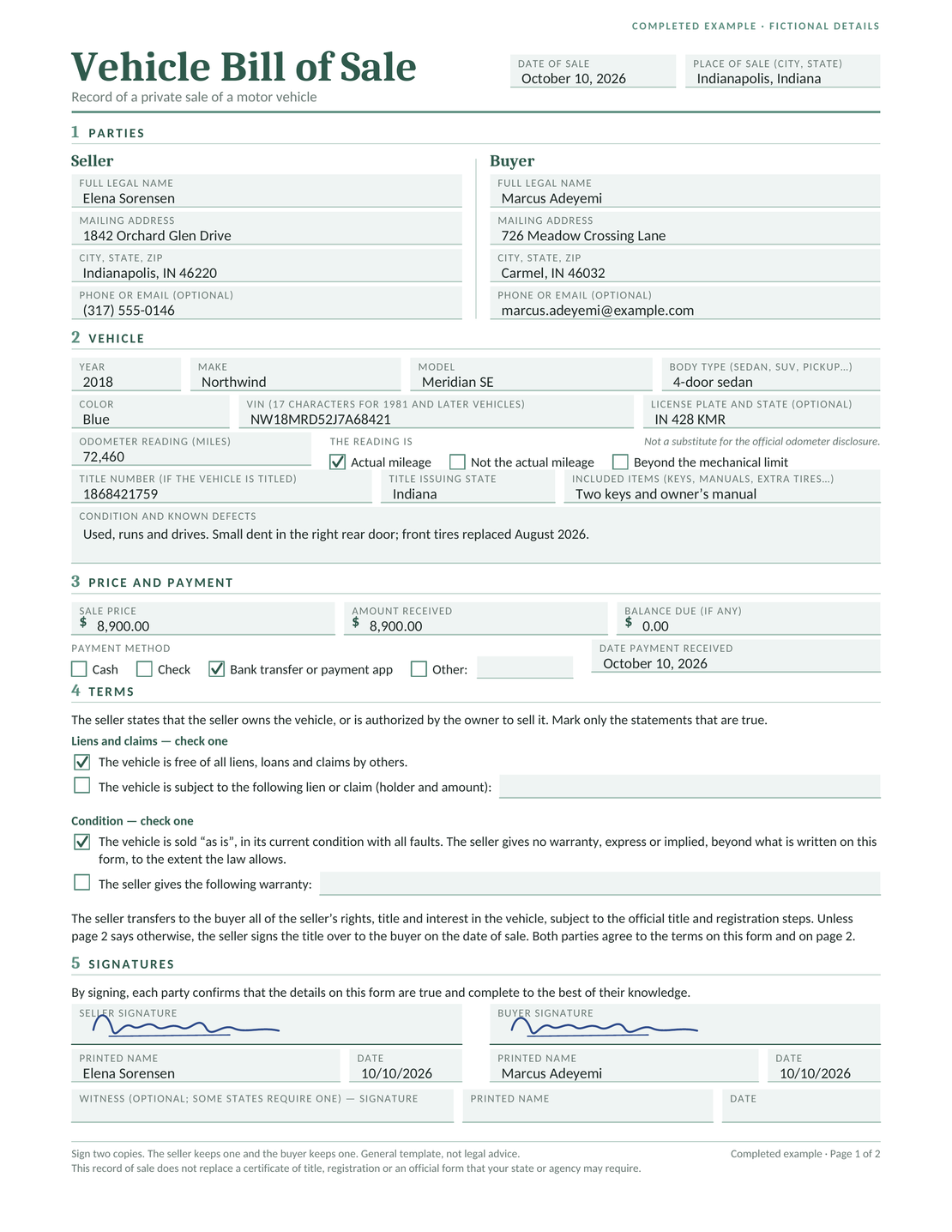
Elena Sorensen sells Marcus Adeyemi a blue 2018 Northwind Meridian SE in Indianapolis for $8,900 on October 10, 2026. This fictional example records 72,460 miles, a small dent in the right rear door and front tires replaced in August.
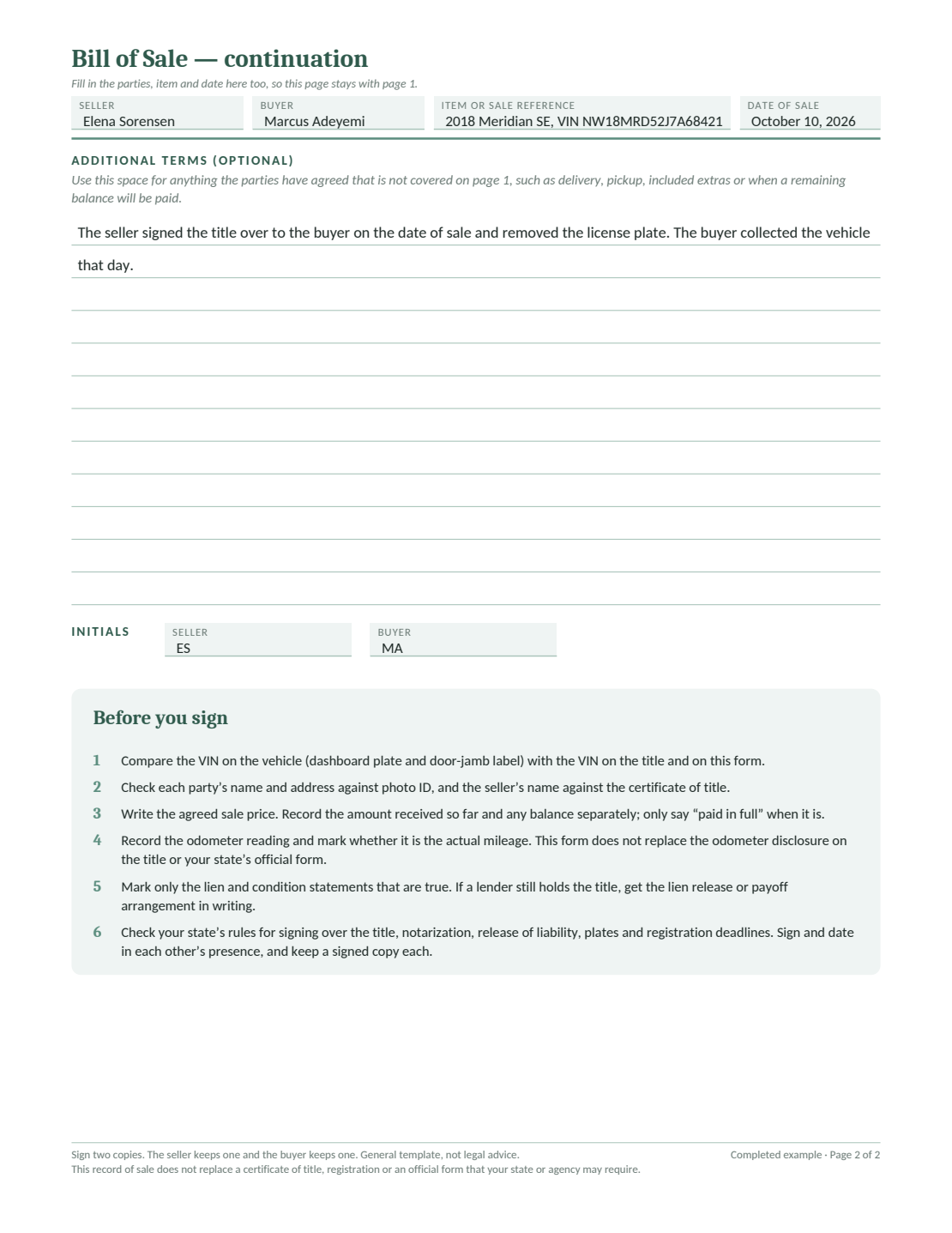
It shows $8,900 received and no balance due. Page 2 records that Elena signed over the title and removed the plate, and Marcus collected the vehicle that day. It does not show a completed BMV title or registration application.
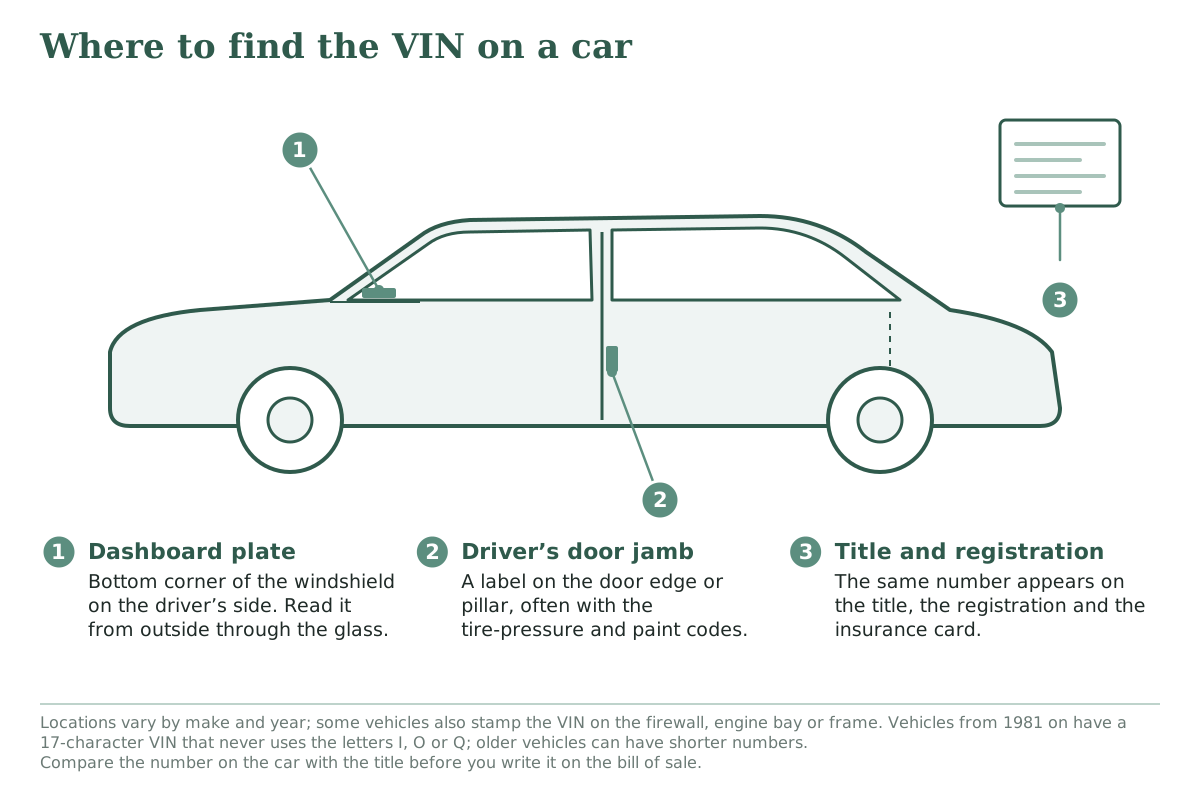
Compare the identifying number on the property with the ownership papers before copying it into your sale record.
Look through the windshield at the driver-side dashboard. Also check the label inside the driver’s door opening. Locations vary, so consult the vehicle’s manual if needed.
Resolve a missing or mismatched number with the agency handling the transfer. Do not guess from an unclear label.
Compare the seller’s name and all co-owners with the ownership document.
Match the VIN or HIN on the property to the papers before copying it.
Record known defects and anything included in the price.
Separate the agreed price, money received and balance still owed.
Resolve any lien and check which title, registration or disclosure signatures are required.
Keep the Sale Record with the Transfer Papers
Keep both signed pages together with a copy of the assigned ownership document and proof of payment. Save any filing receipt separately: a promise in the sale agreement to apply or report the sale does not show that the agency received it.
Usually no. BMV accepts that route only in listed circumstances. A car that legally requires a title needs the correct title-transfer process.
BMV says an ordinary bill of sale under its guidance does not need notarization. Follow any additional certification instructions if you are using a special missing-title process.
No. BMV says it cannot override information already written on the title. Use the title-correction process if the title is wrong.
BMV lists a temporary exception for an operator carrying a qualifying bill of sale within the 45-day purchase period. Include all the required buyer, date and boat details and complete the title and registration process on time.
Remove it from the sold vehicle. Indiana does not require surrendered plates in an ordinary sale, and an eligible plate may be transferred to another vehicle you own.
After 14 days, continue for
$12.99/month
only if you choose to upgrade.
We use cookies to provide you with the best possible experience. Cookies also help us analyze user behaviour so we can continue to improve our website. View our cookie policy.