Choose a free Alaska bill of sale template to record a vehicle, boat or trailer sale. Describe the property, payment and any equipment included in the deal.
Prepare the ownership papers too: a sale receipt alone cannot transfer an Alaska vehicle title.
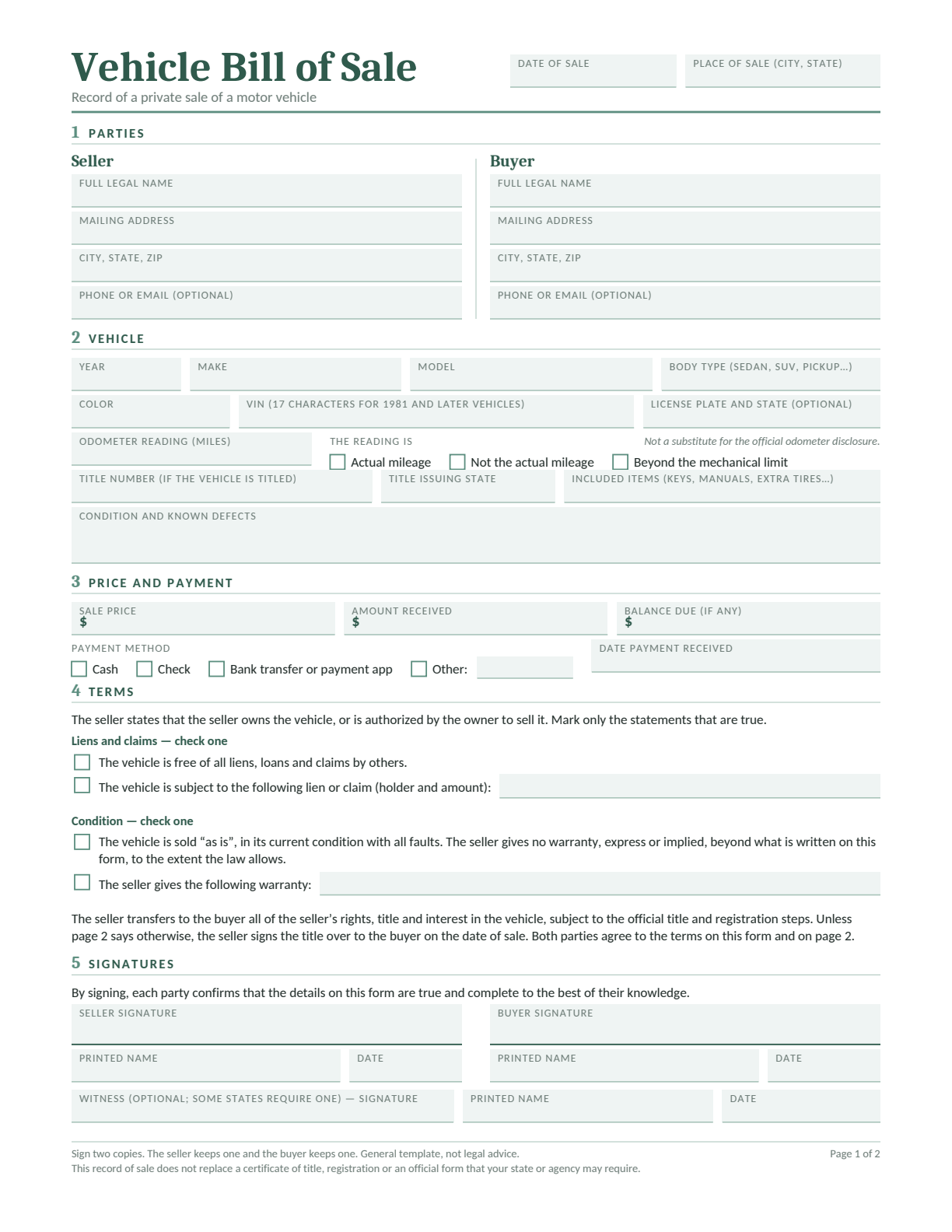
Record the seller and buyer, the vehicle’s VIN and mileage, and the price agreed for the sale. Keep the amount received separate from any remaining balance. Describe known defects and list included keys, documents and equipment.
Edit in Word or Google Docs, type into the fillable PDF, or print the blank PDF to complete by hand.
In Google Docs, sign in and choose Make a copy. Use page 2 for extra terms, then keep both pages together.
An Alaska bill of sale records the agreement between a seller and buyer. It identifies the property and helps show its price, condition and delivery date if either person needs to check the transaction later.
Alaska DMV recommends a sale record signed by both parties, but makes clear that it does not replace a vehicle title assignment. The paperwork for a boat can differ depending on its length and whether a title is being requested.
Sign Over the Title as Well as the Sale Record
The seller must assign the vehicle title and give it to the buyer when delivering the vehicle. On the bill, record the VIN, vehicle description, both printed names, date and both signatures, along with price and payment details. See Alaska DMV’s sale instructions.
Read the title’s ownership wording before signing. A title joined by “or” can be released by either listed owner; titles joined by “and,” another conjunction or no conjunction require all owners’ signatures under DMV’s purchaser guidance. Do not use a dealer reassignment space for an ordinary private resale.
Seller: Report the Sale to DMV
Complete the notice attached to the title and send it to DMV promptly, or use the online vehicle sale report. Keep the buyer’s correct name and address and a copy of the signed sale record.
Remove personalized or specialty plates before handing over the vehicle. Keep copies of the assignment and any lien release, and give the original title to the buyer. A submitted sale notice records the pending transfer; the buyer still needs a new title.
Buyer: Apply Within 30 Days
Apply for an Alaska title in your name within 30 days of purchase. Submit the assigned ownership document and completed Vehicle Transaction Application V1, with any required lien release, disclosure and registration documents.
Complete the applicable odometer disclosure on the ownership document. If it was omitted or the title has no suitable space, DMV may require form V6. Do not guess the mileage: an incomplete disclosure can lead to an unknown-mileage record. Check the title application requirements before submitting.
When the Seller Cannot Produce a Title
If an Alaska title was lost, the owner shown in DMV’s records should obtain a duplicate. For missing ownership evidence that cannot be resolved that way, DMV has a surety-bond title process with an appraisal and inspection. Buying with a bill of sale does not guarantee approval through that process.
The Alaska DMV forms list provides title, odometer and transfer-notice documents. It does not list a general vehicle bill-of-sale form; use the sale template for the parties’ record and the relevant agency forms for the application.
Alaska Boat Bill of Sale Templates
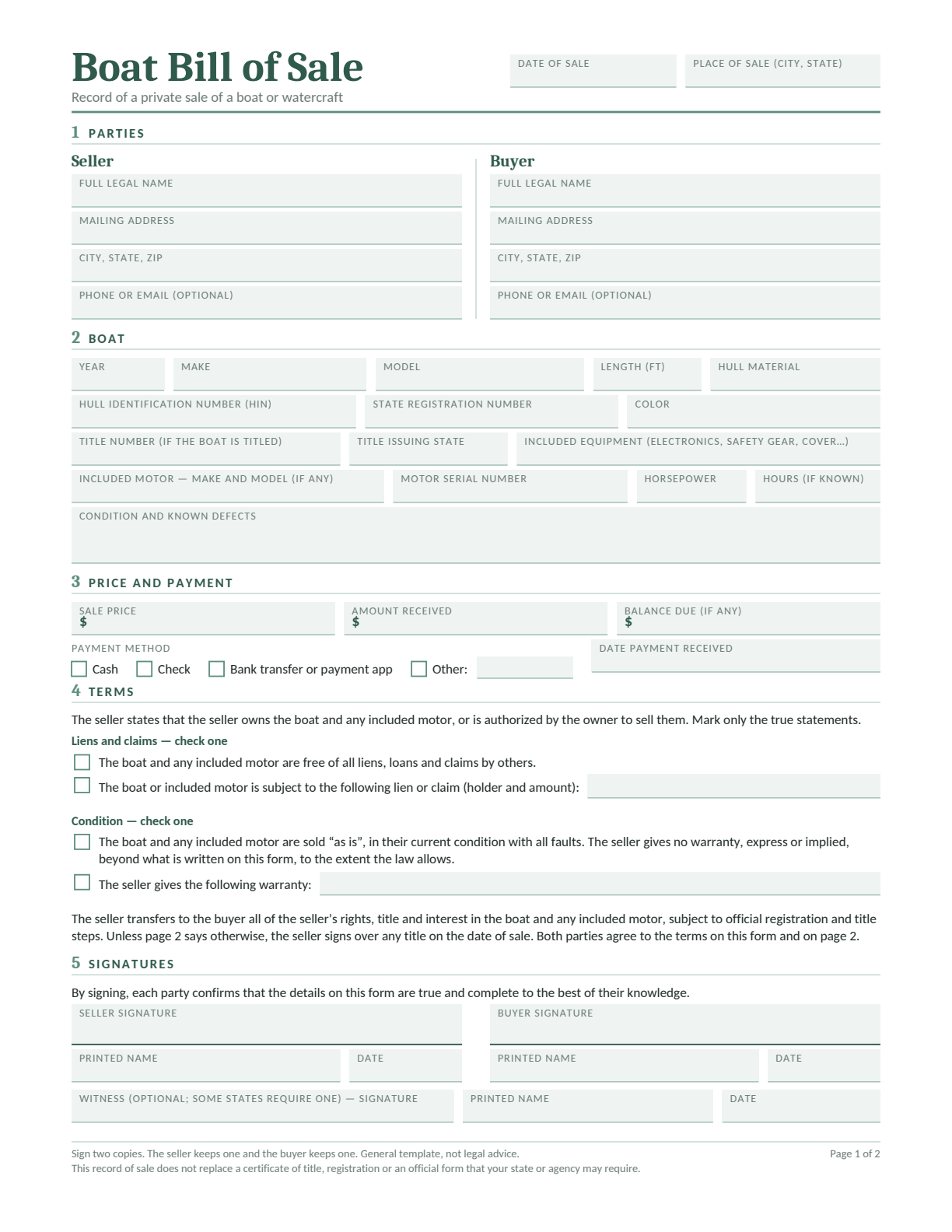
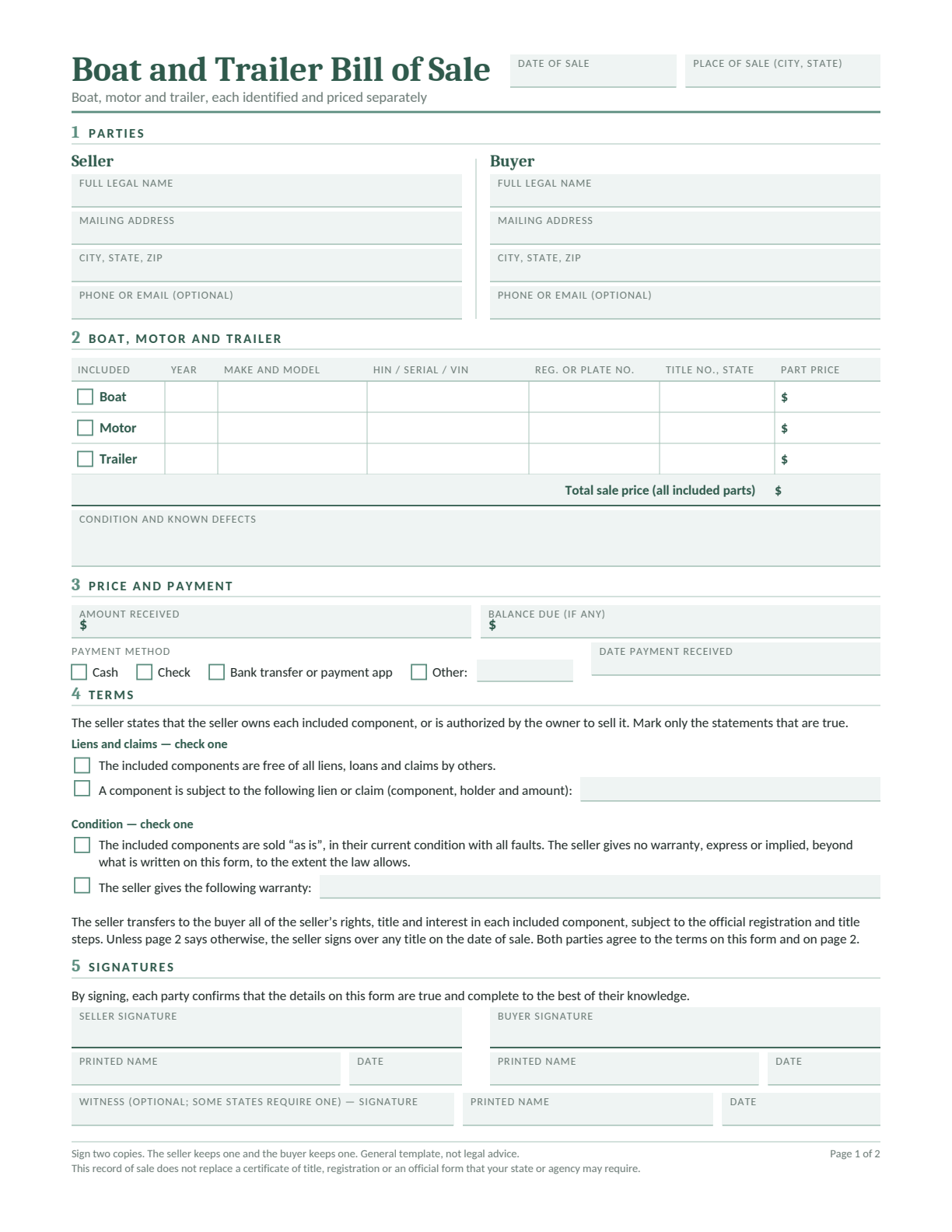
Record the boat’s HIN, length and existing registration or title details. If the motor and trailer are included, identify each one separately and list what ownership papers the buyer will receive.
Boat Bill of Sale
Record the boat, included equipment, condition, price and payment.
Boats principally used in Alaska generally need state registration unless exempt. DMV requires titles for boats longer than 24 feet, except vessels documented by the U.S. Coast Guard; boats of 24 feet or less may be titled voluntarily. Check Alaska’s boat registration guidance against the vessel’s length and documentation.
A bill from a dealer or previous owner is among the documents DMV accepts for registration only. To obtain a title, collect the required ownership evidence, such as the original manufacturer’s document or previous title and registration. Do not assume the registration-only list also proves eligibility for a title.
Use the boat application B1 and the appropriate transfer process. After applying, DMV allows a copy of the application to serve as registration for up to 60 days or until the new registration arrives. A bill of sale by itself is not that temporary application record.
Alaska Trailer Bill of Sale
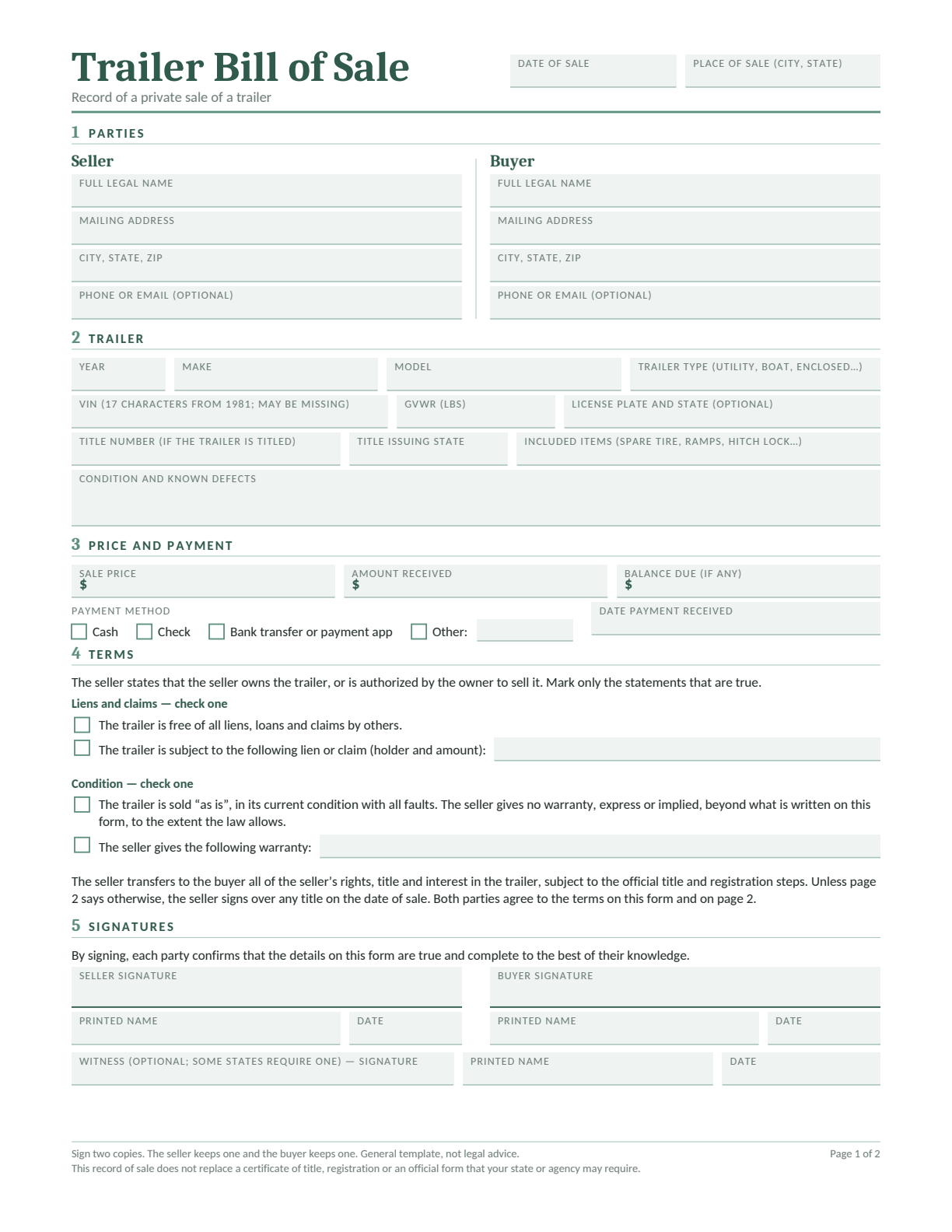
Use the trailer template for a separate sale or alongside a boat bundle. Record the trailer VIN, actual weight, included equipment and title details; the boat’s registration does not identify its trailer.
Trailer Bill of Sale
Describe the trailer and included equipment, then record the price, payment and any remaining balance. Use page 2 for extra terms, such as collection arrangements.
Edit in Word or Google Docs, type into the fillable PDF, or print a blank copy. Complete both pages and keep them with the ownership papers.
Alaska DMV issues titles for trailers. An ordinary used-trailer transfer therefore needs the seller’s assigned title and the buyer’s application. Do not treat the 500-pound rule in the missing-ownership process as a general exemption from titling.
DMV says trailers over 500 pounds need a surety bond when ownership proof is inadequate, while those under 500 pounds may qualify without one using a certified weight slip. Ask DMV about an exact boundary or unusual case before buying without a title.
A homebuilt trailer needs the builder’s notarized Homebuilt Trailer Affidavit, a weight slip, inspection and records for major parts. Save the receipts and bills of sale needed for Alaska’s homebuilt trailer process. The affidavit’s notarial requirement is separate from the ordinary sale record.
Completed Alaska Bill of Sale Example
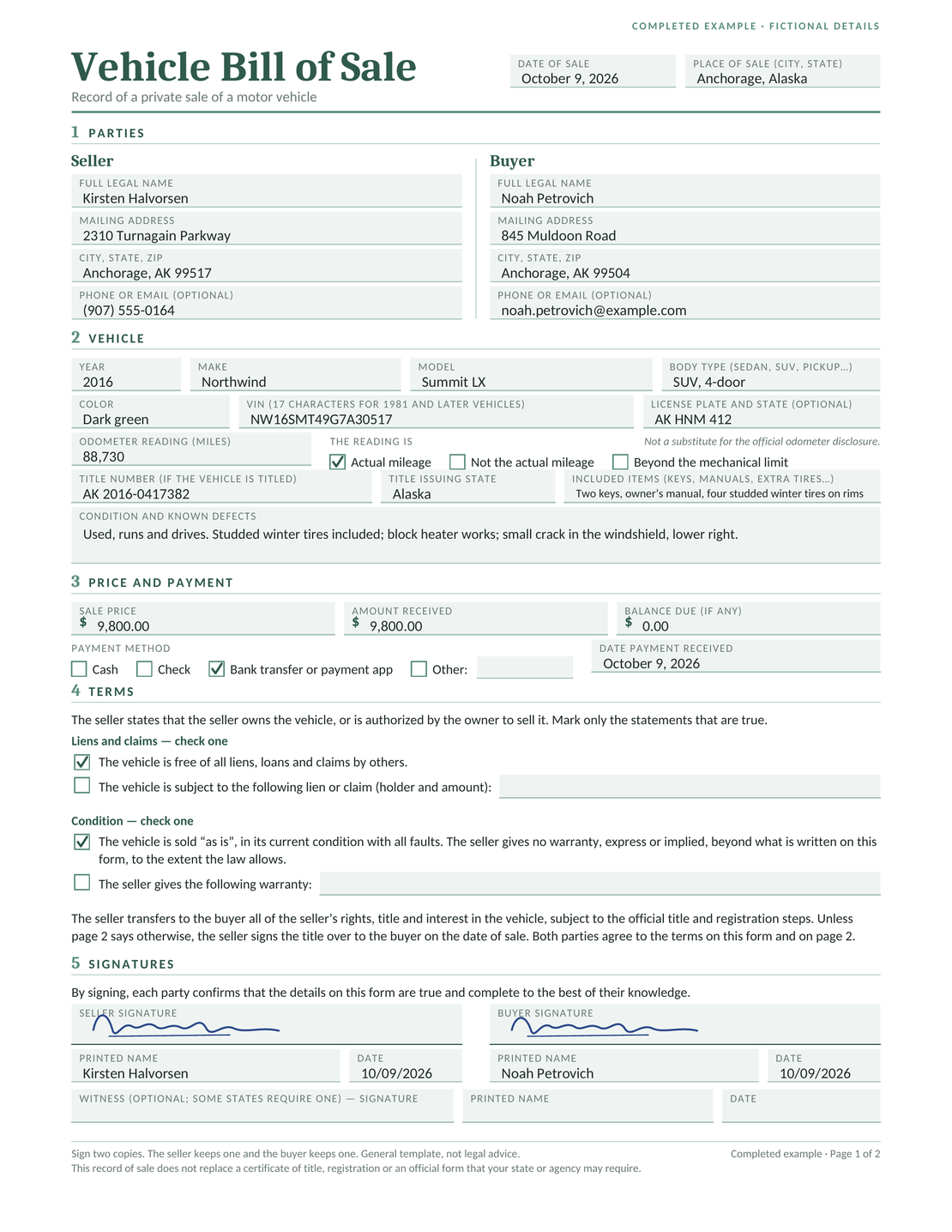
In this fictional Anchorage sale, Kirsten sells Noah a 2016 Summit LX for $9,800. The form records the full amount received and no remaining balance. Its notes describe a working block heater and a small windshield crack, and include four studded winter tires on rims.
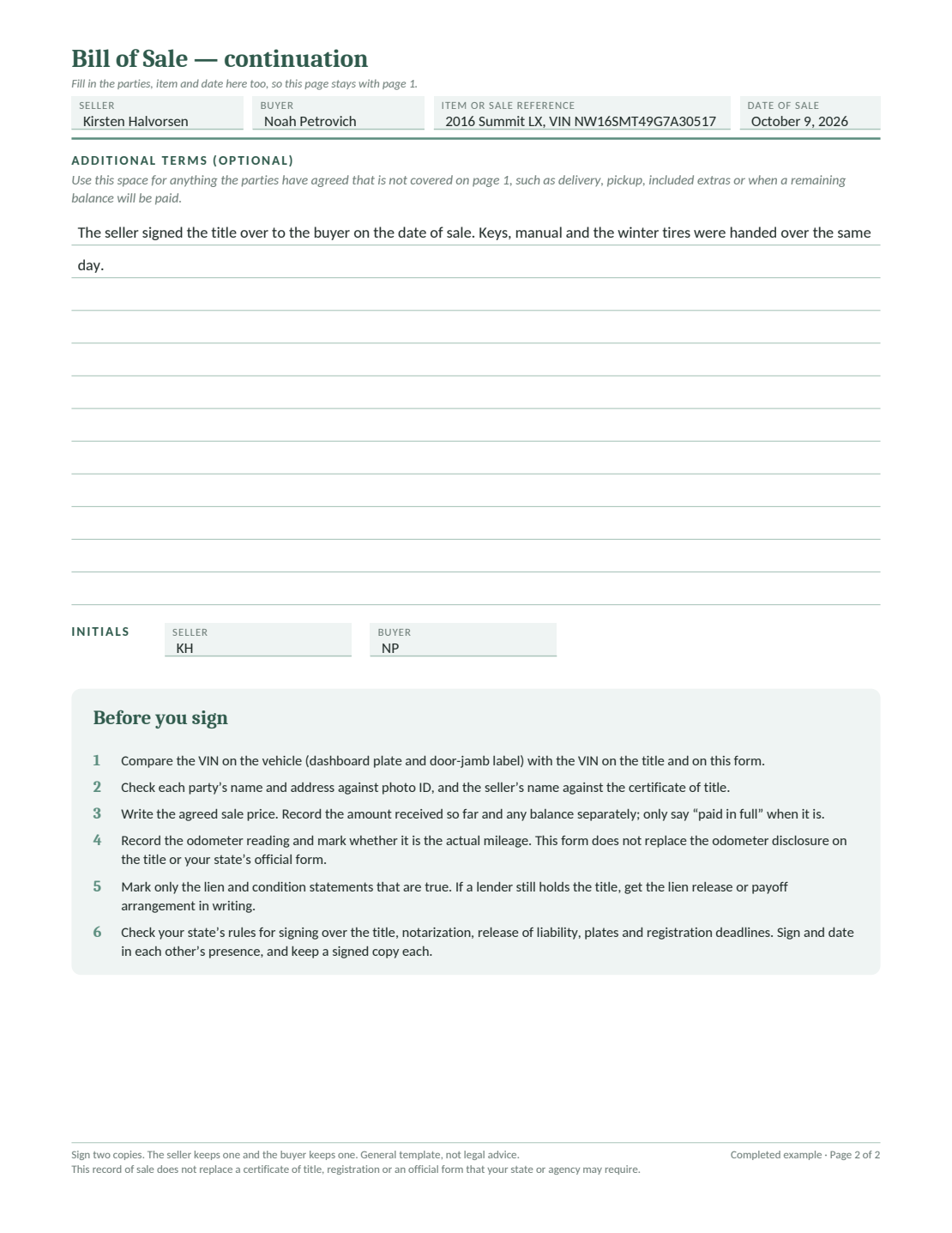
The second page records the title assignment and same-day handover of the keys, manual and winter tires. It does not show a DMV sale-report confirmation or the buyer’s new title. Those agency steps remain separate from the completed example.
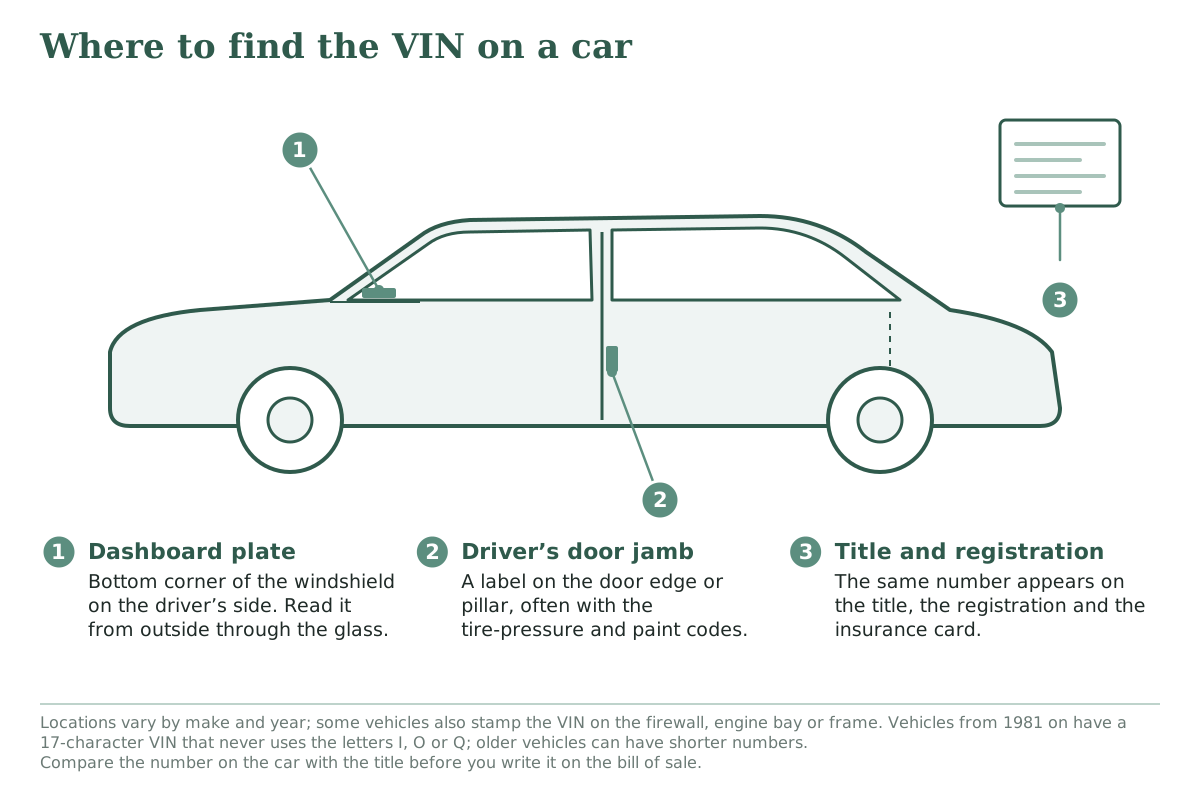
Compare the identifying number on the property with the ownership papers before copying it into your sale record.
Look through the windshield at the driver-side dashboard. Also check the label inside the driver’s door opening. Locations vary, so consult the vehicle’s manual if needed.
Resolve a missing or mismatched number with the agency handling the transfer. Do not guess from an unclear label.
Compare the VIN or HIN on the property with every ownership document.
Check which titled owners must sign the assignment.
Confirm payment received and record any unpaid balance accurately.
List extra tires, motors, equipment and the documents handed over.
Resolve a missing title or lien before relying on a future promise.
The ordinary sale instructions do not call for notarizing the bill of sale. Separate documents, including a homebuilt trailer affidavit or a power of attorney, have their own signing requirements.
Keep the Sale Record with the Transfer Papers
Keep the bill, payment evidence and copies of the assigned ownership papers together. Add the online sale-report confirmation or a copy of the notice sent to DMV.
For a boat application used as temporary registration, keep the application copy with the vessel until the registration arrives or the temporary period ends. For a homebuilt trailer, preserve the supporting construction records after the application is processed.
No. DMV says a bill of sale is not valid for a vehicle ownership transfer. Obtain the assigned title or use the applicable missing-title process.
The current DMV forms list does not include one. DMV recommends a written record with the vehicle description and serial number, both printed names, sale date and both signatures.
Within 30 days of purchase. The assigned ownership papers and V1 application are part of the process.
A boat of 24 feet or less may be titled voluntarily. Boats longer than 24 feet generally need a title unless Coast Guard documented. Registration requirements apply separately.
The 500-pound guidance concerns whether a surety bond may be needed when ownership evidence is missing. It is not a general title exemption. Check the trailer’s papers with DMV.
After 14 days, continue for
$12.99/month
only if you choose to upgrade.
We use cookies to provide you with the best possible experience. Cookies also help us analyze user behaviour so we can continue to improve our website. View our cookie policy.