Trailer Bill of Sale
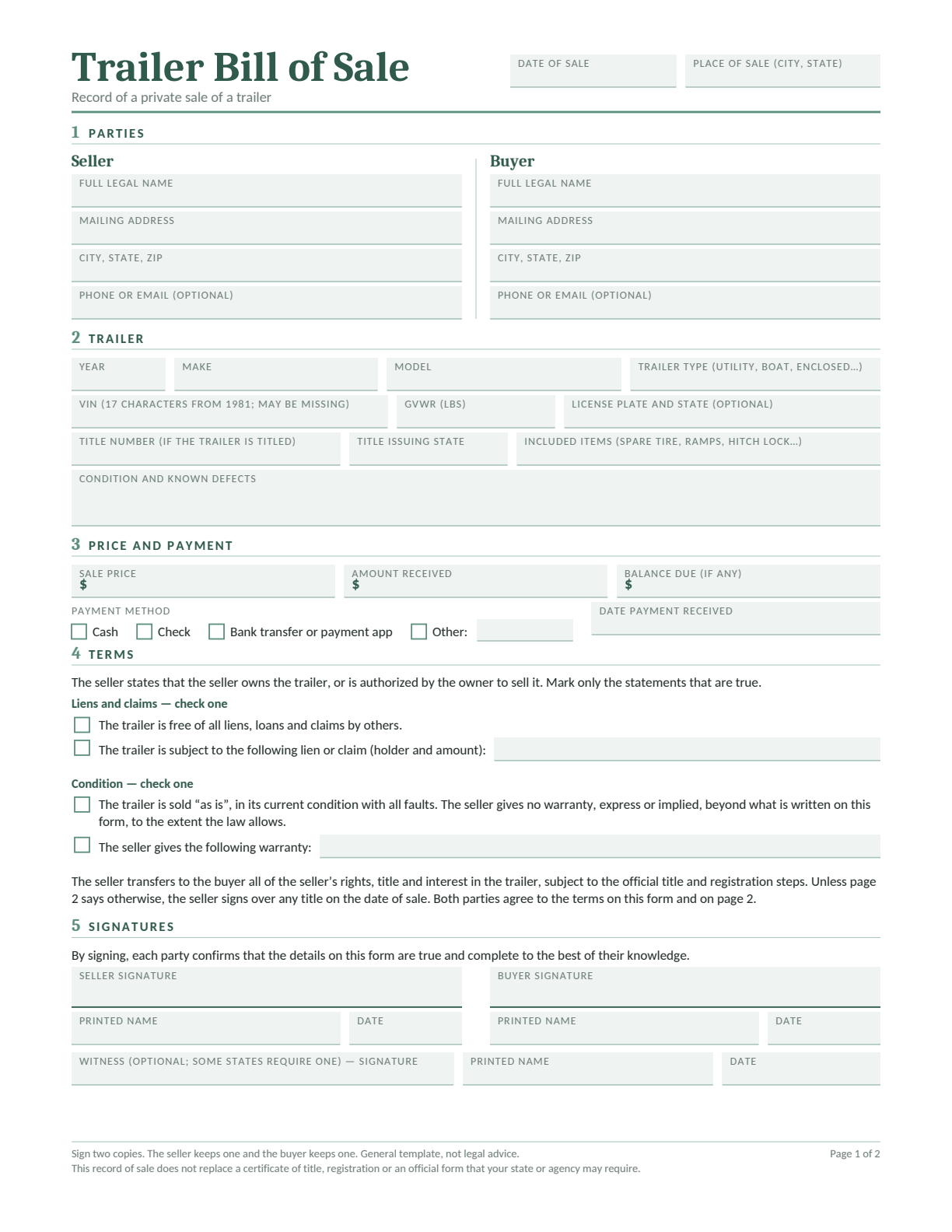
Record the trailer type, VIN, GVWR, condition and payment. Add title and plate details where applicable.
Download a free template for your trailer sale.
Record your trailer sale with the VIN, condition and agreed payment. Use the template for a utility, cargo, boat or horse trailer.
Edit in Word or Google Docs, type into a fillable PDF, or print a blank PDF to fill in by hand.
Document the sale and agreed terms. Give both seller and buyer a signed copy.
The same form covers common trailer types. Add the trailer’s details, included equipment and sale terms, with more space on page 2 if you need it.
Choose Word or Google Docs to edit the wording, a fillable PDF to type into, or a blank PDF to print. In Google Docs, sign in and choose Make a copy to save your own version.
Record the trailer type, VIN, GVWR, condition and payment. Add title and plate details where applicable.
A trailer bill of sale records the seller, buyer, trailer and sale terms. It helps distinguish the trailer from other equipment and shows the agreed price, payment received and any amount still owed.
The trailer’s VIN is especially useful when the sale includes other property. For example, a boat trailer has its own VIN, separate from the boat’s hull identification number.
This is a general template, not legal advice. Trailer title and registration requirements vary by state, trailer type and weight. Check the official instructions; a bill of sale does not replace a required or missing title.
Write the type of trailer and the details that help the buyer identify it: open or enclosed, size, number of axles and intended use. List removable extras such as ramps, a spare tire or a hitch lock.
Use this form for a trailer sold on its own. For a camper, use the RV and camper bill of sale templates. For a boat sold with its trailer, the boat, motor and trailer template records each component separately.
Bring the trailer’s paperwork and check its identification label as you fill in the form.
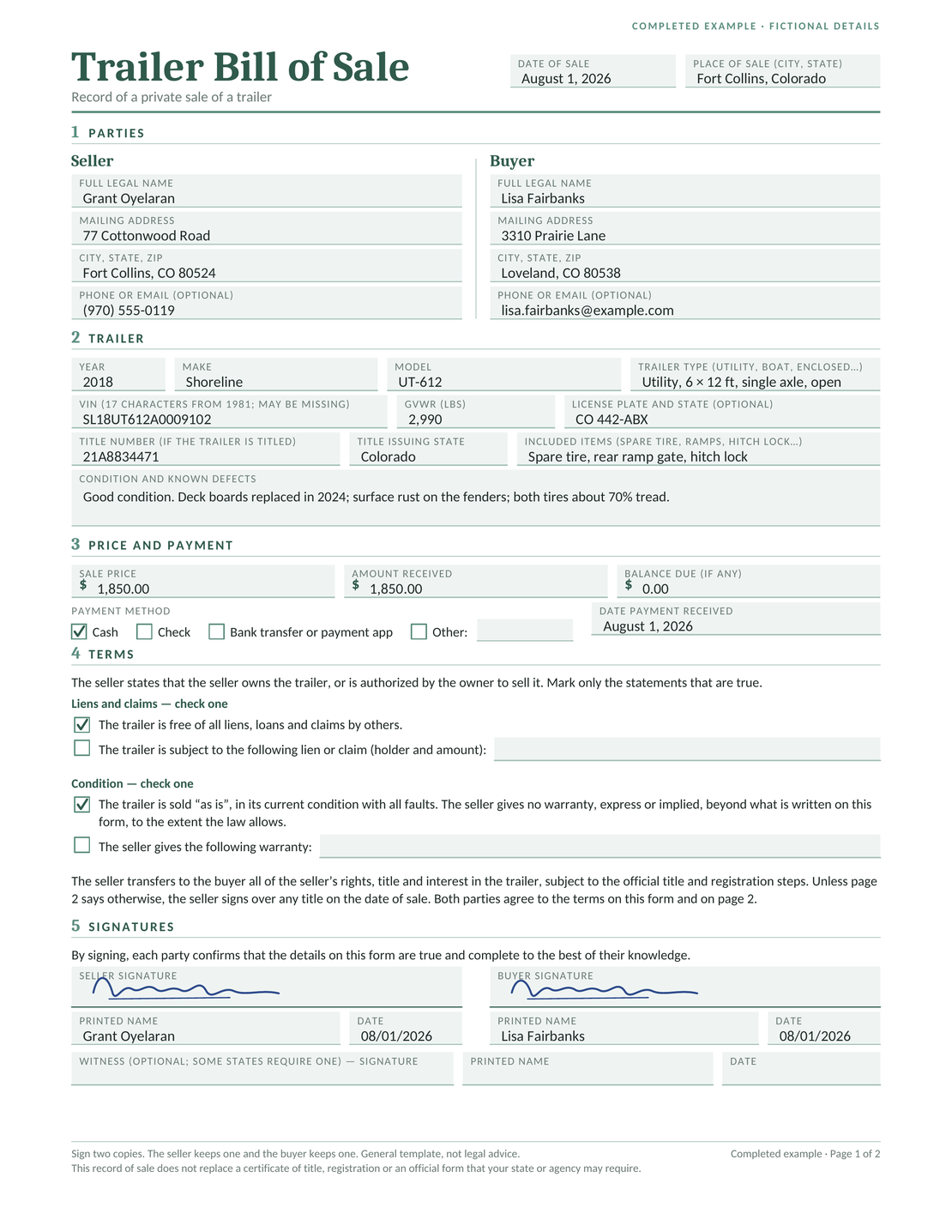
In this fictional example, Grant Oyelaran sells a 2018 Shoreline UT-612 utility trailer to Lisa Fairbanks in Fort Collins, Colorado, on August 1, 2026. The price is $1,850, received in cash that day, with no balance due.
| Detail | What the example records |
|---|---|
| Trailer | 6 × 12 ft, single axle, open utility trailer |
| VIN | SL18UT612A0009102 |
| GVWR | 2,990 lb |
| Title and plate | Colorado title 21A8834471; plate CO 442-ABX |
| Included items | Spare tire, rear ramp gate and hitch lock |
| Condition | Deck boards replaced in 2024; surface rust on fenders; tires about 70% tread |
The form records a free-of-liens, as-is sale. Page 2 notes that the title was assigned and Lisa towed the trailer away that day. The 2,990 lb figure is GVWR; the example does not give an empty weight.
Download the Completed Example (PDF)
The example contains fictional details and specimen signatures. Use the bill of sale examples for guidance, then fill in a blank template with your own sale details.
The VIN, title number and plate number identify different records. Copy each into its own field. If the trailer was not required to have a title, explain that on page 2 after checking the rules that apply.
Do not describe a missing title as “not required” without checking. If the seller’s name, VIN or ownership history does not match the documents, resolve the difference before completing the sale.
Start with the manufacturer’s identification label on the front half of the trailer’s left side. The illustration shows common places to check around the tongue and front frame; the exact position varies by manufacturer and model.
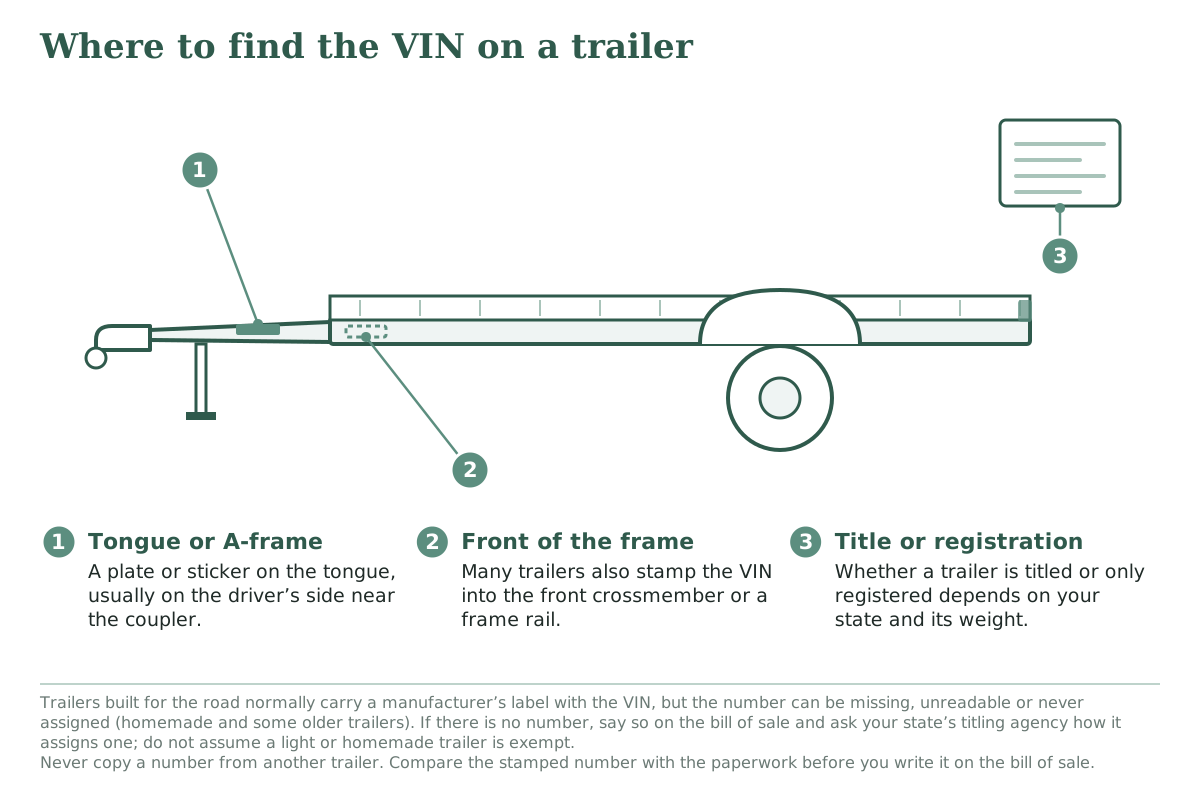
The federal certification-label rule places a trailer’s label on its forward left side and requires it to include the VIN. A stamped number may be elsewhere on the frame; use the manufacturer’s instructions to find it.
Compare the label or stamped number with the title or registration before entering it on the bill of sale. If it is missing, unreadable or does not match, ask the registration office what to do. Never use a number from another trailer.
The template asks for GVWR: the manufacturer’s maximum loaded weight rating. Empty or net weight is the trailer without a load. If your agency asks for empty weight or a weight certificate, obtain that separately.
Use the weight measure named in your state’s instructions. A rule based on empty weight cannot be checked using GVWR alone. The federal vehicle definitions explain gross vehicle weight rating.
Start with a blank template, copy the VIN carefully and record what the buyer is paying for.
Start by finding out which situation applies: a title was lost, the trailer was never titled, or it was legally untitled in the previous state. Those situations can require different evidence.
Ask the responsible office what the seller and buyer must provide. For example, Texas has a replacement title process. A bill of sale alone does not repair an incomplete ownership record.
Keep a signed copy each, including additional terms, with proof of payment. The buyer should complete any required title or registration application. The seller should follow the state’s sale-reporting and plate instructions.
Keep any weight certificate, inspection or assigned-VIN paperwork with the trailer’s records so the next step does not depend on finding it again.
Trailer rules differ by state and by the weight measure used. These examples show why the details matter:
These are state-specific examples. Choose your state and check the current requirements for your trailer. A manufactured trailer with missing paperwork should not be described as homemade to avoid the transfer process.
It depends on the trailer and state. Some transfers also need a title, registration receipt, weight certificate or inspection. Check the registration office’s requirements before relying on the bill of sale alone.
Check the state’s instructions for the bill of sale and any title transfer. The requirements can differ between the two documents. Follow any witness or notary instructions before signing.
Yes, when the trailer is sold on its own. Use the trailer VIN, not the boat’s HIN. For a boat, motor and trailer sold together, the combined boat bill of sale template has separate fields for each component.
Do not create a number yourself. Ask the registration office what evidence, inspection or assigned-number process applies. A homemade trailer and a manufactured trailer with missing records may need different steps.
Record the full price, amount received and balance separately. Add the due date and agreed collection terms on page 2. Only write “paid in full” when the full payment has been received.
Give the seller and buyer a clear record of the trailer, included equipment and payment.
Create free business documents like invoices, estimates, quotes and receipts from these blank, printable and downloadable templates

Create and send unlimited documents. Every feature is included.
Create and send unlimited documents.
Every feature is included.
No credit card required.
After 14 days, continue for $12.99/month only if you choose to upgrade.