Motorhome Bill of Sale
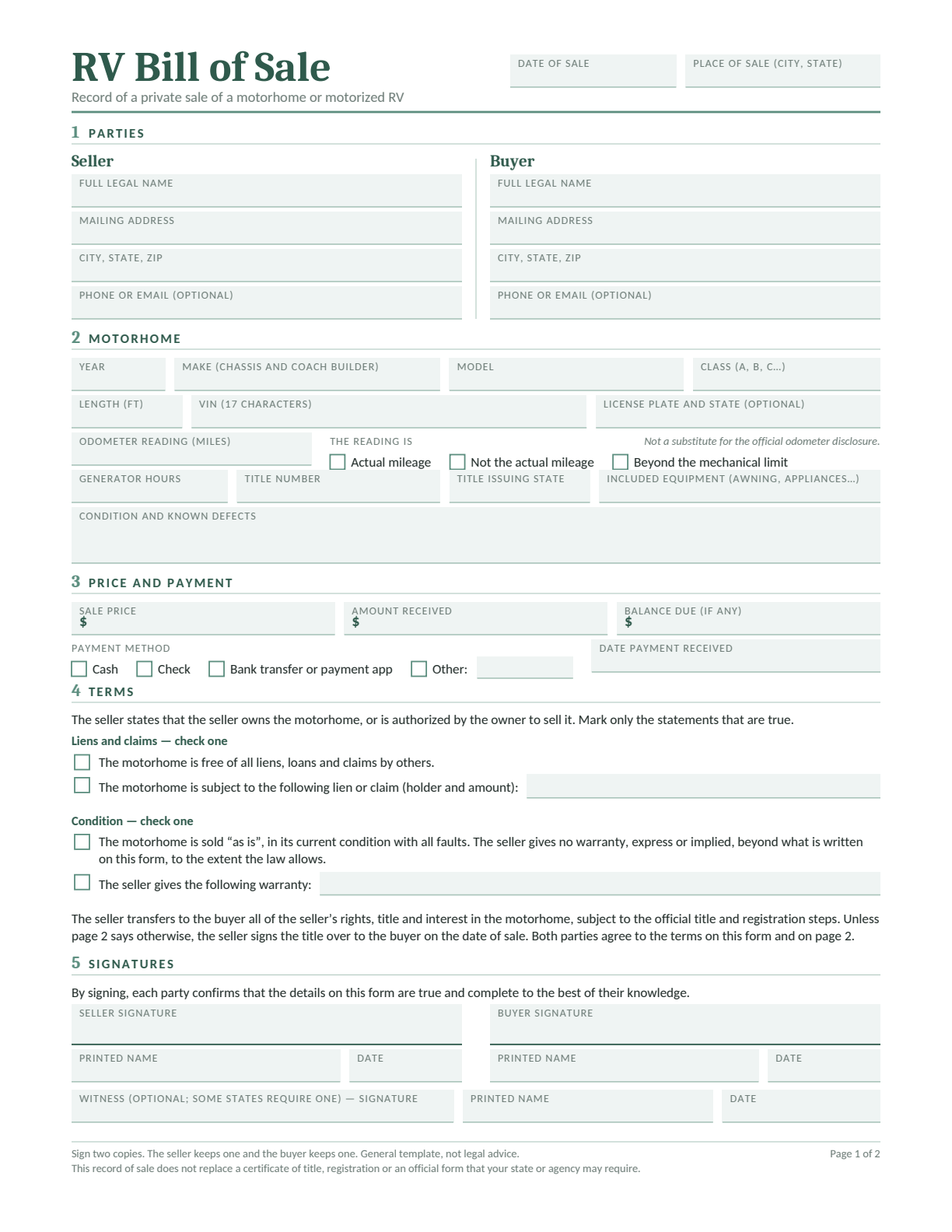
For an RV with its own engine. Record the chassis and coach, VIN, odometer reading, generator hours and included equipment.
Download a free template for your RV or camper.
Choose a free bill of sale for a motorhome or camper. Record the vehicle, equipment and payment so the seller and buyer know what the sale includes.
Edit in Word or Google Docs, use the fillable PDF, or print a blank copy.
Document the sale and agreed terms. Give both seller and buyer a signed copy.
Choose a Word or Google Docs template to edit, a fillable PDF to type into, or a blank PDF to print. For Google Docs, sign in and choose Make a copy to save your own version.
For an RV with its own engine. Record the chassis and coach, VIN, odometer reading, generator hours and included equipment.
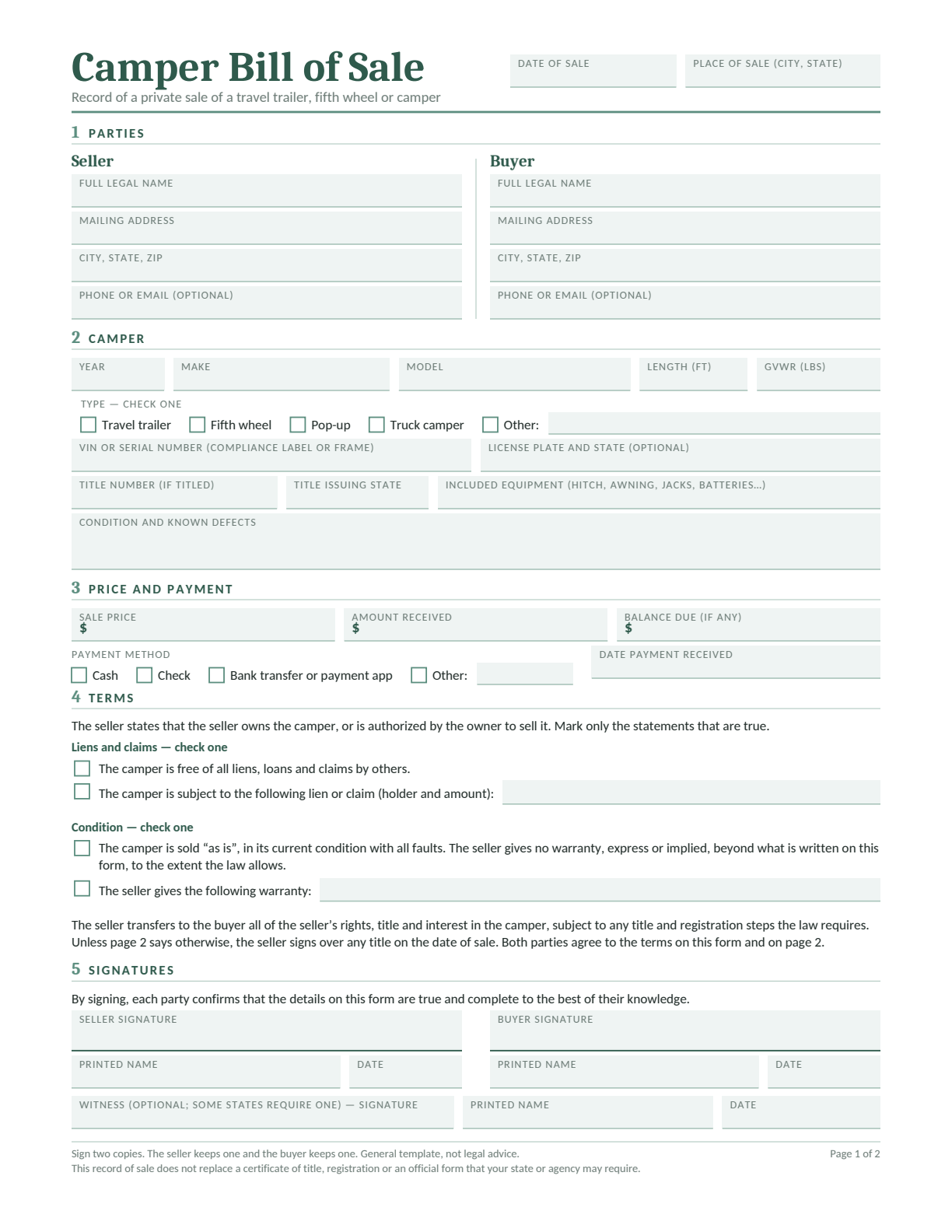
For a travel trailer, fifth wheel, pop-up or truck camper. Record its VIN or serial number, size, weight rating and included equipment.
These are general templates, not legal advice. Follow the official forms and transfer instructions for your sale. See our Terms and Conditions.
An RV bill of sale records the vehicle, seller, buyer and agreed sale terms. It also helps make clear which appliances, accessories and equipment go with the RV.
Keep the bill of sale with the title and transfer papers. It records the sale details, but it does not replace a required title transfer. See how a bill of sale differs from a title.
Use the motorhome template when the RV has its own engine, such as a Class A, B or C motorhome. Use the camper template for a towable camper or a removable truck camper.
For a camper, record the camper’s own VIN or serial number. Do not use the tow vehicle’s VIN or mileage. A cargo or utility trailer belongs on the trailer bill of sale template.
Check the agency’s classification if you are selling a conversion, truck camper or park model. For example, Oregon DMV lists campers and motorhomes separately. A manufactured home sold as personal property uses the mobile home bill of sale template.
| Detail | What to Record |
|---|---|
| Seller, buyer and sale | Full legal names, addresses, sale date and location. |
| Vehicle identity | Year, make, model, type, VIN or serial number, and title or registration details. For a motorhome, identify the chassis and coach where shown. |
| Size and readings | Length; weight rating where the camper template asks for it; motorhome mileage and generator hours in separate fields. |
| Equipment and condition | Included appliances, hitch, awning, jacks, batteries, cables and keys. Describe known damage or faults. |
| Payment | Sale price, amount received, payment date and method, and any balance and due date. |
| Terms and signatures | Ownership and lien statements, condition terms, any extra agreement and dated signatures. |
Copy the gross vehicle weight rating (GVWR) from the manufacturer’s label. It is the rated maximum loaded weight, not the empty weight or a guess based on the RV’s size.
Check the identification or certification label on the RV, then compare its number with the title. The label’s position depends on the manufacturer and RV type.
Look in the driver’s door or seat area, using your manual to find the exact position. Winnebago lists the driver’s door, adjacent wall or door pillar as certification-label locations. Its label guide distinguishes the chassis VIN from Winnebago’s separate coach serial number. Copy the chassis VIN into the VIN field.
For a travel trailer or fifth wheel, check the manufacturer’s label on the camper. Jayco places VIN weight stickers inside the entrance door and on the exterior roadside wall. Other makes can use different locations; check the owner’s manual. For a truck camper, check its own identification label. For example, Lance’s serial-number guidance points to a data plate inside the unit near the entry door. Copy the full VIN or serial number provided for your camper.
Use the camper’s number, not the towing vehicle’s VIN. Keep any separate coach serial number with the other vehicle details, and resolve a mismatch with the ownership records before signing.
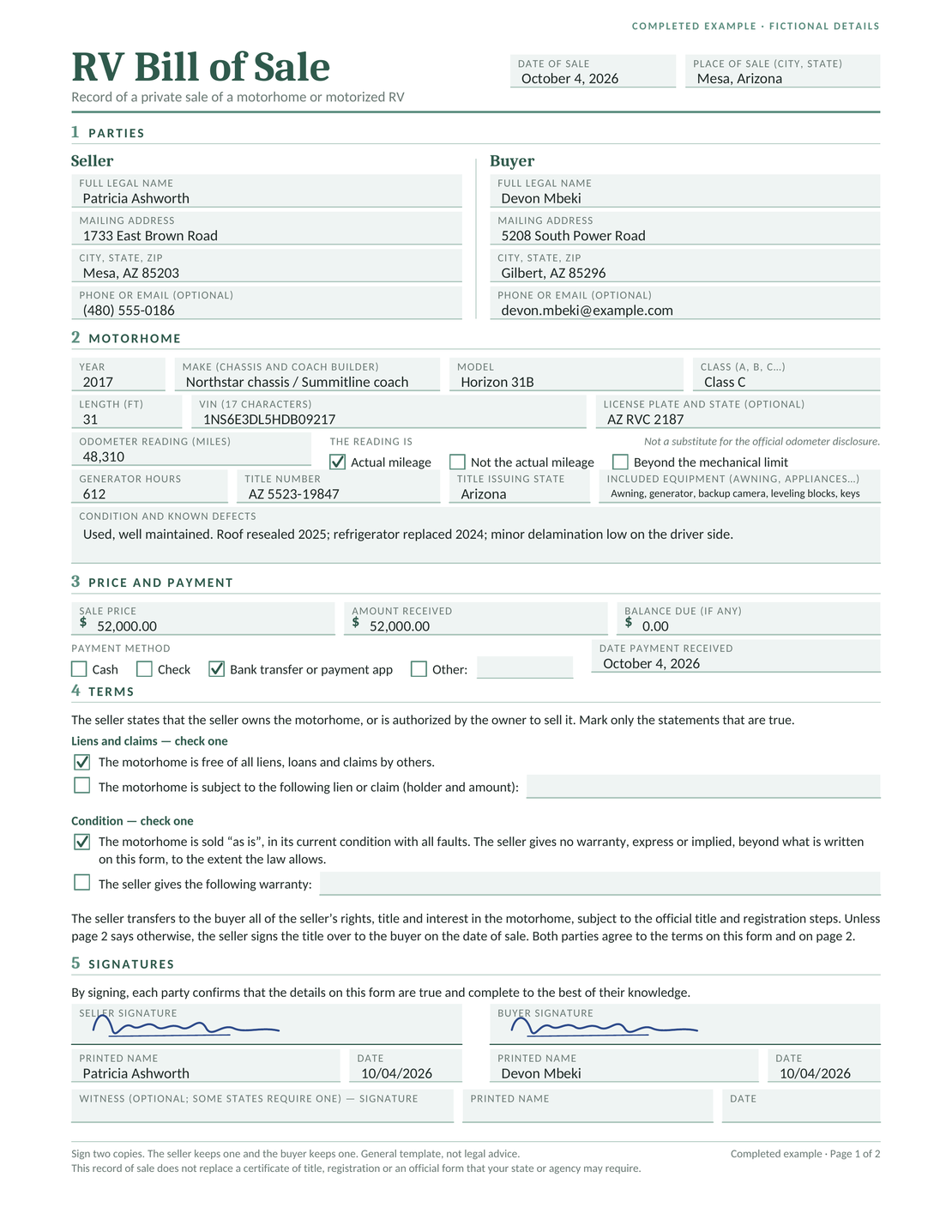
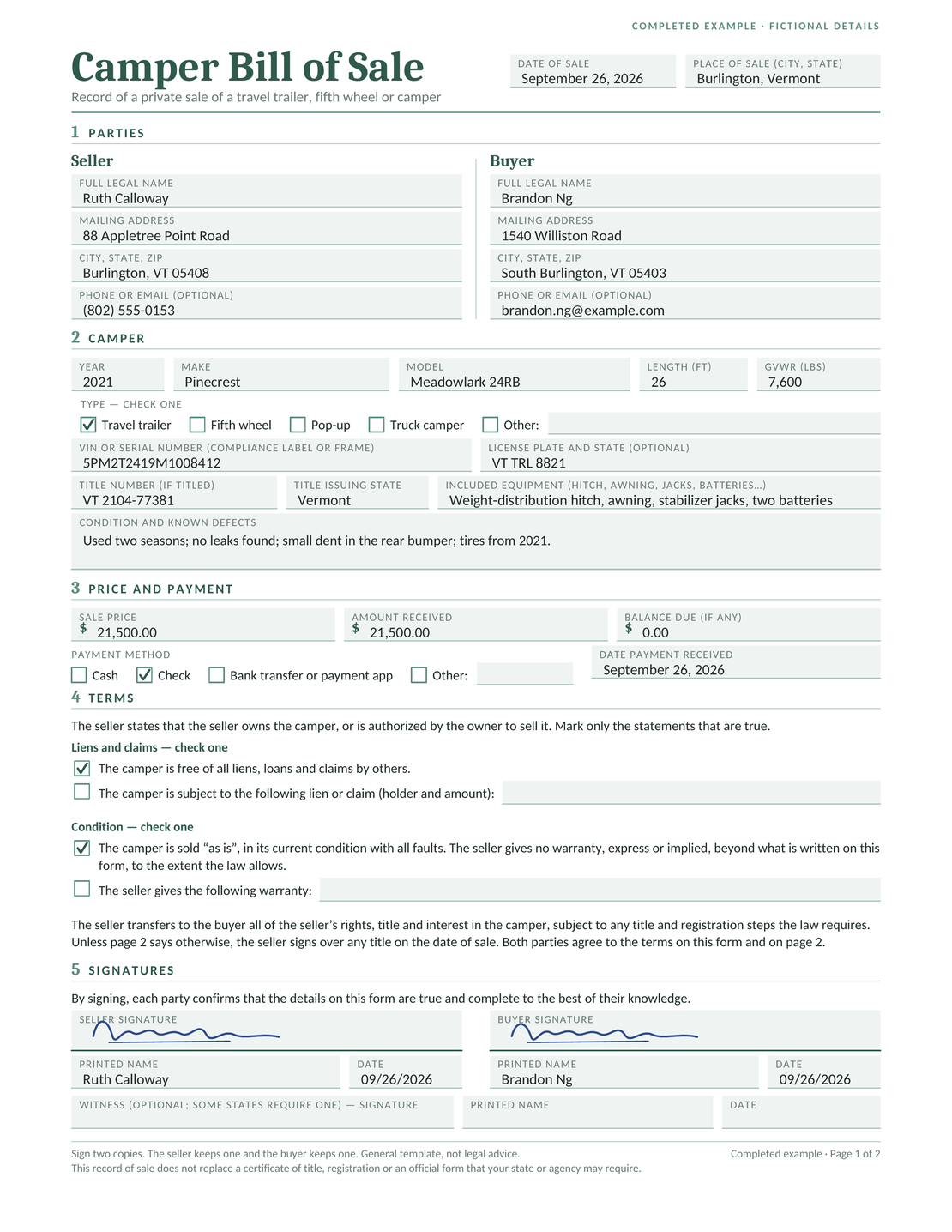
Use the ownership papers and the identifying number on the RV. The illustration shows the motorhome template; the camper template follows the same five sections.
List the appliances and accessories the buyer is getting, including loose items such as leveling blocks, a hitch, power cables and spare keys. Name anything the seller will remove.
Record known leaks, water damage, worn tires or equipment faults. An appliance being included does not mean it has been tested or promised to work.
During the inspection, check the roof, windows, floors, plumbing, appliances and slide-outs. Put any promised repair in writing, including who will do it and by when.
In this fictional sale, Patricia Ashworth sells a 2017 Summitline Horizon 31B Class C motorhome to Devon Mbeki in Mesa, Arizona, on October 4, 2026.
| Detail | Fictional Example |
|---|---|
| Vehicle | 31-foot motorhome; Northstar chassis and Summitline coach; VIN 1NS6E3DL5HDB09217. |
| Readings | 48,310 actual miles on the odometer; 612 generator hours. |
| Title and plate | Arizona title AZ5523-19847; plate AZ RVC2187. |
| Included equipment | Awning, generator, backup camera, leveling blocks and keys. |
| Disclosed condition | Roof resealed in 2025; refrigerator replaced in 2024; minor delamination on the lower driver’s side. |
| Payment | $52,000 sale price; $52,000 received by bank transfer on October 4, 2026; $0 balance. |
| Terms and paperwork | Lien-free and as-is statements selected. The title and its odometer disclosure are completed on the sale date; service records go with the keys. |
For a towable example, Ruth Calloway sells a 2021 Pinecrest Meadowlark 24RB travel trailer to Brandon Ng for $21,500, paid in full by check. It records the camper’s own identifying number and equipment, with no motorhome odometer reading.
Choose the motorhome or camper template. Add the equipment, condition and payment details so the written record matches your agreement.
The motorhome’s odometer records distance traveled. A generator’s hour meter records running time. Enter each in its own field and label the units; generator hours cannot stand in for mileage.
Federal odometer disclosure exemptions include vehicles that are not self-propelled and vehicles with a GVWR of more than 16,000 pounds. A rating of exactly 16,000 pounds does not meet that weight exemption. Age exemptions use 10 years for model year 2010 and older, and 20 years for model year 2011 and newer, counted from January 1 of the model year. See 49 CFR 580.17.
When disclosure is required, use the title or official disclosure process. A reading on this template does not replace it. Check the federal disclosure rule and your state’s instructions.
Check the process in the state where the buyer will title or register the RV. For an out-of-state sale, check the seller’s transfer and reporting duties too. Choose your state below to find templates and official sources.
As one example, Oregon DMV’s title instructions list the application, ownership documents and other items needed for a transfer. Follow the requirements for your vehicle and state, including any tax, inspection or odometer forms.
The seller and buyer should each keep the full signed bill of sale, including page two. Store it with proof of payment, any lien release, inspection information and transfer records.
Complete any required seller notice and buyer title application. Arrange the plates or permits, insurance and transport that apply before using the RV.
Use the official sources for the vehicle’s classification, title and required disclosures:
Use the camper template for a travel trailer, fifth wheel, pop-up or truck camper. Use the motorhome template when the RV has its own engine. Check the agency’s classification for conversions or unusual vehicles.
No. If the vehicle needs a title, follow the title-transfer process as well. If the title is missing or held by a lender, resolve the paperwork with the relevant agency or lender before relying on the bill of sale.
No. Use the odometer field for the motorhome’s distance reading and the generator field for its running hours. Keep the readings and units separate.
Check your state’s instructions for the bill of sale, title and other transfer forms. Their signing requirements can differ.
Yes. List what is included and what will be removed. Describe known faults and say when an appliance has not been tested. Put any separate warranty or repair promise in writing.
Start with the document that fits the vehicle you are selling.
Create free business documents like invoices, estimates, quotes and receipts from these blank, printable and downloadable templates

Create and send unlimited documents. Every feature is included.
Create and send unlimited documents.
Every feature is included.
No credit card required.
After 14 days, continue for $12.99/month only if you choose to upgrade.