Bill of Sale vs. Title
Know which paperwork your vehicle sale needs.
A bill of sale records the transaction between seller and buyer. A vehicle title identifies the recorded owner. You may need both to complete the transfer.
Compare their roles, see a completed example and find the official next steps if a title is missing.
Document the sale and agreed terms. Give both seller and buyer a signed copy.
What Is the Difference Between a Bill of Sale and a Title?
A bill of sale explains the deal: who sold the vehicle, who bought it, the price and the agreed terms. A title is the state-issued ownership document. Signing the bill of sale does not complete the state’s title-transfer process.
| Question | Bill of Sale | Vehicle Title |
|---|---|---|
| What does it record? | The seller, buyer, vehicle, sale date, price and terms. Payment details show what the seller received. | The recorded owner, vehicle details and any listed lienholder. It may also show a title brand, such as salvage. |
| Who prepares it? | The seller or buyer fills it in. Use an official form if the state requires one. | The state titling agency issues it, either on paper or electronically. |
| What happens at the sale? | Seller and buyer check the details, follow the signing requirements and keep copies. | The required parties complete the transfer paperwork. The buyer applies for a title in their name. |
| Does it replace the other document? | It does not replace a required title or missing-title procedure. | It does not necessarily replace a required bill of sale or a separate payment record. |
Registration generally allows the vehicle to be used on public roads, subject to insurance and other requirements. Some states also use a particular type of registration as ownership evidence for vehicles they do not title. For example, New York distinguishes a transferable registration from an ordinary registration document.
Can You Get a Title With a Bill of Sale?
A bill of sale can support a title application, but it does not automatically replace a missing title. The agency needs acceptable evidence of ownership as well as a record of the sale. What it accepts depends on the vehicle, its history and the state.
For example, New York DMV requires proof of sale and the appropriate ownership document. For a titled car, that usually means the properly transferred title as well as the bill of sale.
If the seller cannot provide the title, find out why before paying. The missing-title situations below explain the main routes to check.
One Sale, Two Different Records
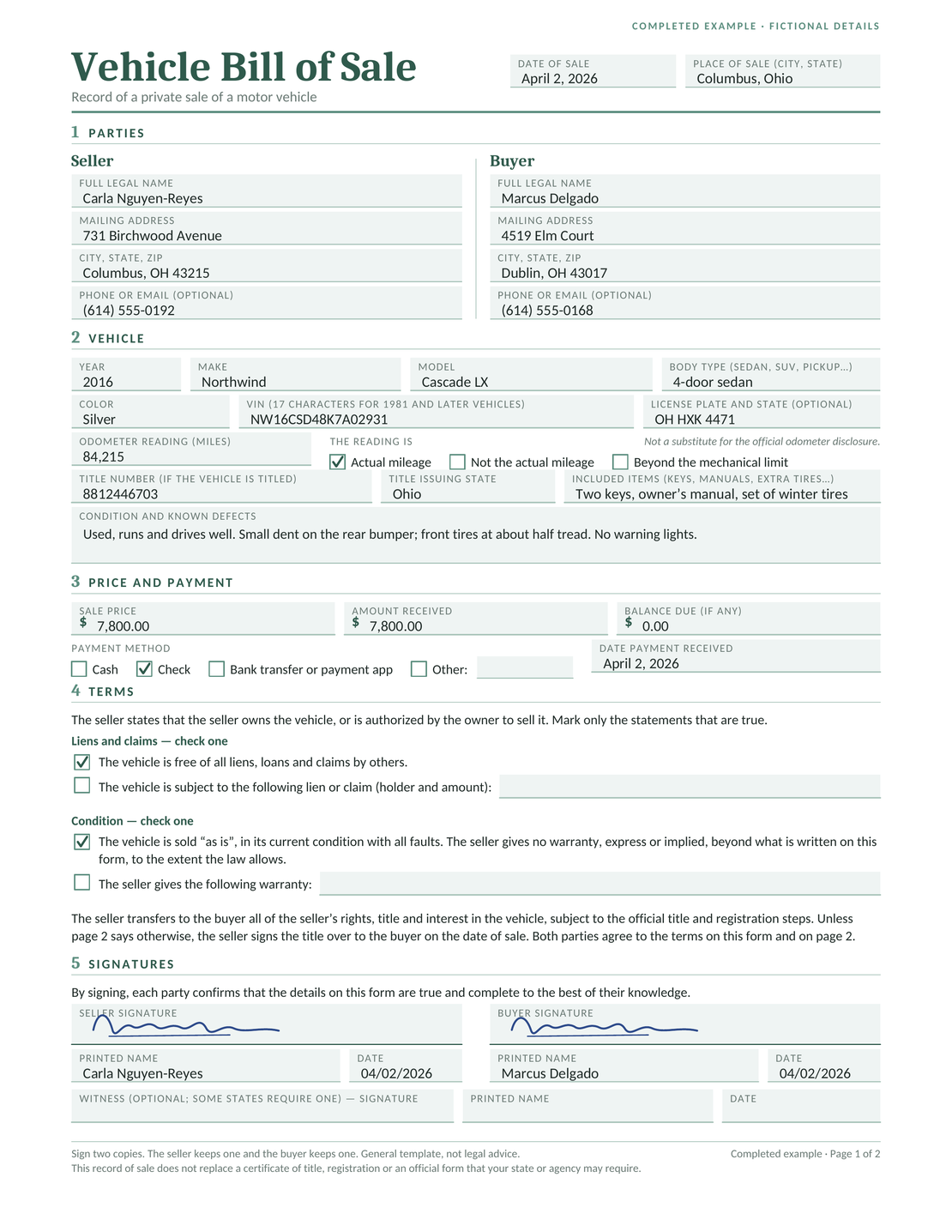
Carla Nguyen-Reyes sells Marcus Delgado a silver 2016 Northwind Cascade LX sedan for $7,800 in Columbus, Ohio. The example records the sale on April 2, 2026, with $7,800 received by check and no balance due.
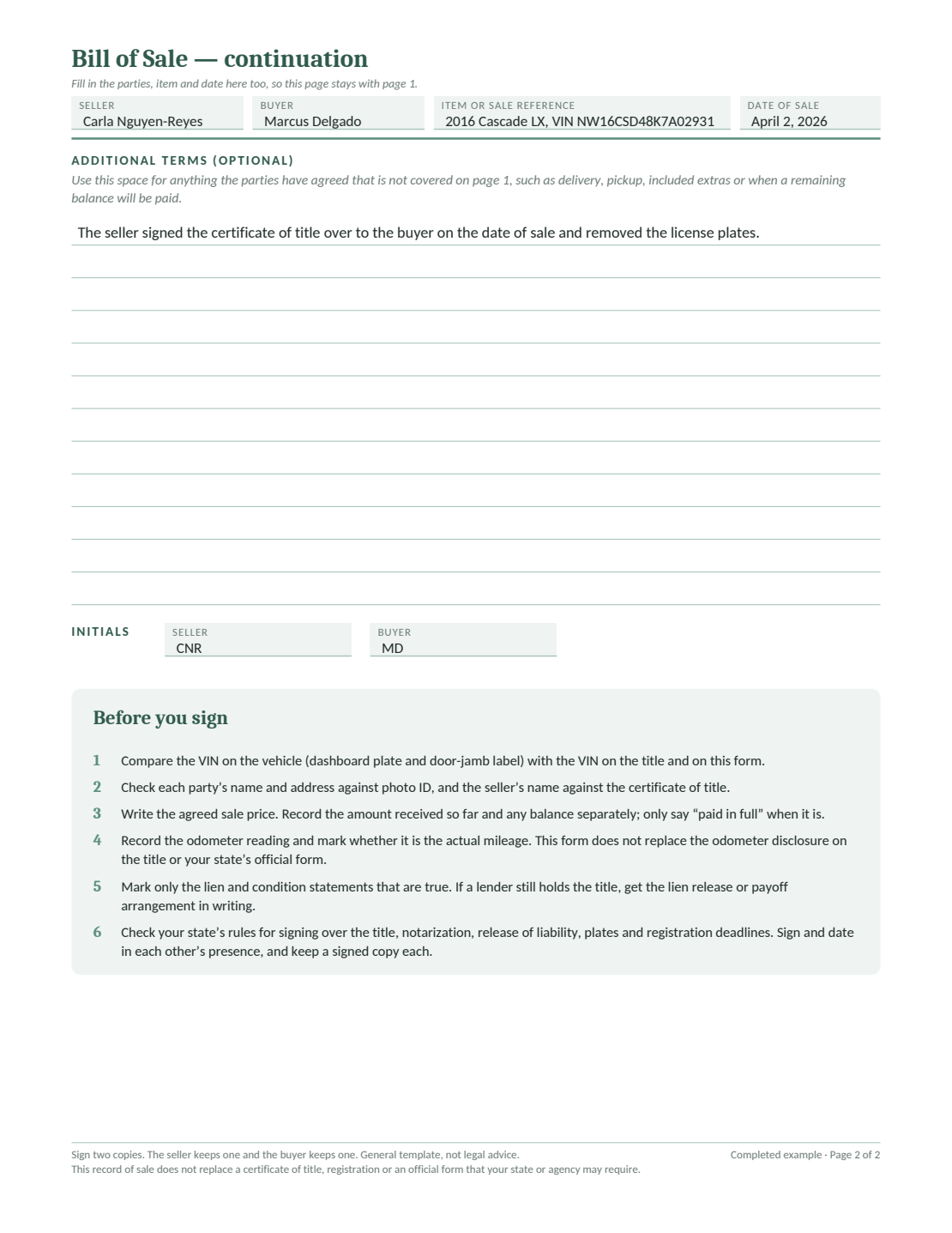
The bill of sale identifies the car and records the price, payment and as-is terms. Page 2 notes that Carla signed the title over to Marcus, a separate step from signing the bill of sale. Marcus still needs to complete the buyer’s title application. The payment entry confirms what Carla received; it does not show that a new title has been issued.
About This Example
The names, vehicle details and signatures are fictional. The checked lien and condition statements describe this example only. Use statements that are true for your sale. This guide is general information, not legal advice. Follow the official forms and instructions and see our Terms and Conditions.
Page 1: Sale Details
Page 2: Additional Terms
What to Do When the Title Is Missing
Start with the reason the title is missing. A lost certificate needs a different solution from a vehicle with incomplete ownership records. These state examples show the difference; use the state chooser to find the instructions for your own sale.
The Recorded Owner Lost the Title
Ask the seller to follow the issuing state’s replacement process. In Texas, the recorded owner or lienholder, or an authorized agent, can request a certified copy. Buying the vehicle does not automatically authorize you to request the seller’s replacement title.
See TxDMV’s replacement-title instructions and Form VTR-34 (PDF). If a lender is still listed, follow the lien-release requirements too.
The State Offers a Replacement-and-Transfer Form
California may allow a missing California title to be replaced as part of the transfer using Form REG 227 (PDF). This does not remove the other transfer requirements.
The form cannot release a lien held through California’s Electronic Lien and Title system. Special rules also apply to newer vehicles with a lienholder outside that system. Check the REG 227 restrictions before using it.
If the registration says “Nontransferable/No California Title Issued,” follow the California title-transfer instructions instead. Obtain the title from the state where the vehicle was last titled. If that state cannot issue one, get documentation of this and contact California DMV.
The Ownership Records Are Incomplete
Ask the agency whether a bonded-title process applies. This involves an ownership review and, if the application can proceed, a surety bond. A bill of sale may be part of the evidence, but it does not guarantee approval.
Texas has rules for the applicant, vehicle and any recorded liens. Follow TxDMV’s bonded-title steps and Form VTR-130-SOF (PDF). Ask the agency to review the situation before buying a bond.
The Vehicle Does Not Require a Title
Some vehicles use another accepted ownership document. For example, New York does not issue titles for model-year 1972 or older cars, trucks and motorcycles. A New York transferable registration can be signed over with a bill of sale; acceptable out-of-state ownership evidence may also be used.
Check New York’s accepted ownership documents for the vehicle category. A title exemption still leaves paperwork to complete.
Does a Trailer Need a Title Too?
Check the trailer separately. Its type, gross weight and existing title record can change the paperwork needed. A car’s title rules do not automatically apply to a trailer.
For example, Texas requires a title for non-farm manufactured trailers with a gross weight over 4,000 pounds. Gross weight includes the trailer’s own weight plus its carrying capacity. For used non-farm manufactured trailers at or below 4,000 pounds, TxDMV lists a bill of sale and registration receipt, or a title if one was issued.
Farm trailers have separate rules. A manufactured trailer with missing paperwork cannot simply be registered as an assembled trailer. Check the official Texas trailer instructions and choose a trailer bill of sale template. If a boat and motor are included, check their ownership documents separately too.
What to Check Before You Sign or Pay
Check the vehicle and its paperwork together while the seller can answer questions and correct missing details.
- VIN: Match the number on the vehicle to the title and bill of sale. A mismatch needs to be resolved before the transfer.
- Seller: Match the seller’s identity to the recorded owner, or check their authority to sell for that owner.
- Liens: Find out whether a lender or other lienholder must release an interest in the vehicle.
- Title brands: Check entries such as salvage or nonrepairable. Ask the agency how the brand affects titling, registration and road use.
- Transfer forms: Confirm the required signatures, odometer disclosure and any witness or notary requirements.
For an out-of-state purchase, ask the agency where you will title and register the vehicle whether it accepts the seller’s documents. If the seller never transferred the title into their own name, ask how that gap must be resolved. Do not leave the buyer’s name blank to pass a signed title along.
What to Do After the Sale
Keep copies of the signed bill of sale, payment evidence and transfer paperwork. The seller should complete any required sale or transfer notice. The buyer should submit the title application and supporting documents within the state’s deadline.
Check insurance, registration, plates and any temporary permit before driving the vehicle away. A signed bill of sale does not itself give permission to drive.
Already Paid and Only Have a Bill of Sale?
Keep the bill of sale and contact the seller for the missing ownership document. Give the titling agency the VIN and the records you have. Ask which replacement, bonded-title or other official process applies before paying for more paperwork.
Official Forms and Instructions
Choose your state to find its official forms and transfer instructions. The Texas, California and New York examples above describe those states’ rules.
- Alabama
- Alaska
- Arizona
- Arkansas
- California
- Colorado
- Connecticut
- Delaware
- Florida
- Georgia
- Hawaii
- Idaho
- Illinois
- Indiana
- Iowa
- Kansas
- Kentucky
- Louisiana
- Maine
- Maryland
- Massachusetts
- Michigan
- Minnesota
- Mississippi
- Missouri
- Montana
- Nebraska
- Nevada
- New Hampshire
- New Jersey
- New Mexico
- New York
- North Carolina
- North Dakota
- Ohio
- Oklahoma
- Oregon
- Pennsylvania
- Rhode Island
- South Carolina
- South Dakota
- Tennessee
- Texas
- Utah
- Vermont
- Virginia
- Washington
- West Virginia
- Wisconsin
- Wyoming
- New York DMV: Buy, Sell or Transfer Vehicle Ownership — Proof of sale and ownership documents.
- New York DMV: Certificate of Title — Titles, registration and vehicles that are not titled.
- New York DMV: Acceptable Proofs of Ownership — Accepted documents for different vehicle categories.
- TxDMV: Get a Copy of Your Title — Who can apply for a replacement and how.
- TxDMV: Bought a Vehicle With No Title? — Bonded-title eligibility and the application process.
- California DMV: Title Transfers and Changes — Replacement-and-transfer steps and required documents.
- TxDMV: Trailers — Title and registration rules by trailer type.
Sources reviewed .
Bill of Sale and Title Questions
Check with the registration agency before relying on it alone. You may need a signed title, an accepted alternative ownership document or completion of a missing-title process. The vehicle must also meet the other registration requirements.
Your state may require both. New York’s private-sale instructions, for example, call for proof of sale as well as acceptable ownership evidence. A bill of sale also records the price, payment and agreed terms, which may not all appear on the title.
The issuing state decides who can apply. In Texas, the recorded owner or lienholder, or an authorized agent, can request a certified copy. A bill of sale alone does not give the buyer that authority. Some states offer a combined replacement-and-transfer process.
No. A replacement provides another title document when the existing one is lost or damaged. A bonded-title process addresses missing or incomplete ownership evidence through agency review and a required surety bond. Eligibility and procedures vary by state.
Document Your Car Sale
Choose a free car bill of sale template and prepare a record for seller and buyer to keep.
- Identify the people and vehicle.
- Record the agreed terms and payment received.
- Review, sign and keep a copy each.