What Is a Bill of Sale?
Understand the document before you sign.
A bill of sale documents a sale between a seller and buyer. It identifies what was sold, the date, the agreed price and the terms.
See a completed example, understand the main fields and choose a free template for your own sale.
Document the sale and agreed terms. Give both seller and buyer a signed copy.
Why Use a Bill of Sale?
A bill of sale gives seller and buyer a written record of their transaction. It shows who sold the property, who bought it and what they agreed. Details such as a serial number, included accessories and known defects help identify exactly what changed hands.
The payment entry has a separate job: it records how much the seller received and whether anything is still owed. A price of $650 tells you what the buyer agreed to pay. A dated entry showing $650 received in cash confirms that the seller received that payment.
Is a Bill of Sale a Contract?
It can be. A bill of sale can set out the agreement between seller and buyer, including the property, price, condition and other terms they accept. It can also provide evidence of that agreement later.
The document’s contents and the applicable law determine its legal effect. Calling a document a bill of sale, or adding signatures, does not make every term enforceable. The Florida Bar’s contract guide explains the basic requirements for an enforceable agreement.
What Does a Bill of Sale Look Like?
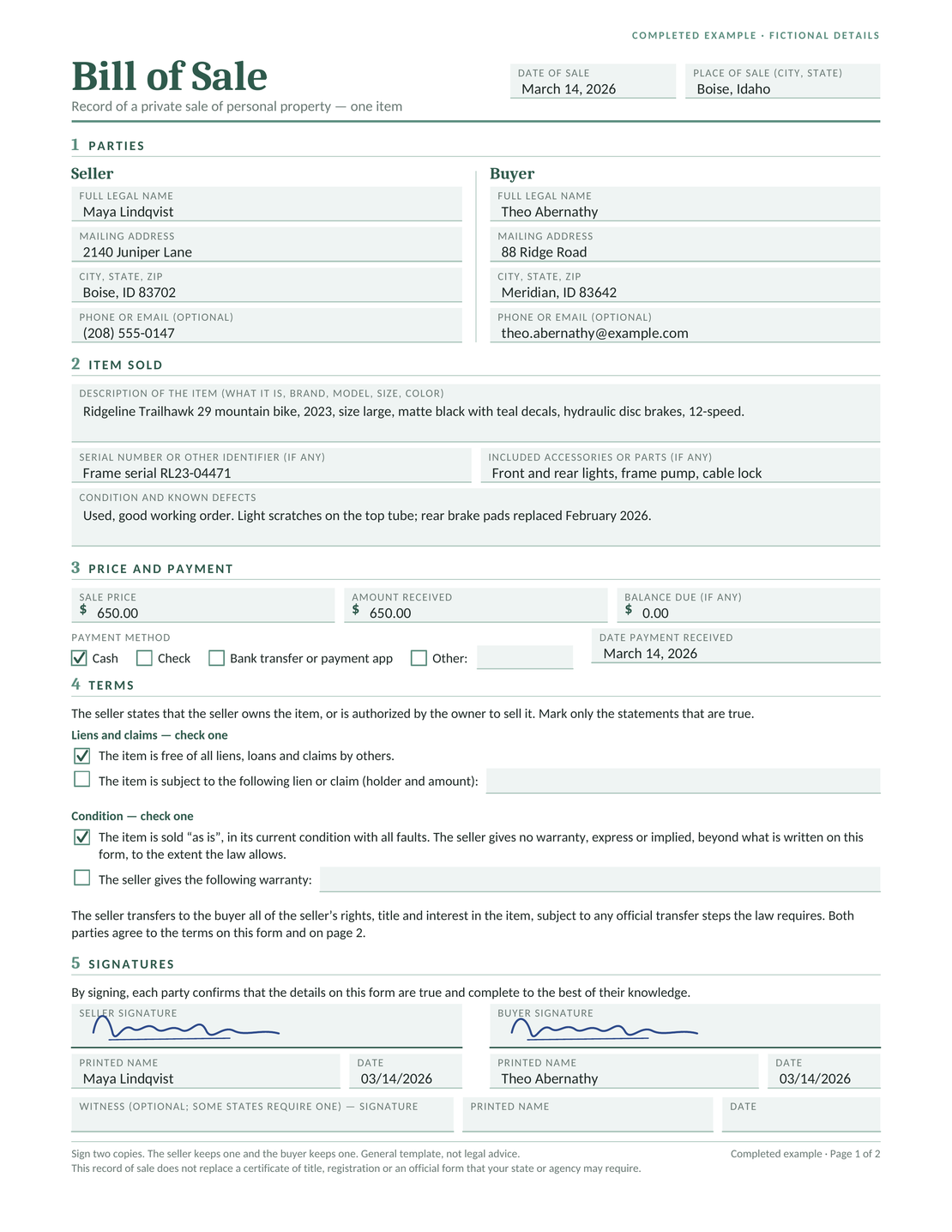
In this fictional example, Maya Lindqvist sells Theo Abernathy a used 2023 Ridgeline Trailhawk mountain bike for $650 in Boise, Idaho, on March 14, 2026. The form records the frame serial number, included lights, pump and lock, and scratches on the top tube.
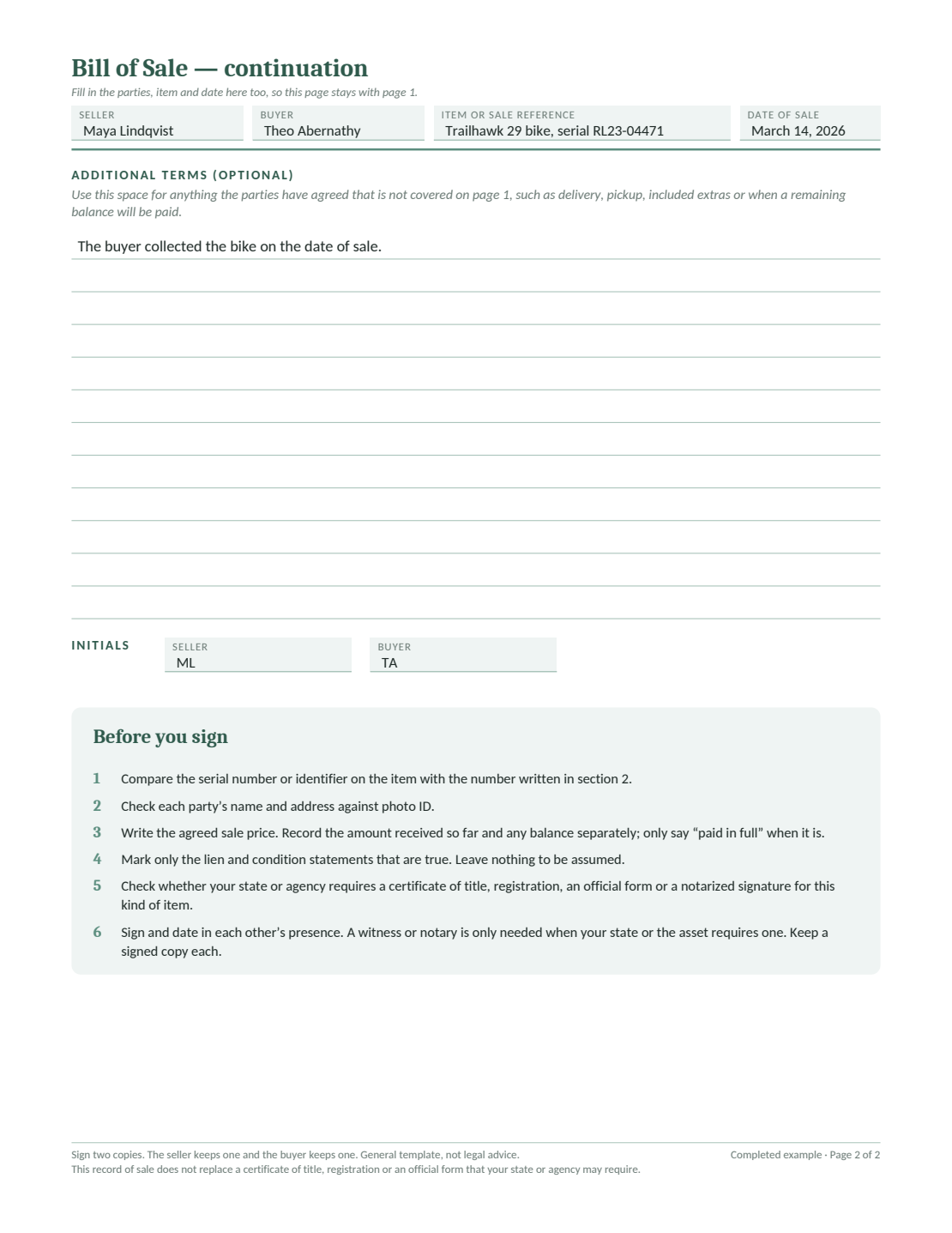
The payment fields show $650 received in cash on the sale date and a $0 balance. The seller and buyer sign page 1. Page 2 records that Theo collected the bike that day.
About This Example
Names, contact details, identifying numbers and signatures are fictional. This guide and its examples are general information, not legal advice. Follow the official forms and instructions for your sale. See our Terms and Conditions.
Page 1: Sale Details
Page 2: Collection and Review
What Does a Bill of Sale Include?
A useful bill of sale connects the people, property and agreed terms. The main fields usually cover:
- Seller and buyer: Full names and addresses identify the parties.
- Property: Describe the item and any identifying number, such as a VIN or serial number. List what comes with it.
- Sale date and price: Record when the sale takes place and the amount agreed.
- Payment: State the amount received, payment method and date, and any remaining balance.
- Condition and terms: Describe known defects and any agreed repairs, warranties or collection arrangements.
- Signatures: Follow the signing instructions for the form and transaction, including any witness or notary requirement.
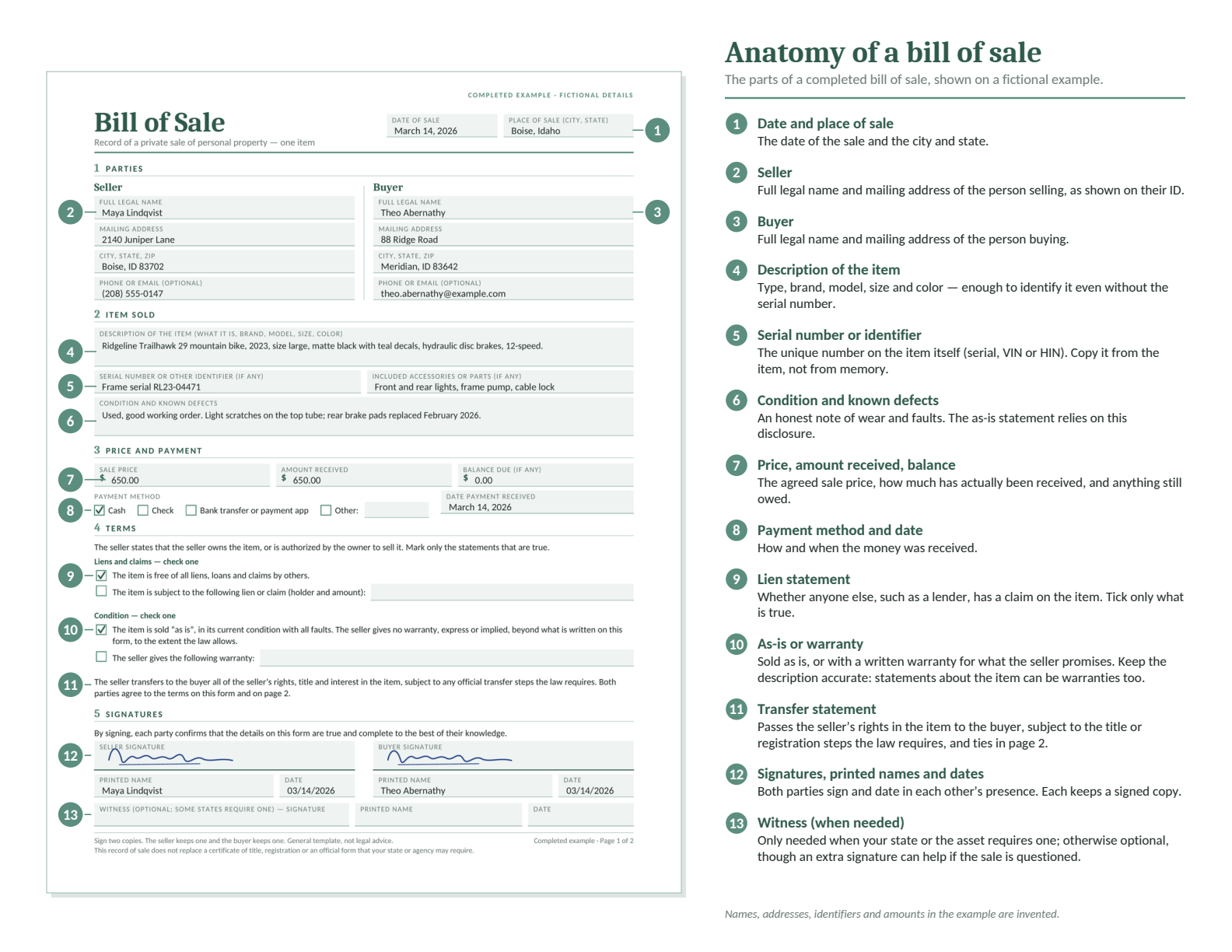
Bill of Sale Anatomy
This sheet labels the fields in the example. Use it to find each part of the form; check your own agency’s instructions for the signing requirements.
When Should You Use a Bill of Sale?
A bill of sale is useful for a private sale of a car, boat, trailer or everyday item such as furniture, a bicycle or tools. Businesses can also use one when selling equipment or other property. It gives both sides a record of the item’s condition and the agreed terms.
Whether a particular form is required depends on the property and where the transfer is handled. For example, New York DMV requires a bill of sale with the appropriate ownership documents for the transfers covered by its guidance. Check the instructions for your own state before signing.
Bill of Sale, Receipt, Title or Purchase Agreement?
These documents can be used in the same transaction. Their purposes overlap, but one does not automatically do the job of another.
| Document | What It Records | What That Means for Your Sale |
|---|---|---|
| Bill of sale | The seller, buyer, property and sale terms. | Include payment details if you also want it to acknowledge money received. |
| Receipt | A payment received, including its amount and date. | It may not contain the property or ownership details needed for a transfer. |
| Title | Official ownership information for property covered by a title system. | Complete the issuing agency’s transfer process. A bill of sale does not automatically replace a required title. |
| Purchase agreement | The deal and the parties’ commitments, including any steps still to be completed. | Check the payment, inspection and handover terms. Do not assume the sale is complete just because an agreement is signed. |
A bill of sale can also serve as a receipt when it accurately records payment received. Keep the supporting payment record too. For business purchases, the IRS explains why purchase details and proof of payment may need separate records.
A vehicle’s title and registration also serve different purposes. New York DMV explains title as proof of ownership and registration as permission to operate the vehicle. For more on that distinction, read bill of sale vs. title.
What Do the Different Types Mean?
Some names describe the property; others describe the sale terms. For example, a vehicle bill of sale can also include as-is terms.
General and Vehicle Bills of Sale
A general template suits everyday items such as furniture or tools. A vehicle template has fields for the year, make, model, VIN and mileage. Its mileage field does not replace a required official odometer disclosure. The car bill of sale page explains the additional paperwork.
As-Is Bills of Sale
As-is wording describes the intended condition and warranty terms. It does not automatically remove every responsibility. Record known defects and any promises clearly. See the as-is templates and wording examples. For business sellers, the FTC’s warranty guide explains limits on disclaimers.
Absolute and Conditional Sales
An absolute sale generally means an unconditional sale. A conditional sale depends on something still happening, such as an agreed payment. Read the actual terms to see when ownership and possession change. Washington’s sales law, for example, distinguishes a present sale from an agreement to sell later.
If the arrangement involves installments, retained ownership or security for a debt, use an agreement suited to that arrangement and get legal help with those terms. A payment date alone does not explain what happens if the buyer does not pay.
Ready to Fill In Your Bill of Sale?
Follow six steps with a completed example beside you. The guide explains what to enter and what to check before signing.
Where Can You Get a Bill of Sale?
Start with a template for the property you’re selling. The pages below offer free Word, Google Docs and PDF options, including fillable PDFs. Choose your format, enter your sale details and review the document before signing.
- General Item Templates
- Car Bill of Sale Templates
- Boat Bill of Sale Templates
- Trailer Bill of Sale Template
If your state requires an official form, get that form from the issuing agency. Use the state chooser below to find the relevant forms and transfer instructions.
Check the Details Before Signing
Read the document together while you can still inspect the item and correct mistakes.
- Match names and identifying numbers to the property and its records.
- Check the price, payment received and any amount still owed.
- Confirm the included items, known defects and any promised repairs or warranties.
- Agree when the buyer will collect the property and which documents go with it.
- Follow the required signature, witness and notary instructions.
Keep a Signed Copy and Finish the Transfer
Seller and buyer should each keep a complete signed copy with their payment and handover records. If an agency needs an original, keep a copy before submitting it.
For titled or registered property, complete the ownership, registration and seller-reporting steps that apply. Signing the bill of sale does not finish those tasks. Check the deadlines with the responsible agency.
Official Forms and Instructions
Choose your state for official forms and transfer instructions. Requirements depend on the property and the transaction.
- Alabama
- Alaska
- Arizona
- Arkansas
- California
- Colorado
- Connecticut
- Delaware
- Florida
- Georgia
- Hawaii
- Idaho
- Illinois
- Indiana
- Iowa
- Kansas
- Kentucky
- Louisiana
- Maine
- Maryland
- Massachusetts
- Michigan
- Minnesota
- Mississippi
- Missouri
- Montana
- Nebraska
- Nevada
- New Hampshire
- New Jersey
- New Mexico
- New York
- North Carolina
- North Dakota
- Ohio
- Oklahoma
- Oregon
- Pennsylvania
- Rhode Island
- South Carolina
- South Dakota
- Tennessee
- Texas
- Utah
- Vermont
- Virginia
- Washington
- West Virginia
- Wisconsin
- Wyoming
The sources below support this guide. State guidance applies to transactions in that state; the FTC guidance focuses on business sellers.
- New York DMV: Buying, Selling and Transferring Ownership — Bills of sale and required ownership documents.
- New York DMV: Certificate of Title — The difference between title and registration.
- Utah DMV: Buyer and Seller Responsibilities — Handwritten bills of sale and the details Utah requires.
- Florida Bar: Contracts — Basic requirements for an enforceable agreement.
- Washington Legislature: Sales Definitions — A present sale and an agreement to sell later.
- FTC: Businessperson’s Guide to Federal Warranty Law — Warranty disclaimers and their limits for business sellers.
- IRS: Business Records to Keep — Purchase details and supporting payment records.
Sources reviewed .
Bill of Sale Questions
It can be. Its legal effect depends on the agreement, the circumstances and applicable law. A signature does not make an unlawful term valid or guarantee that an agency will accept the document. Read the terms and follow any required transfer process.
No. Requirements vary by state, property and transaction. Check the official instructions for the form you are using. The title or another transfer document may have its own signing requirements; a notary space on a general template does not establish what is required.
Yes. Write it clearly and include the required details and signatures. If you need to submit it to an agency, check its rules. For example, Utah DMV allows a handwritten bill of sale in ink.
Either seller or buyer can prepare a draft. Both should check the details and each should keep a complete signed copy. Follow the agency’s instructions if it requires an original or a particular form.
Do not assume it can. Ask the motor vehicle agency which ownership documents it accepts for that vehicle. If a required title is missing, follow its missing-title process. A general bill of sale does not remove that requirement.
Choose a Template for Your Sale
Start with a free template and give seller and buyer a clear record to keep.
- Choose a template for your property.
- Add the agreed terms and payment details.
- Review, sign and keep a copy each.