Selling an older car in New Hampshire? Its title status decides which ownership papers the buyer needs. Record the price, payment and condition alongside those papers.
Choose a vehicle, boat or trailer template, then check the state and town-clerk steps below.
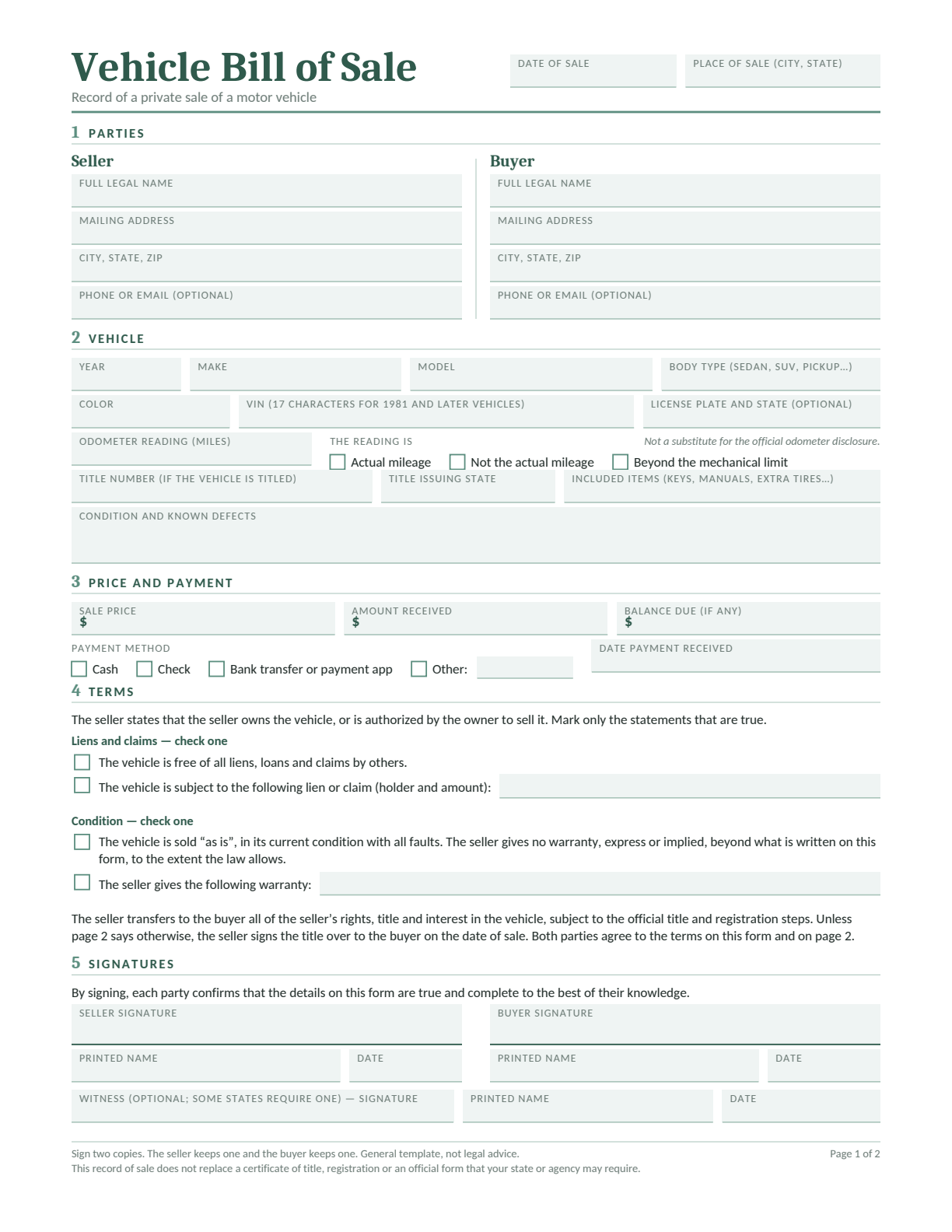
Use the vehicle template to record the VIN, odometer, price, payment and condition. For a title-exempt vehicle, add the year of manufacture and number of cylinders in the description or Additional terms space; those details do not have dedicated boxes in this general form.
Edit in Word or Google Docs, type into the fillable PDF, or print the blank PDF to complete by hand.
In Google Docs, sign in and choose Make a copy. Use page 2 for extra terms, then keep both pages together.
A New Hampshire bill of sale identifies the seller, buyer and property and records their agreement. It can also show payment received, disclosed defects and when the buyer will collect the item.
For a title-exempt vehicle, the bill of sale has a specific registration role. For a titled vehicle, it accompanies the assigned title. Boats follow the DMV’s vessel-registration process, while a boat trailer has its own road-registration requirements.
TDMV 22A — Non-Titled Vehicle Sale
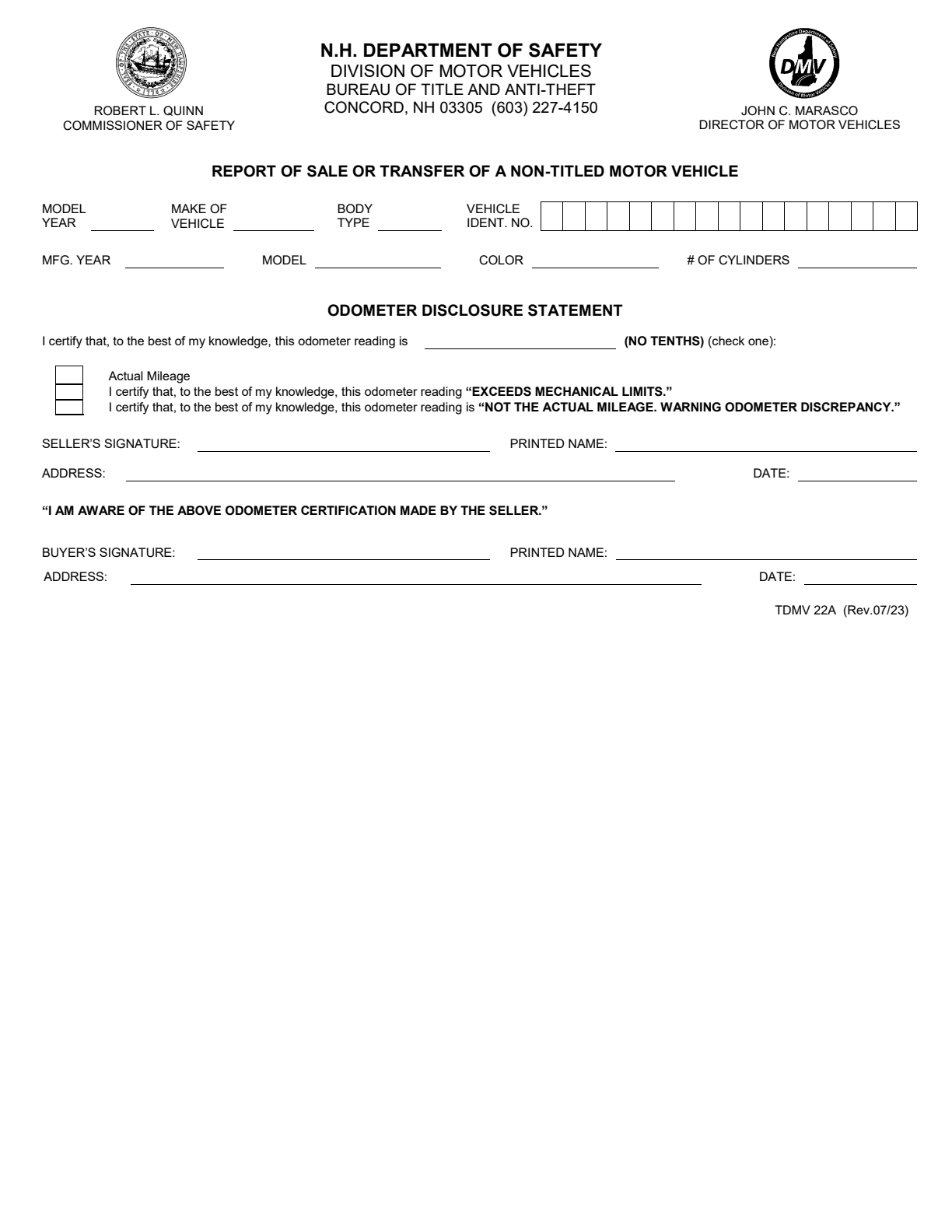
Use New Hampshire DMV form TDMV 22A to record the sale of a vehicle that qualifies for a title exemption. The preview shows the July 2023 form. If your vehicle requires a title and yours is missing, ask the DMV how to replace it.
What to Fill In
Vehicle: Enter the VIN, model year, make and body type, then the year of manufacture, model, color and number of cylinders.
Odometer: Enter the reading without tenths and check the statement that accurately describes the mileage.
Seller: Sign the odometer certification, print your name and enter your address and signing date.
Buyer: Read the acknowledgment of the seller’s odometer statement, then sign, print your name and enter your address and signing date.
This form has no price or payment fields. Keep those details in your sale record, together with the supporting identification evidence required by the clerk.
If the PDF won’t open, ask your town or city clerk for form TDMV 22A, or call the New Hampshire DMV Title Bureau at (603) 227-4150.
Check Whether the Vehicle Needs a Title
New Hampshire’s ordinary motor-vehicle exemption uses a fixed model-year boundary: before 2000. It is not a rolling age exemption. RSA 261:3 makes an exception for heavy trucks and truck-tractors over 18,000 pounds gross vehicle weight.
For a title-exempt private sale, RSA 261:148 requires a bill of sale for the initial registration or ownership change. Include the sale date, make, model, VIN, model year, year of manufacture, body type and cylinders, plus the buyer’s name and address and the seller’s signature and address.
Seller: Hand Over the Ownership Evidence
For a titled vehicle, complete the assignment on the original title and give it to the buyer. Enter the buyer’s details and the correct odometer disclosure before signing; do not hand over an open title.
For an exempt vehicle, give the buyer the signed bill of sale and the previous registration or other accepted identification evidence. Keep your plates and a copy of the paperwork. Nashua’s registration checklist shows how the clerk distinguishes these cases.
Buyer: Start With Your Town or City Clerk
Bring your identification and ownership documents to the clerk where you live. The municipal permit and state registration are related steps; the clerk can explain which services that office completes.
For a pre-2000 vehicle, a bill of sale alone does not settle the identification requirement. RSA 261:2-a lists supporting evidence such as a prior New Hampshire registration, title or state VIN-verification form. Resolve missing papers before pickup.
New Hampshire Boat Bill of Sale Templates
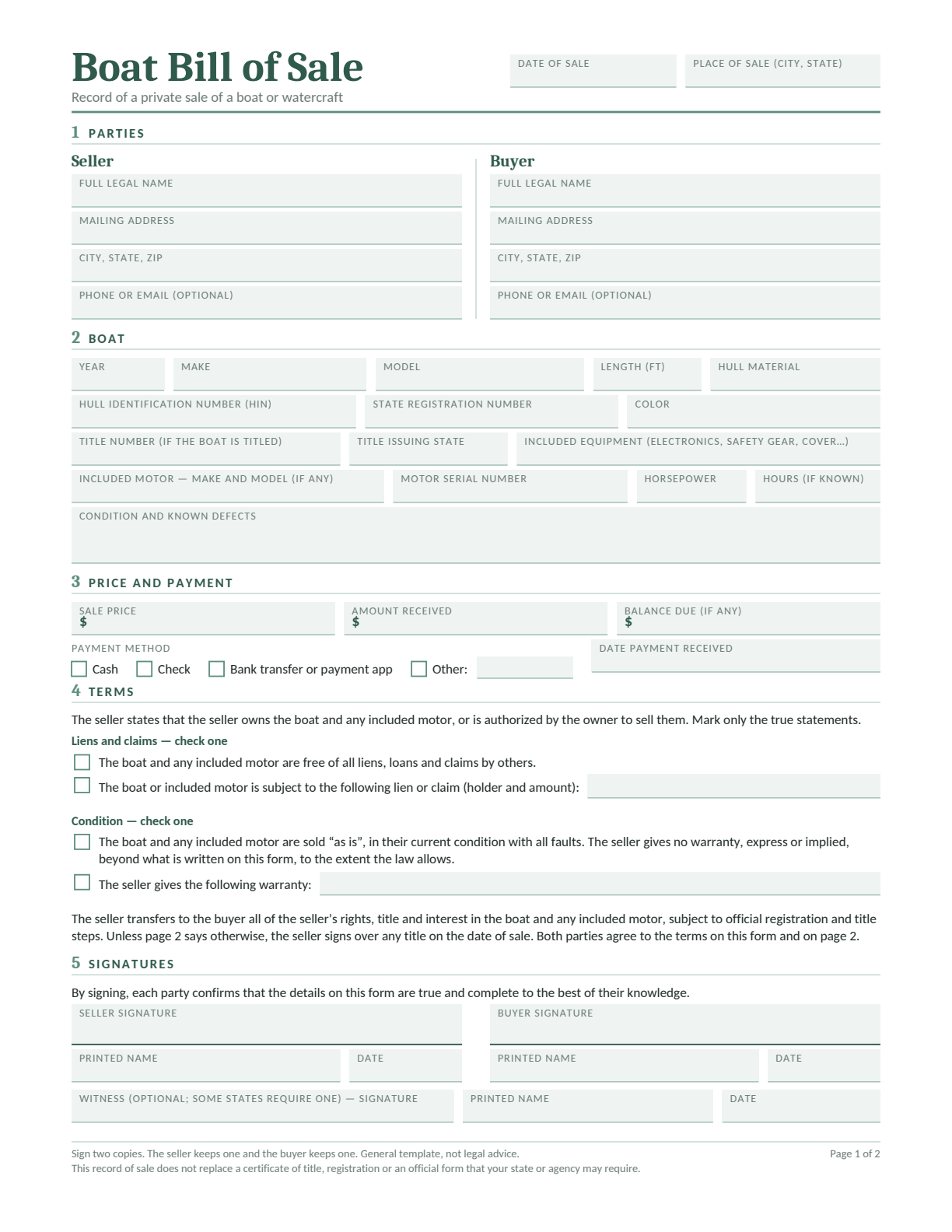
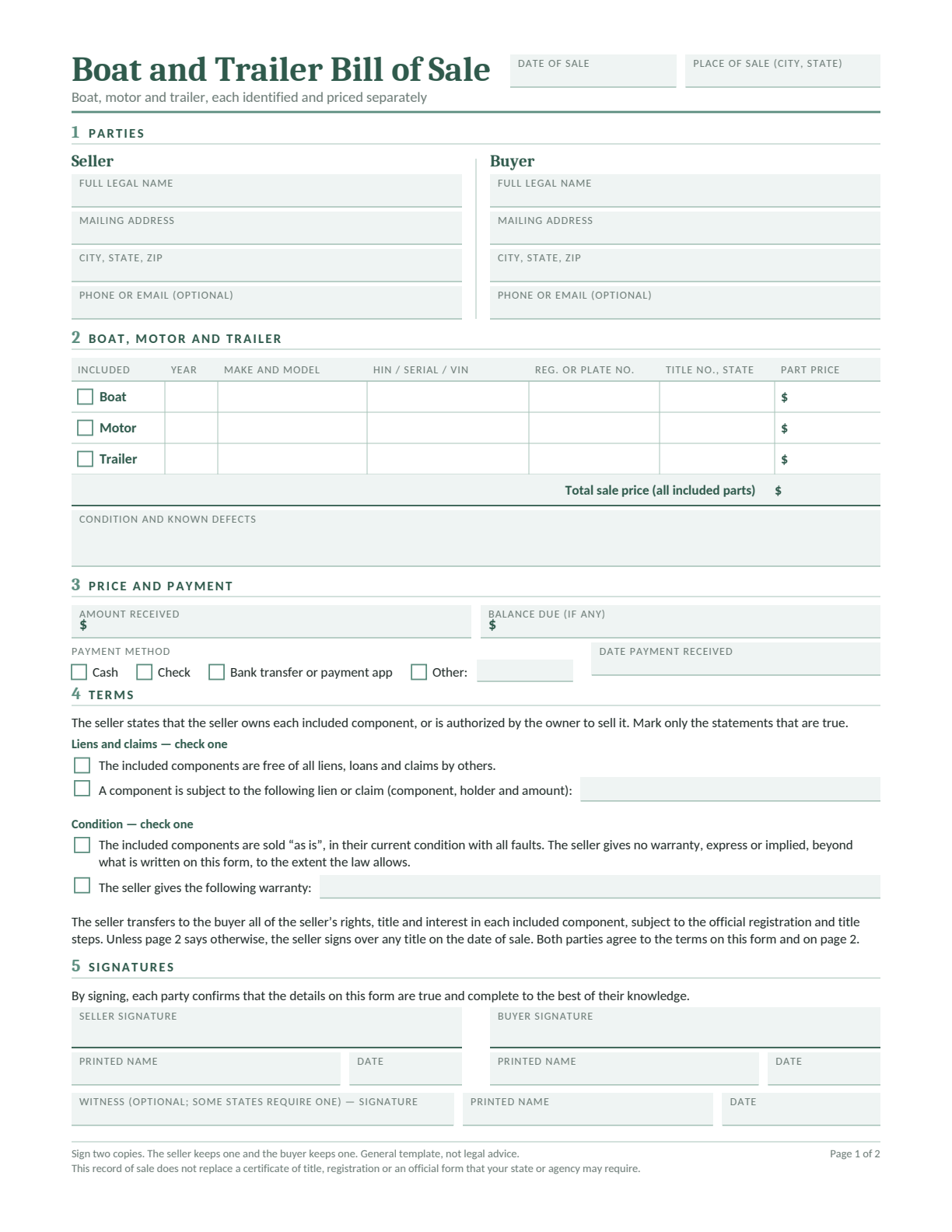
A New Hampshire boat sale needs enough detail to connect the vessel to its registration. Use the boat-only template for the hull and included equipment, or the package template when a motor and trailer are sold together.
Boat Bill of Sale
Record the boat, included equipment, condition, price and payment.
Prepare the Boat’s First Registration in Your Name
New Hampshire uses boat registration through the DMV and authorized agents. For an initial registration, Saf-C 2302.03 requires proof of ownership signed by both the applicant and the seller. Submit the separate RDMV 612 boat application too.
Gather the HIN, previous New Hampshire bow number, length, hull material, color and engine details. Nashua’s boat checklist also asks for fuel, horsepower, inboard or outboard designation and single or twin engines. Add these in the description or Additional terms when the template has no separate box.
If there is no 12-digit HIN, use the state’s RDMV 690 verification process with New Hampshire law enforcement. Do not create your own number. The boat’s registration does not register an included trailer.
New Hampshire Trailer Bill of Sale
Check a trailer’s gross weight and whether it is specifically a boat trailer before deciding which ownership papers to collect. Record its VIN separately from the boat’s HIN.
Trailer Bill of Sale
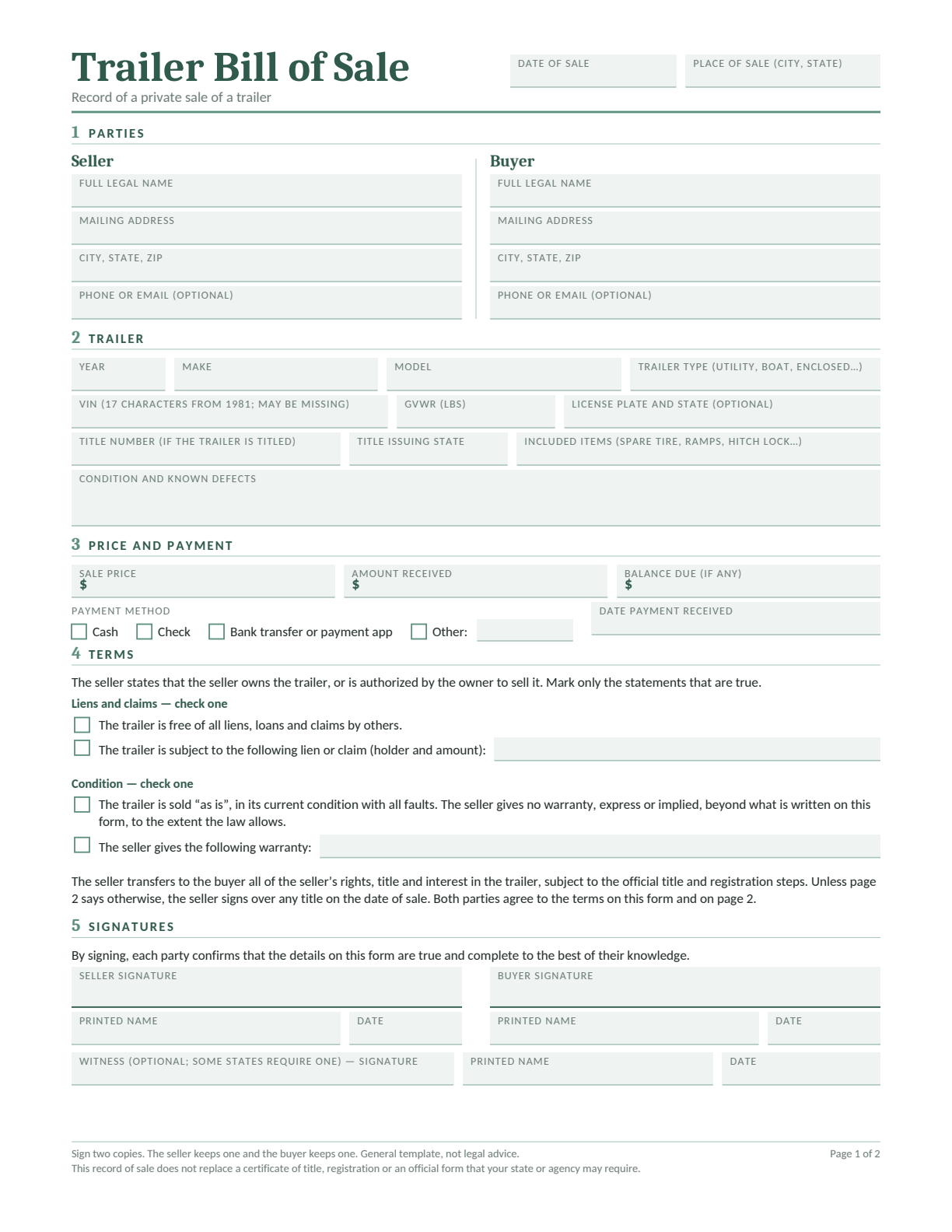
Describe the trailer and included equipment, then record the price, payment and any remaining balance. Use page 2 for extra terms, such as collection arrangements.
Edit in Word or Google Docs, type into the fillable PDF, or print a blank copy. Complete both pages and keep them with the ownership papers.
Under RSA 261:3, I(j), trailers below 3,001 pounds gross weight are title-exempt. Since August 18, 2026, the exemption also covers boat trailers over 3,001 pounds whose manufacturer’s model year is more than 10 years old. That additional exception does not cover every trailer type.
The statute says “over 3,001 pounds” for the older boat-trailer exception. Ask the DMV about a trailer at exactly that weight. Title-exempt trailers still need the applicable registration papers; bring the bill of sale and proof of identity to the clerk.
Completed New Hampshire Bill of Sale Example
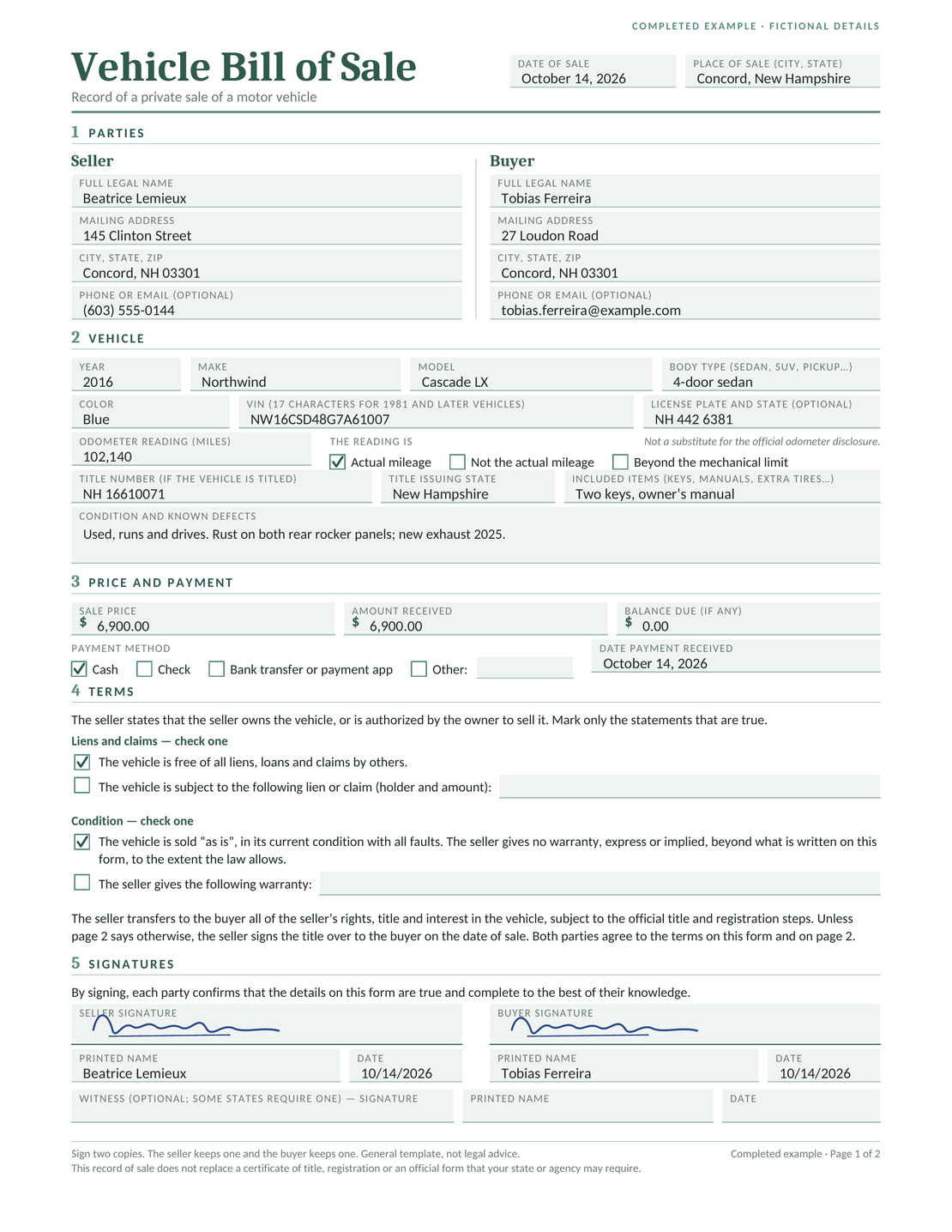
In this fictional sale in Concord, New Hampshire, Tobias Ferreira buys a 2016 Northwind Cascade LX from Beatrice Lemieux for $6,900.00. The seller records the full $6,900.00 received, leaving a $0.00 balance.
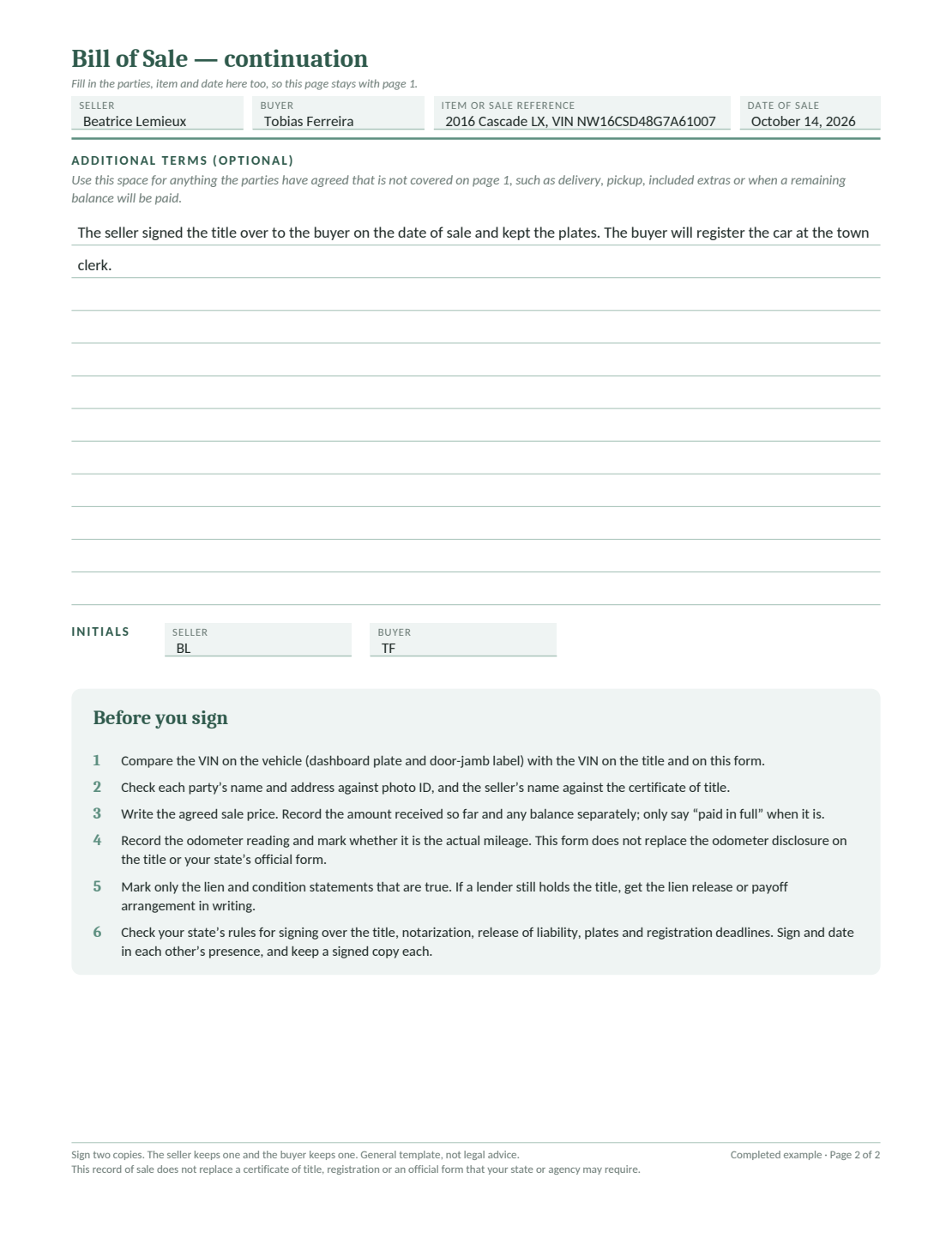
The agreement calls out rust on both rear rocker panels and notes the exhaust replacement in 2025. Beatrice signs over the title and keeps the plates; Tobias plans to register the car with the town clerk. That planned visit is separate from completing this sale record.
The names, identifiers and signatures are fictional. This completed sale record does not show that a title application, registration or seller notice has been accepted by the relevant agency.
Page 1: Parties, vehicle, payment and signatures
Page 2: Agreed handover terms and signing checklist
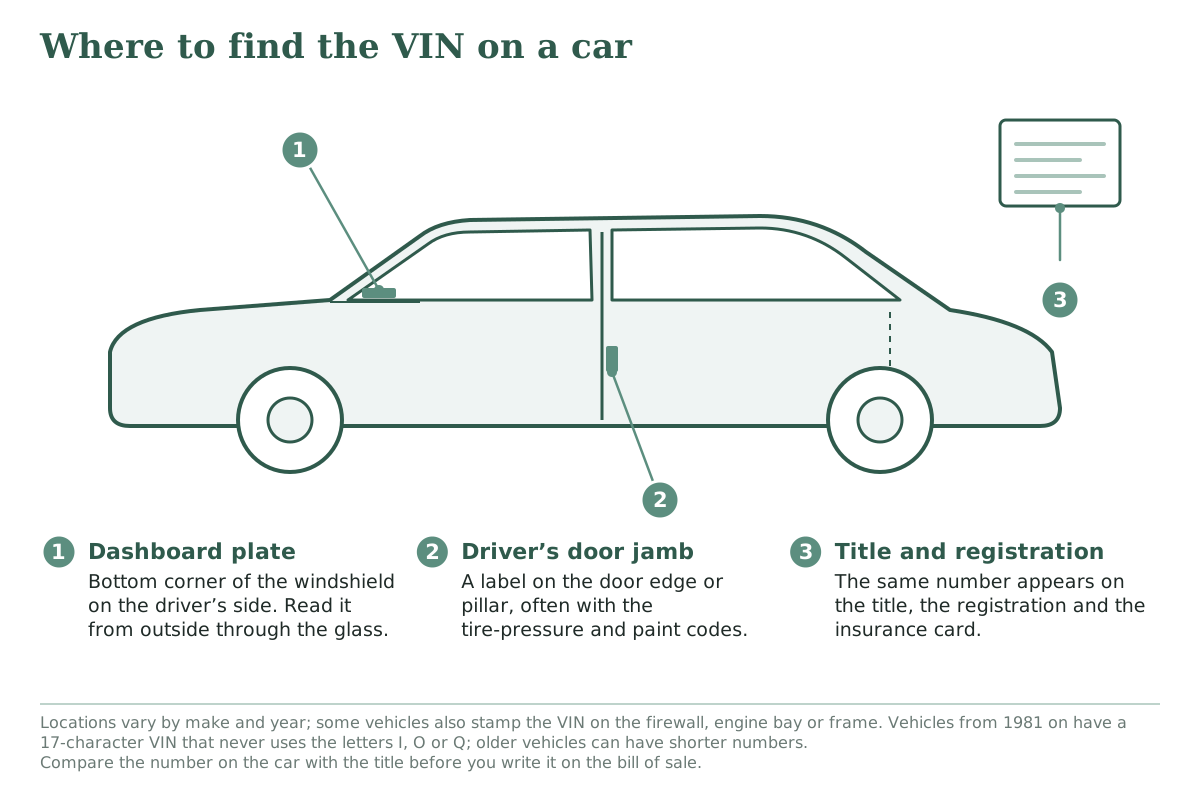
Compare the identifying number on the property with the ownership papers before copying it into your sale record.
Look through the windshield at the driver-side dashboard. Also check the label inside the driver’s door opening. Locations vary, so consult the vehicle’s manual if needed.
Resolve a missing or mismatched number with the agency handling the transfer. Do not guess from an unclear label.
Compare the seller’s name with the ownership record and check every required owner’s signature.
Match the VIN or HIN on the property to the title, registration and sale record.
Record the agreed price, money actually received and any remaining balance separately.
Describe known defects and the equipment included in the price.
Confirm the ownership papers and transport arrangements before handover.
The exempt-vehicle bill-of-sale requirements in RSA 261:148 do not call for notarization. Separate affidavits can have different rules. Both parties should sign the general sale record; initial boat ownership evidence needs both signatures.
Keep the Sale Record with the Transfer Papers
Give each party a signed copy of both pages. Keep payment evidence, lien releases and copies of the ownership papers with it. If pickup or a final payment happens later, add a dated receipt or acknowledgment that refers to the same vehicle or vessel.
Keep the agency’s receipt when you submit a title application or seller report. Signing a private form and submitting official paperwork are separate actions.
No. The ordinary exemption is for model years before 2000, with a heavy-truck exception. A vehicle’s age alone does not establish the paperwork it needs.
Use the vehicle description or Additional terms space. Also add the year of manufacture for an exempt-vehicle sale; the general template does not have separate boxes for these New Hampshire details.
Do not use a title-exempt form merely because a title is missing. Confirm the vehicle’s exemption or arrange the appropriate replacement-title process before the sale.
Both the buyer applying for the initial registration and the seller must sign the ownership evidence. The registration application is a separate document.
No. It concerns the certificate of title. Check the municipal and state road-registration requirements for the trailer separately.
After 14 days, continue for
$12.99/month
only if you choose to upgrade.
We use cookies to provide you with the best possible experience. Cookies also help us analyze user behaviour so we can continue to improve our website. View our cookie policy.