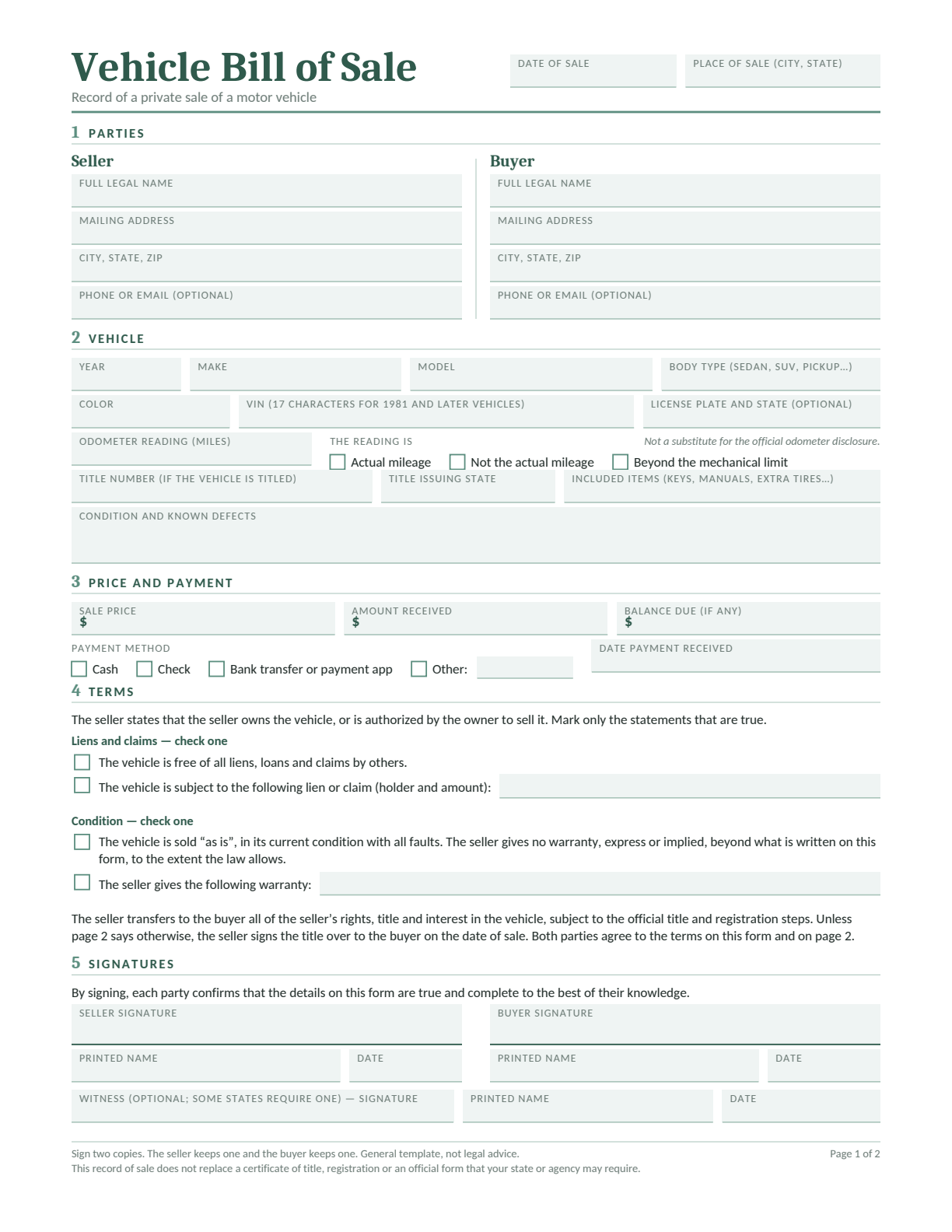
Record the vehicle’s VIN, year, make and model, then separate the purchase price from the amount already paid and any balance. Include the sale date and both parties’ signatures. List defects or included accessories clearly enough that the buyer can compare the agreement with the vehicle at pickup.
Edit in Word or Google Docs, type into the fillable PDF, or print the blank PDF to complete by hand.
In Google Docs, sign in and choose Make a copy. Use page 2 for extra terms, then keep both pages together.
A Virginia bill of sale records who sold the property, who bought it, the date and the agreed price. Use it to explain payment, known defects and the equipment included in the transaction.
For a vehicle, DMV can accept the seller’s declared price on the title as proof of purchase price. A separate bill of sale is useful when the price needs clarification or the parties want a fuller record of their agreement. It does not replace the title assignment.
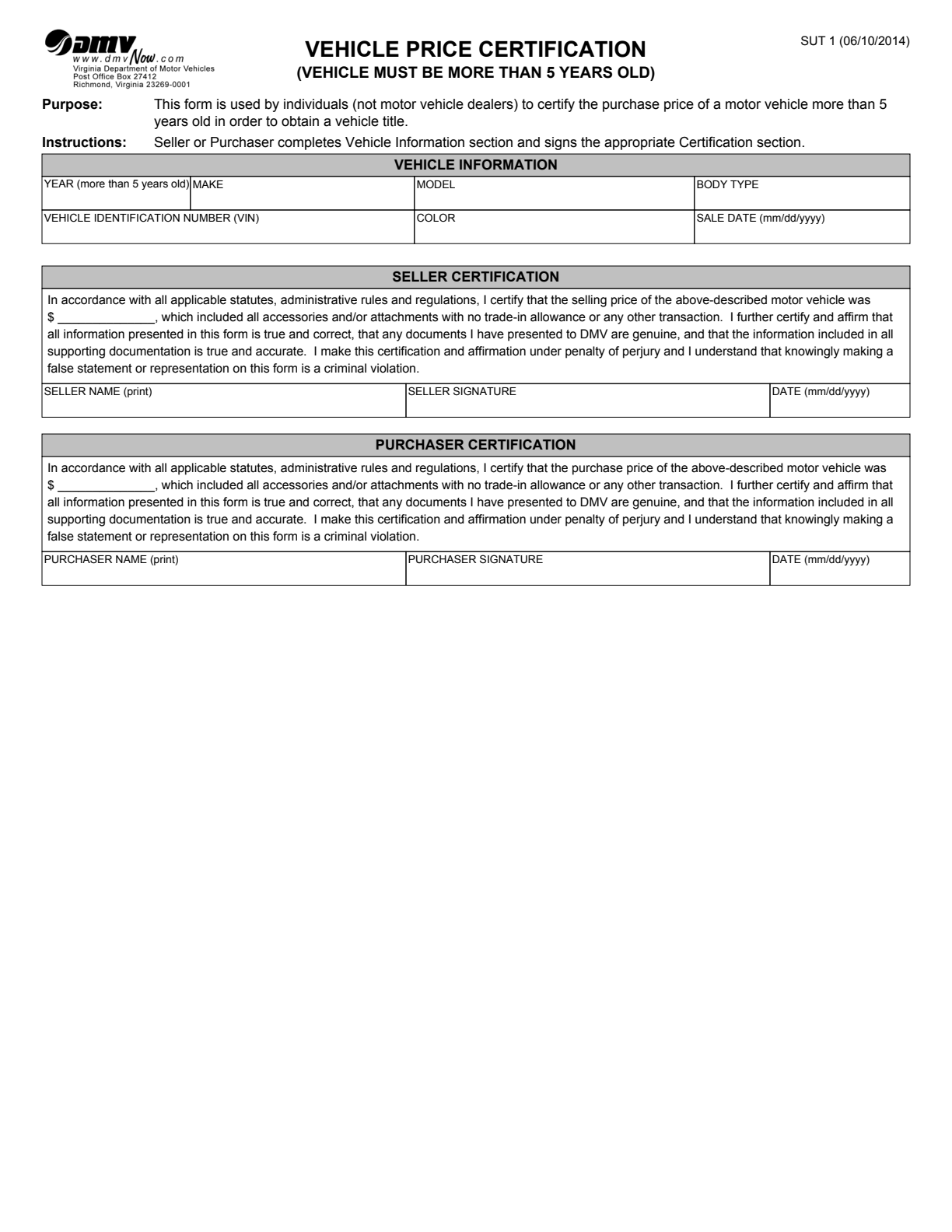
Virginia Vehicle Price Certification (SUT 1)
SUT 1 is for an individual certifying the price of a motor vehicle more than five years old. It is a price certification submitted with title paperwork.
What to Fill In
Vehicle information: Enter the VIN, color, sale date, year, make, model and body type.
Price: State the full price, including accessories and attachments, under the certification’s terms.
Correct certification: The seller or purchaser completes and signs their own certification section. A notary is not required on this form.
Preview of the official form. 08/10/2017. Open its PDF for the complete form and instructions.
Use the sale record with the Virginia title
Complete the ownership assignment and required mileage disclosure on the title. Virginia’s title instructions distinguish title evidence from proof of price: the price may be shown on the title, a bill of sale or an accepted price certification.
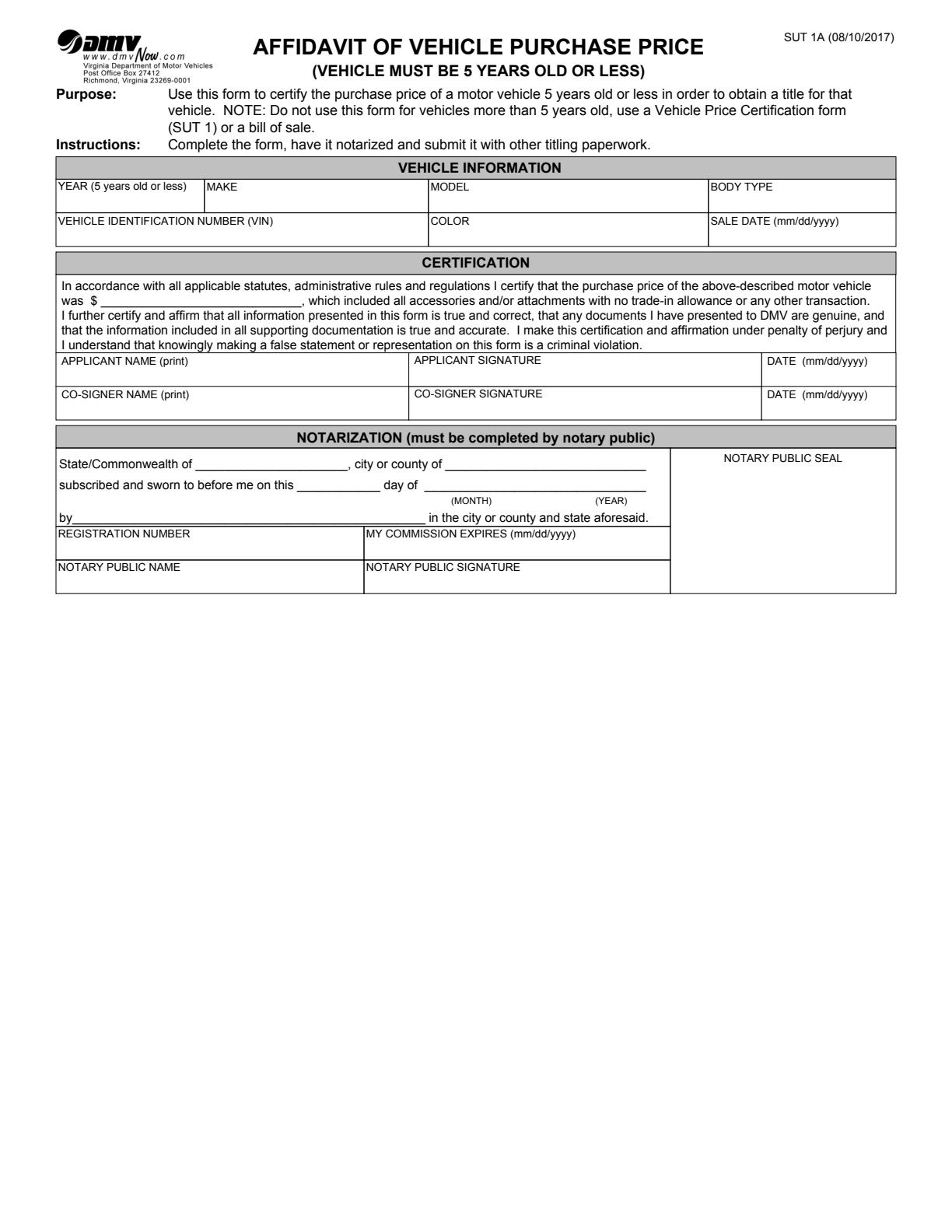
If an older vehicle’s title does not show the correct price, DMV accepts a bill of sale signed by both parties or Form SUT 1. For newer vehicles, DMV may require the notarized SUT 1A price affidavit. These forms certify the amount paid; neither transfers ownership by itself. See DMV’s purchase-price guidance.
Seller: complete the title and report the sale
All owners listed on the Virginia title must sign the seller section. Enter the buyer’s information, actual odometer reading, sale date and price. Give the completed title to the buyer and remove your license plates before handover.
Follow DMV’s sale instructions to notify DMV online, by phone or at an office. Transfer, surrender or inactivate your plates as appropriate, then tell your insurer. Updating DMV first helps prevent the old registration from appearing uninsured.
Buyer: apply for your title and arrange road use
Check every title entry before leaving the seller, including names, price, VIN and mileage. Complete your buyer certifications and submit the ownership documents and application. Virginia law generally requires the title application within 30 days of the transfer.
Arrange insurance, registration, plates and any required inspection before driving. The title application deadline does not give you permission to use the seller’s plates or drive on a private receipt.
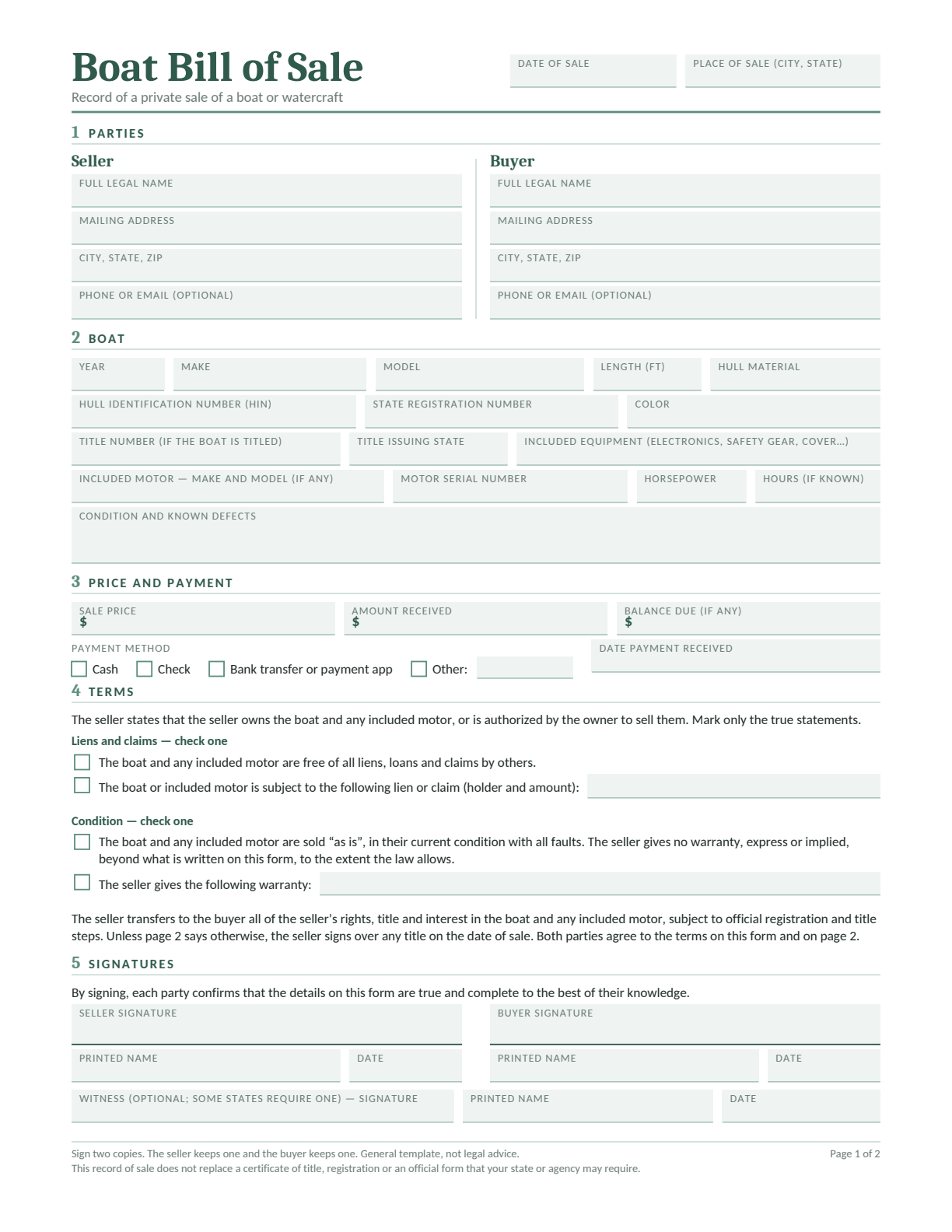
Virginia Boat Bill of Sale Templates
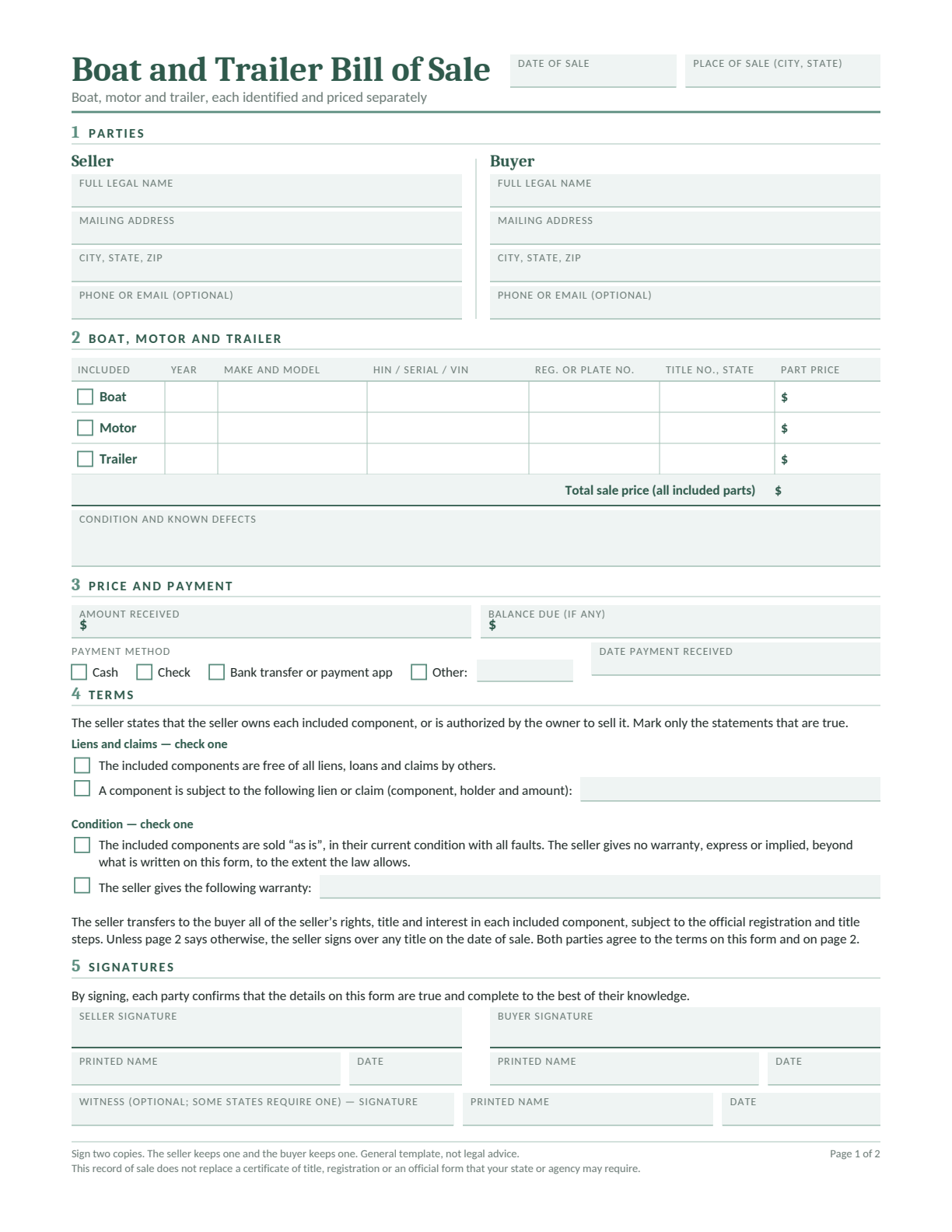
Use the boat template to identify the hull and included motor. When a trailer is part of the purchase, give it a separate description and price: the boat goes through DWR, while the trailer goes through DMV.
Boat Bill of Sale
Record the boat, included equipment, condition, price and payment.
Virginia DWR requires title and registration for watercraft powered by a motor, including an electric trolling motor, when used on public waters. A sail-only vessel longer than 18 feet needs a title but does not need registration. See DWR’s watercraft requirements.
Obtain the assigned original title for a titled boat. If an out-of-state boat was registered but never titled, collect that registration and a dated bill of sale signed by the registered owners. Use DWR’s transfer procedure for the appropriate ownership history and application.
The buyer generally must apply for a required title within 20 days of the later of the transfer or establishing Virginia as the state of principal use. The seller must report a registered boat’s sale to DWR within 15 days. A used boat with a current Virginia registration has a limited 30-day operating allowance only if the dated bill of sale and the former owner’s valid registration are carried aboard.
Virginia Trailer Bill of Sale
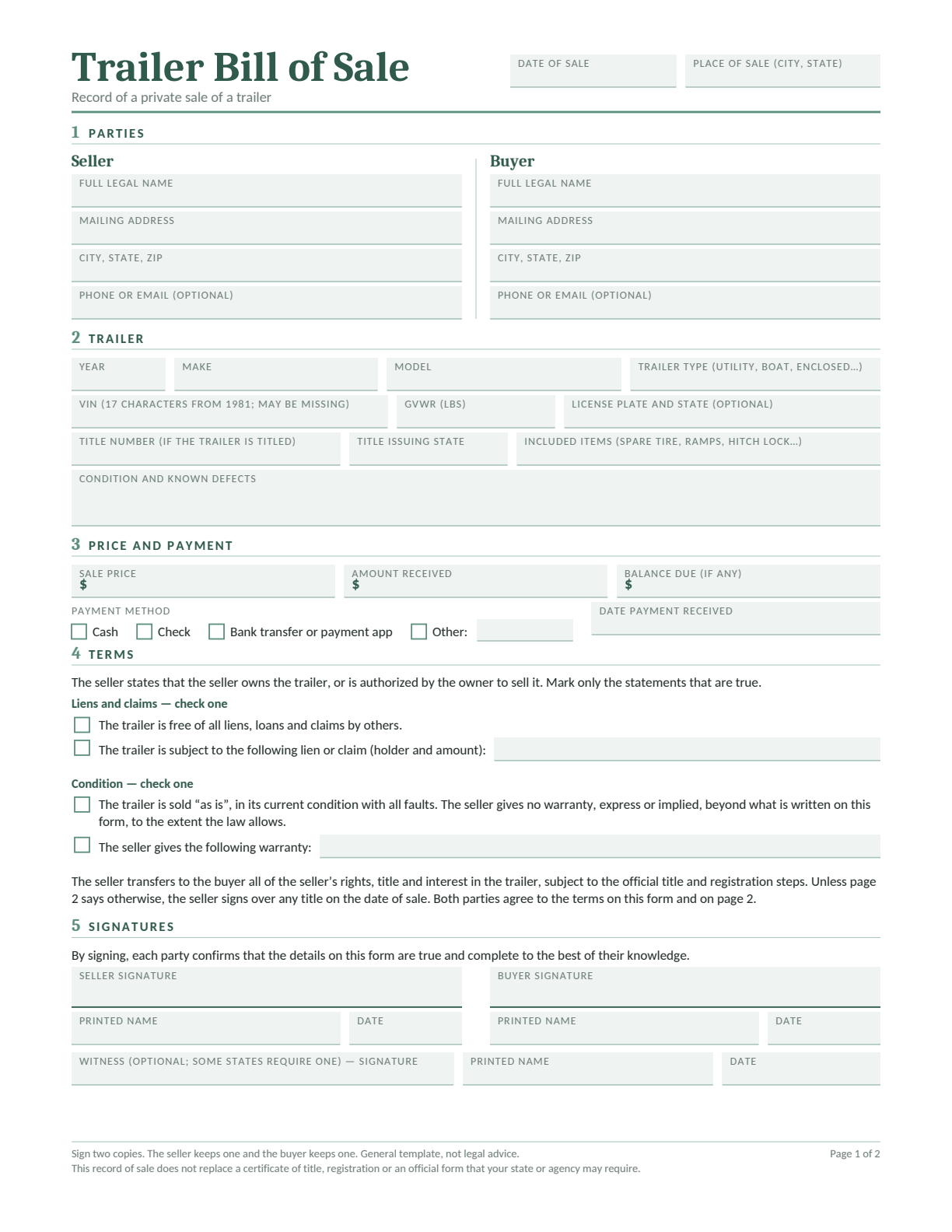
Describe the trailer separately from its load, using its own VIN and price. Virginia DMV handles trailer titles and registration, including a trailer bought with a boat.
Trailer Bill of Sale
Describe the trailer and included equipment, then record the price, payment and any remaining balance. Use page 2 for extra terms, such as collection arrangements.
Edit in Word or Google Docs, type into the fillable PDF, or print a blank copy. Complete both pages and keep them with the ownership papers.
Buying a trailer from a state that did not title it
Virginia has a specific process for an out-of-state trailer with no title. When the prior state does not title that type of trailer, DMV asks for its registration, unexpired or expired less than 12 months, the manufacturer’s certificate if available and the title application.
The application in lieu of a title must be signed and notarized, with an explanation and supporting ownership history. Include the bill of sale, or the accepted price certification if the bill is unavailable. That notarization applies to the title substitute; it is separate from the signatures on the sale record.
Completed Virginia Bill of Sale Example
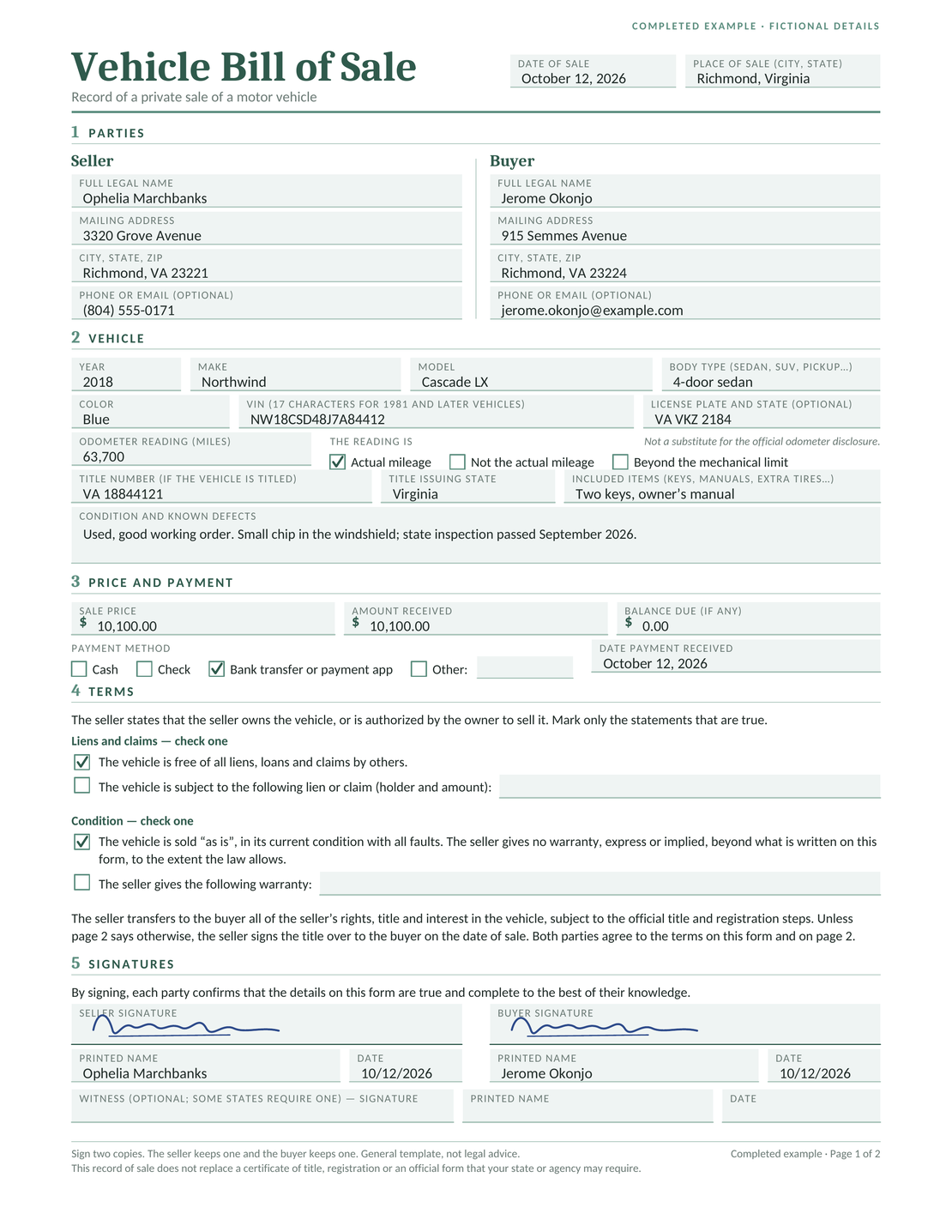
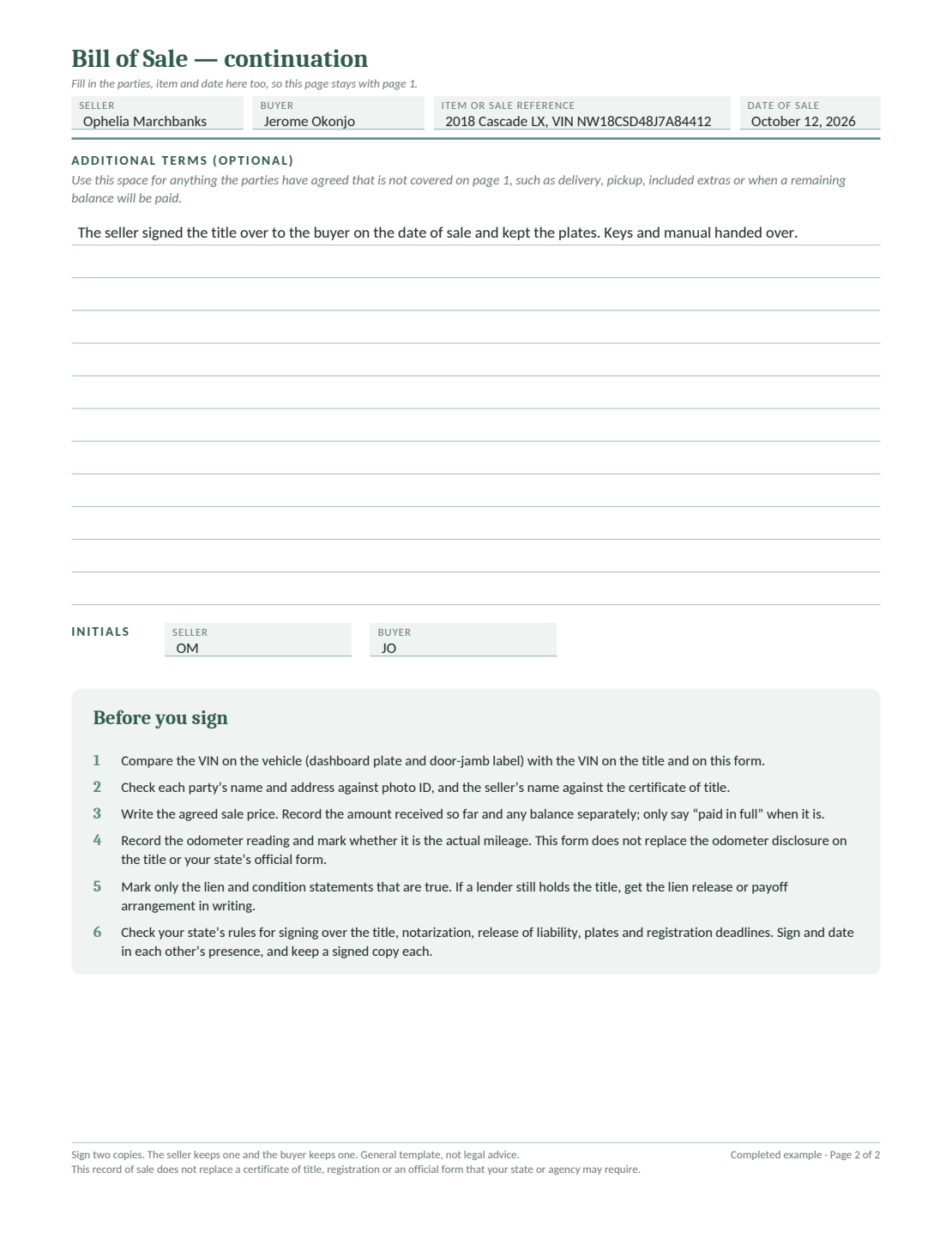
In this fictional sale in Richmond, Virginia, Jerome Okonjo buys a 2018 Northwind Cascade LX from Ophelia Marchbanks for $10,100.00. The seller records the full $10,100.00 received, leaving a $0.00 balance.
Ophelia records the small windshield chip and the September 2026 state inspection. The handover terms cover the signed title, keys and manual, while she keeps the plates. The separate DMV sale notice remains an agency step to verify.
The names, identifiers and signatures are fictional. This completed sale record does not show that a title application, registration or seller notice has been accepted by the relevant agency.
Page 1: Parties, vehicle, payment and signatures
Page 2: Agreed handover terms and signing checklist
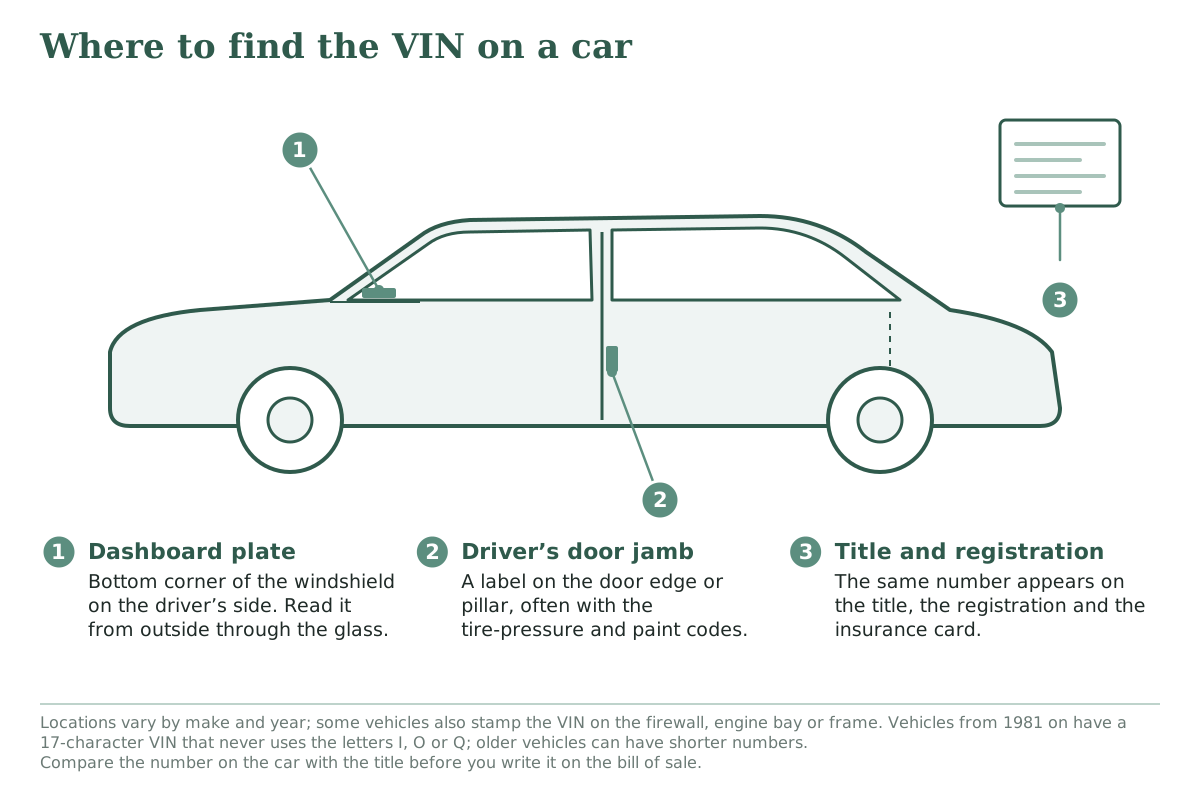
Compare the identifying number on the property with the ownership papers before copying it into your sale record.
Look through the windshield at the driver-side dashboard. Also check the label inside the driver’s door opening. Locations vary, so consult the vehicle’s manual if needed.
Resolve a missing or mismatched number with the agency handling the transfer. Do not guess from an unclear label.
Compare the seller’s name with the ownership record and check every required owner’s signature.
Match the VIN or HIN on the property to the title, registration and sale record.
Record the agreed price, money actually received and any remaining balance separately.
Describe known defects and the equipment included in the price.
Confirm the ownership papers and transport arrangements before handover.
Sign an ordinary Virginia bill of sale as buyer and seller. SUT 1 has no notary requirement; SUT 1A must be notarized. An application in lieu of title for a qualifying out-of-state trailer also requires notarization.
Keep the Sale Record with the Transfer Papers
Give each party a signed copy of both pages. Keep payment evidence, lien releases and copies of the ownership papers with it. If pickup or a final payment happens later, add a dated receipt or acknowledgment that refers to the same vehicle or vessel.
Keep the agency’s receipt when you submit a title application or seller report. Signing a private form and submitting official paperwork are separate actions.
DMV accepts the seller’s declared price on the title as proof of purchase price. A separate agreement can still record condition, accessories, payments and pickup arrangements.
SUT 1 is a price certification for a vehicle more than five years old, signed by the seller or purchaser. SUT 1A covers a vehicle five years old or less and requires notarization when used.
No. The seller must also notify DMV of the sale. Keep the confirmation with your copy of the signed sale record.
A sail-only vessel longer than 18 feet needs a Virginia title but does not need registration. Adding a motor changes the registration requirements.
No. DWR handles the boat. DMV handles the trailer’s title, registration and plates, so identify and price the trailer separately.
After 14 days, continue for
$12.99/month
only if you choose to upgrade.
We use cookies to provide you with the best possible experience. Cookies also help us analyze user behaviour so we can continue to improve our website. View our cookie policy.