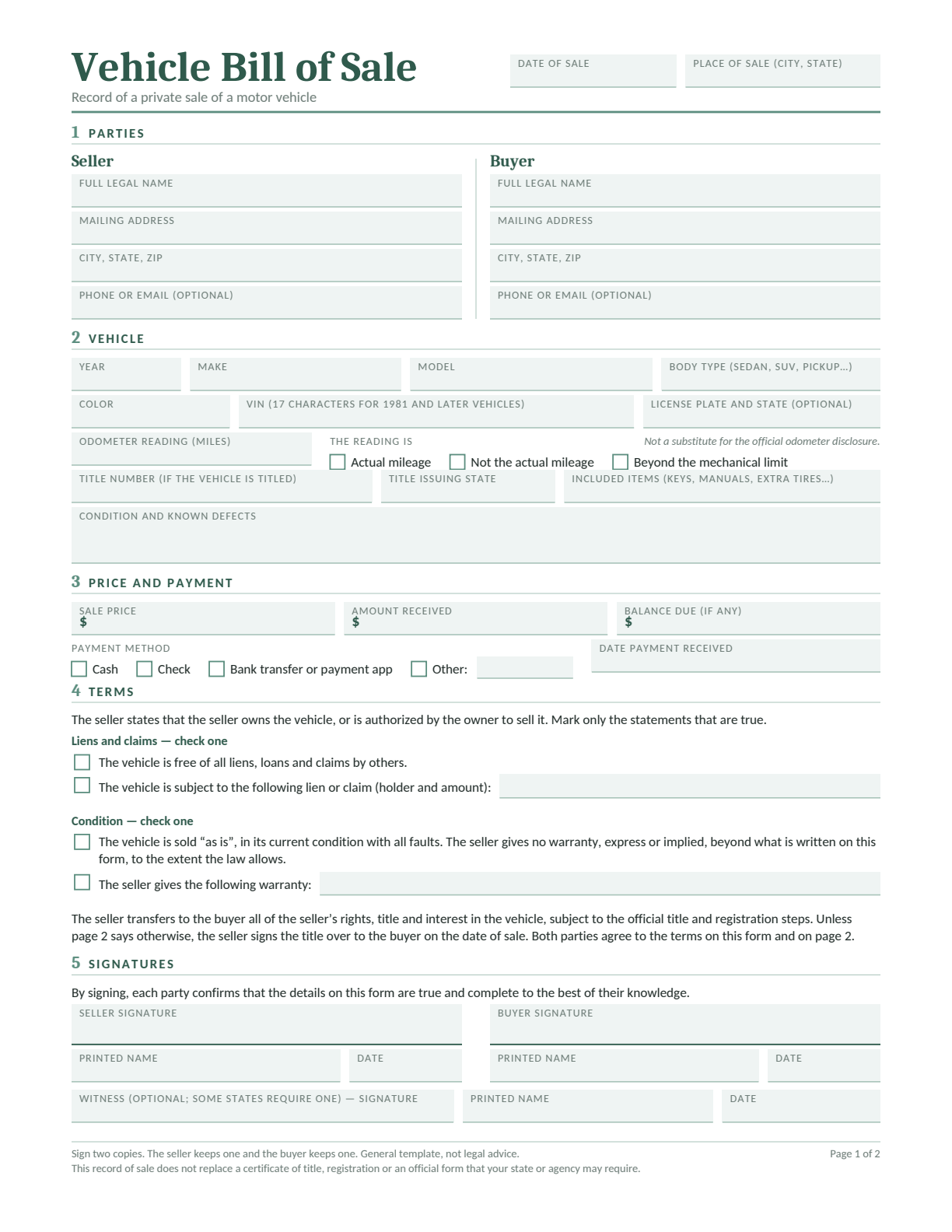
Record the vehicle’s VIN, mileage, price and payment, then describe known defects and included items. Use the second page for a remaining payment, collection date or other agreed terms. Keep both pages with the ownership papers.
Edit in Word or Google Docs, type into the fillable PDF, or print the blank PDF to complete by hand.
In Google Docs, sign in and choose Make a copy. Use page 2 for extra terms, then keep both pages together.
A bill of sale records who sold the property, who bought it, the sale date and the agreed price. Payment fields show how much the seller has received and whether any balance remains. Both people keep a signed copy.
This page covers private vehicle, boat and trailer sales in Massachusetts. Keep the sale record with the title or registration documents that apply to the property. For furniture, tools or other personal property, see the general bill of sale templates.
Match the sale record to the RMV ownership papers
Massachusetts does not prescribe one standard bill-of-sale format for an ordinary private vehicle sale. The RMV’s registration training guide calls for the parties, signatures, date, price, vehicle description, VIN and applicable mileage.
For a titled car, complete the title assignment and required odometer disclosure. If the title has no space for the sale price, submit a bill of sale showing it. A vehicle that qualifies for an age-based title exemption needs the previous registration and bill of sale; age alone does not establish the exemption.
Seller: disclose defects and deal with your registration
Complete and sign the ownership transfer with the buyer. Identify known defects in writing, especially faults affecting safe use.
Keep your plates. If you are not transferring your registration to another eligible vehicle, follow the RMV cancellation process. Save the cancellation receipt and provide a copy to your insurer. Cancelled plates do not have to be returned to RMV.
Buyer: apply within 10 days and arrange inspection
Apply for the required title within 10 days of purchase. For registration, obtain insurance and have your Massachusetts insurance agent complete, stamp and sign the Registration and Title Application.
Bring the ownership papers and application to RMV. Its private-purchase guide also requires an inspection sticker within seven days of registration. Arrange lawful collection; the seller’s plates and a signed bill of sale do not provide your registration.
An “as is” clause does not remove disclosure duties
Massachusetts requires a private seller to disclose known defects that impair safety or substantially impair use. The private-party car-sale guide explains that a buyer who proves the seller knew of an undisclosed qualifying defect may cancel within 30 days of purchase. Write the actual faults in the condition section rather than relying on an “as is” checkbox.
Massachusetts Boat Bill of Sale Templates
Massachusetts uses a bill of sale in the boat registration application. Record the hull identification number carefully and describe any motor or trailer included, even when the package has one agreed total price.
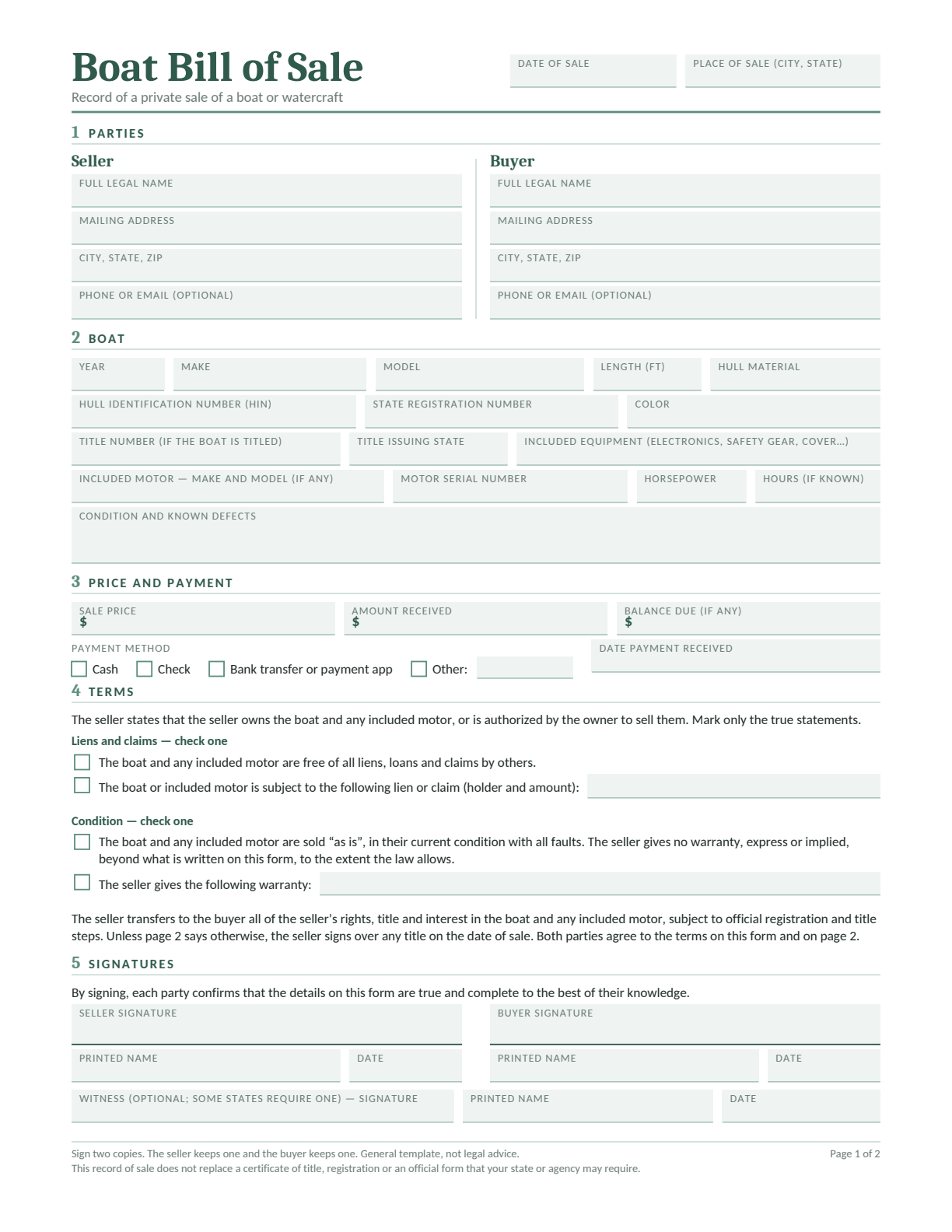
Boat Bill of Sale
Record the boat, included equipment, condition, price and payment.
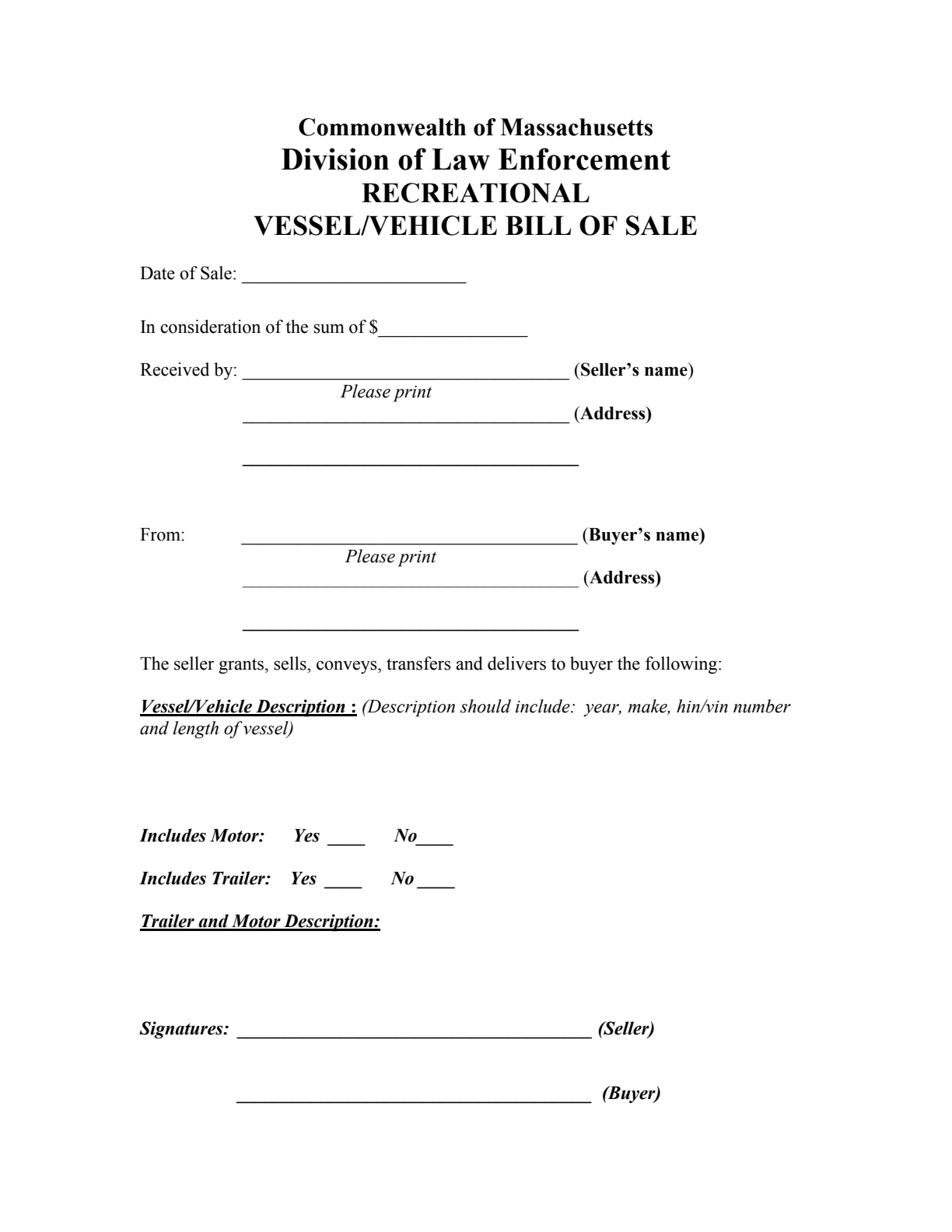
The Environmental Police publishes this recreational vessel/vehicle sale form as its sample for boats. It has space to identify a motor and trailer included in the deal. It is separate from the RMV vehicle title application.
What to Fill In
Date, payment and parties: Write the sale date and amount received, then the seller’s and buyer’s printed names and addresses.
Vessel description: Include the year, make, HIN and vessel length. Match the HIN to the hull and ownership papers.
Included motor and trailer: Mark the yes or no choices and describe any included motor and trailer separately, with their identifying numbers.
Signatures: Both buyer and seller sign the form. Keep a copy with the other ownership and payment records.
Allocate the trailer’s price separately when preparing the boat tax and RMV paperwork. Including a trailer on this form does not register it.
Preview of the official form. Page 1 of 2. Open its PDF for the complete form and instructions.
Prepare the boat application for Environmental Police
Motor-powered boats operated on Massachusetts public waterways generally need registration, including a canoe or sailboat using an electric motor. Boats 14 feet or longer designed for or used with a motor generally also need a title, subject to the listed exemptions. Obtain the seller’s assigned title when applicable.
The first-time registration checklist requires the bill of sale, proof of sales-tax payment and a pencil tracing or digital photograph of the HIN, along with the applicable ownership papers and application. The seller’s name, address and signature must appear on the bill of sale.
After selling, notify Environmental Police within 15 days. The boat registration FAQ explains the registration, title and seller-notice requirements. Road-trailer paperwork goes through RMV separately.
Massachusetts Trailer Bill of Sale
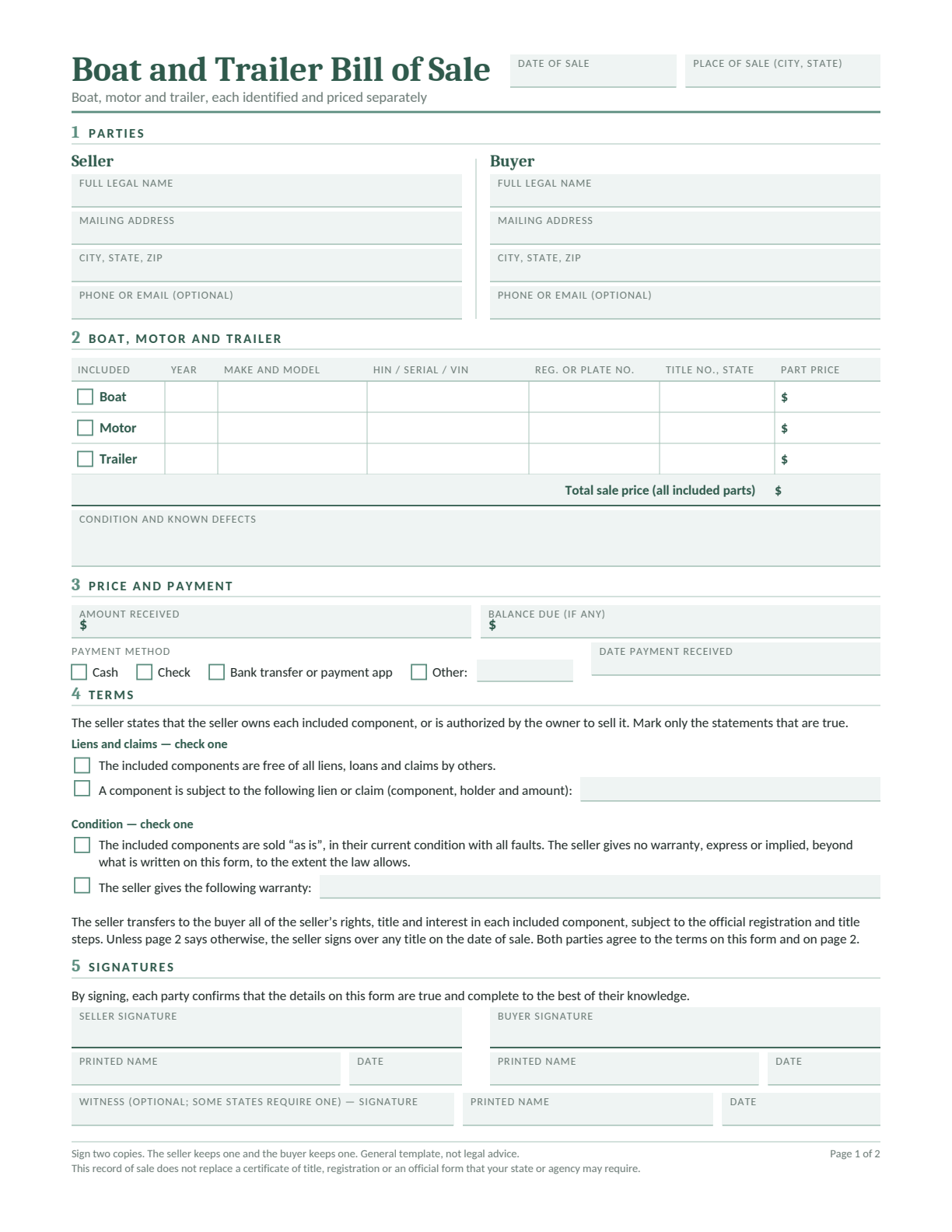
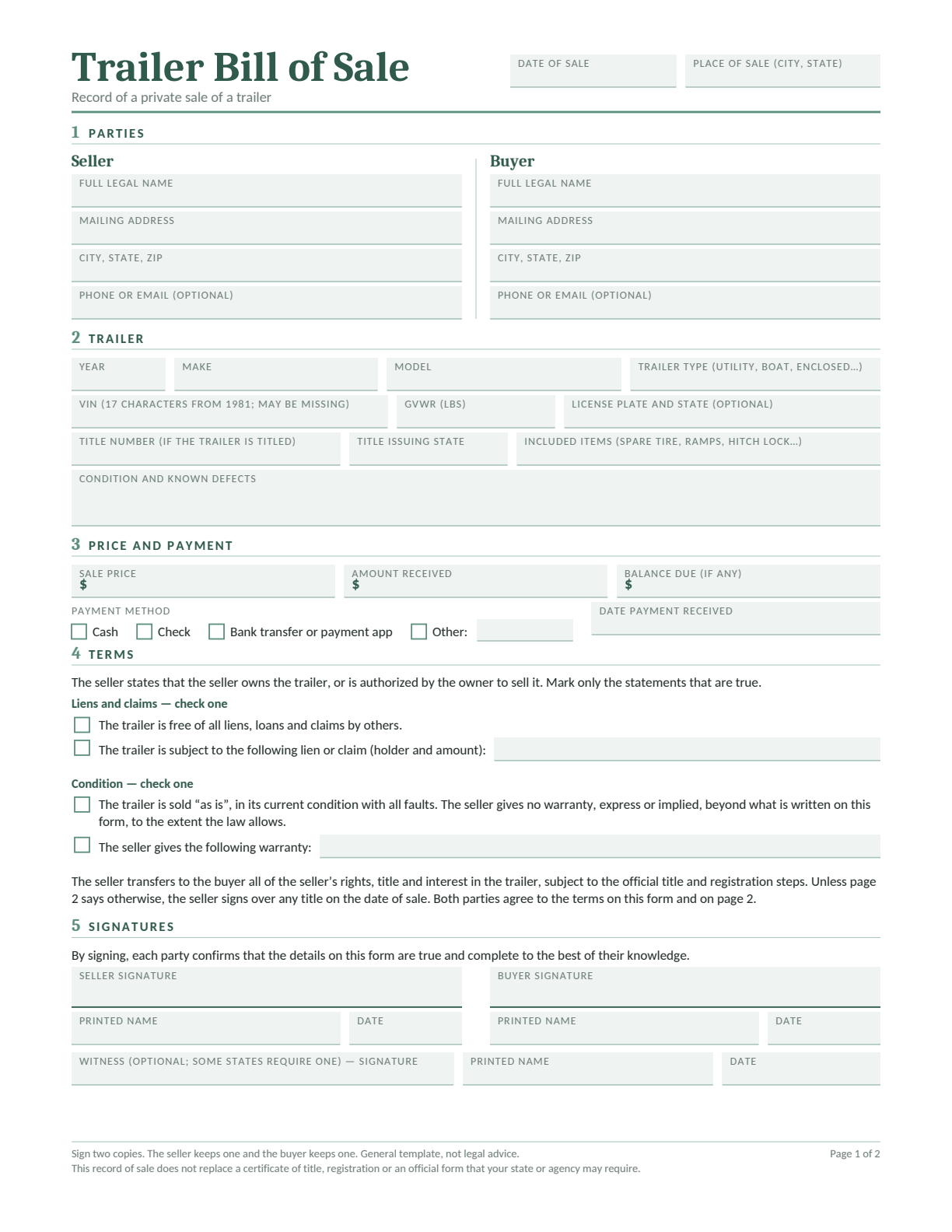
For a trailer, record its VIN, gross weight and sale price, plus any included spare wheel or other equipment. A boat-and-trailer package still needs a separate trailer ownership and registration check.
Trailer Bill of Sale
Describe the trailer and included equipment, then record the price, payment and any remaining balance. Use page 2 for extra terms, such as collection arrangements.
Edit in Word or Google Docs, type into the fillable PDF, or print a blank copy. Complete both pages and keep them with the ownership papers.
Massachusetts title law exempts trailers with a gross weight of 3,000 pounds or less. A heavier trailer generally needs a title. This is gross weight, not simply the empty weight.
For a titled trailer, obtain the assigned title and apply within the RMV’s 10-day period. For a title-exempt used trailer, keep the previous registration and signed bill of sale as ownership evidence. Confirm the RMV registration documents before towing it on public roads; the title exemption does not make the sale record a plate or registration.
Completed Massachusetts Bill of Sale Example
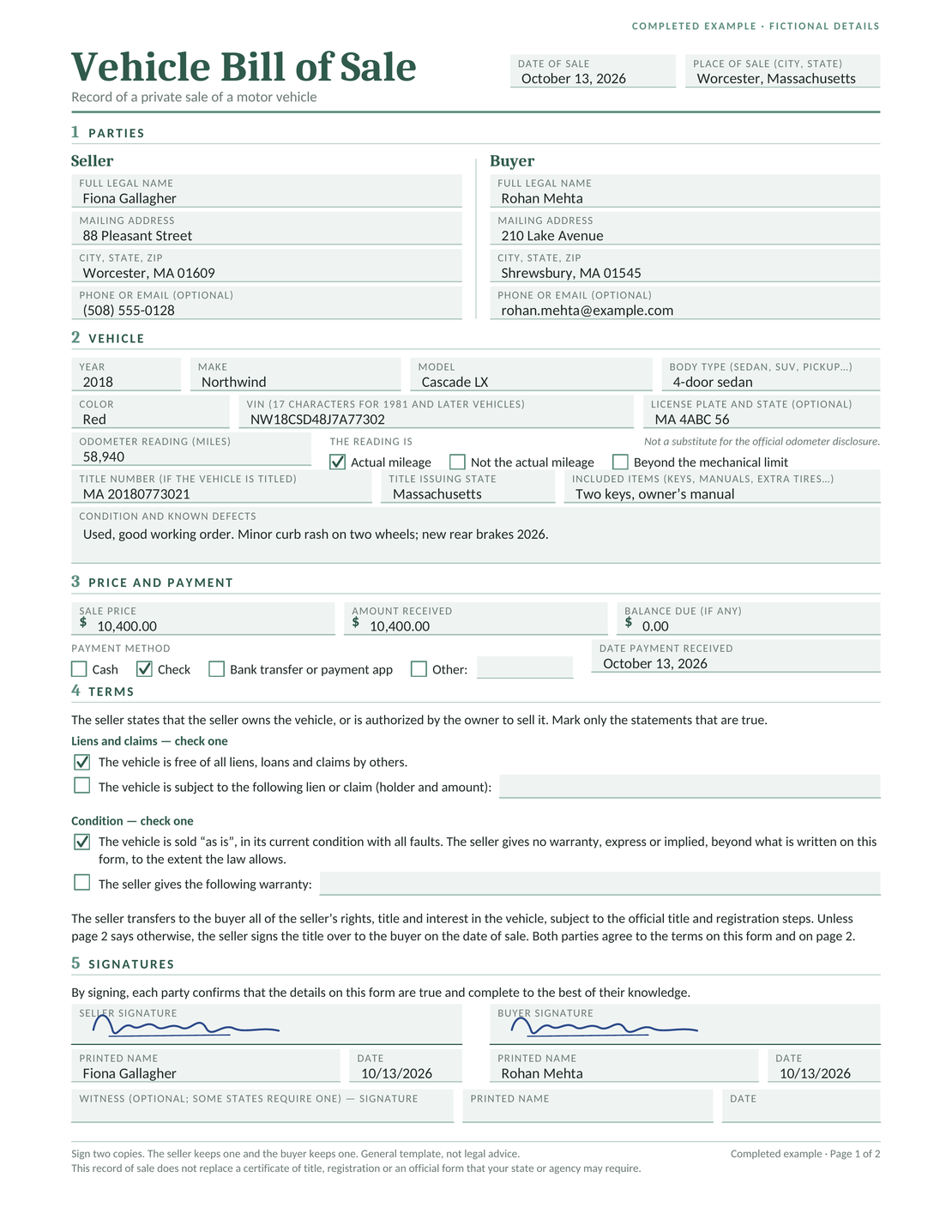
This fictional Worcester sale shows Fiona Gallagher selling Rohan Mehta a red 2018 Northwind Cascade LX for $10,400 on October 13, 2026. The full price is recorded as received, with no balance remaining.
The description records 58,940 miles, minor curb rash on two wheels and new rear brakes fitted in 2026. Two keys and the owner’s manual are included, so the agreement covers both the car’s condition and the items handed over.
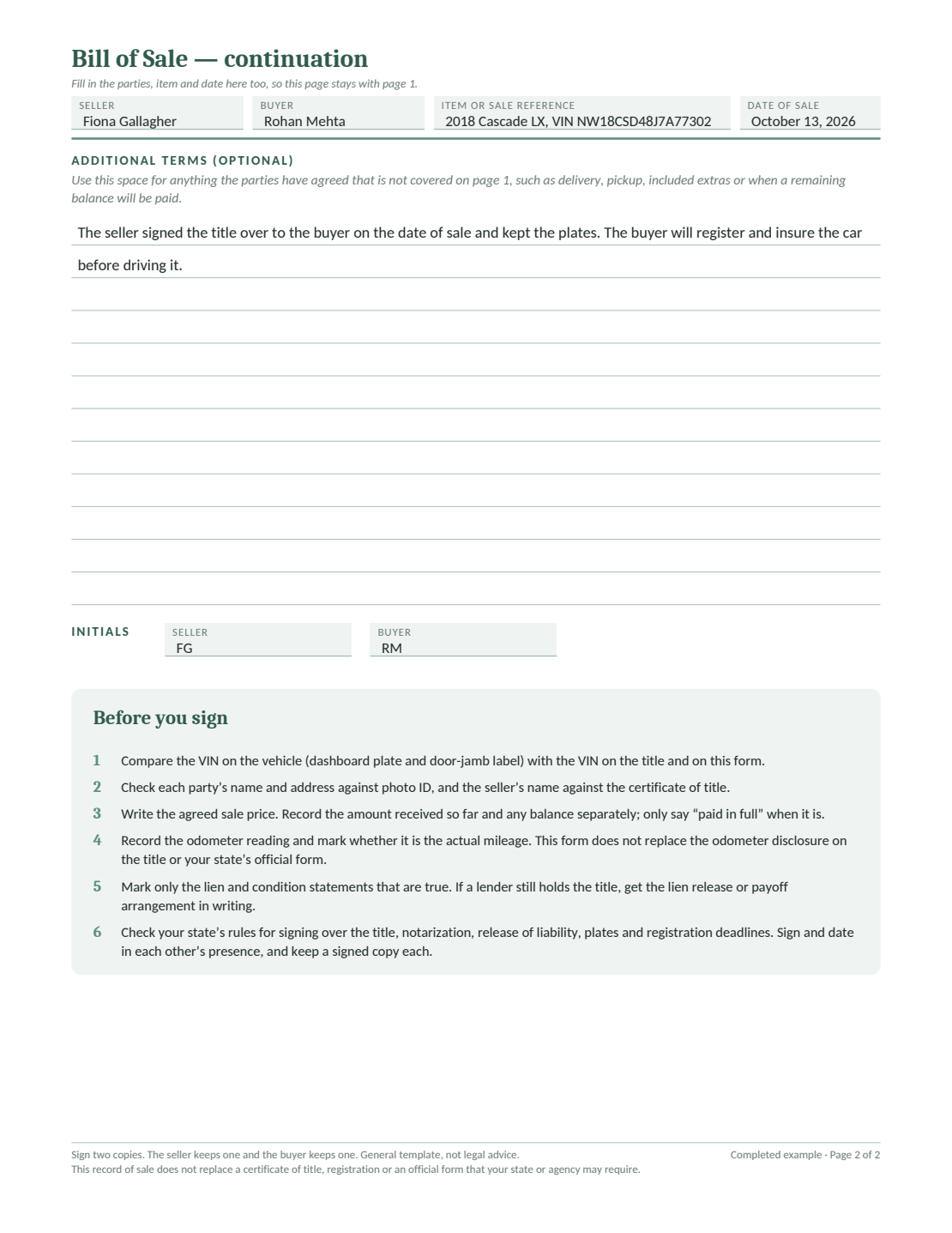
On page 2, Fiona has signed over the title and kept the plates. Rohan’s insurance and registration are planned before driving; the example does not show those steps completed.
Page 1: car, known condition and payment
Page 2: title transfer, retained plates and buyer’s next steps
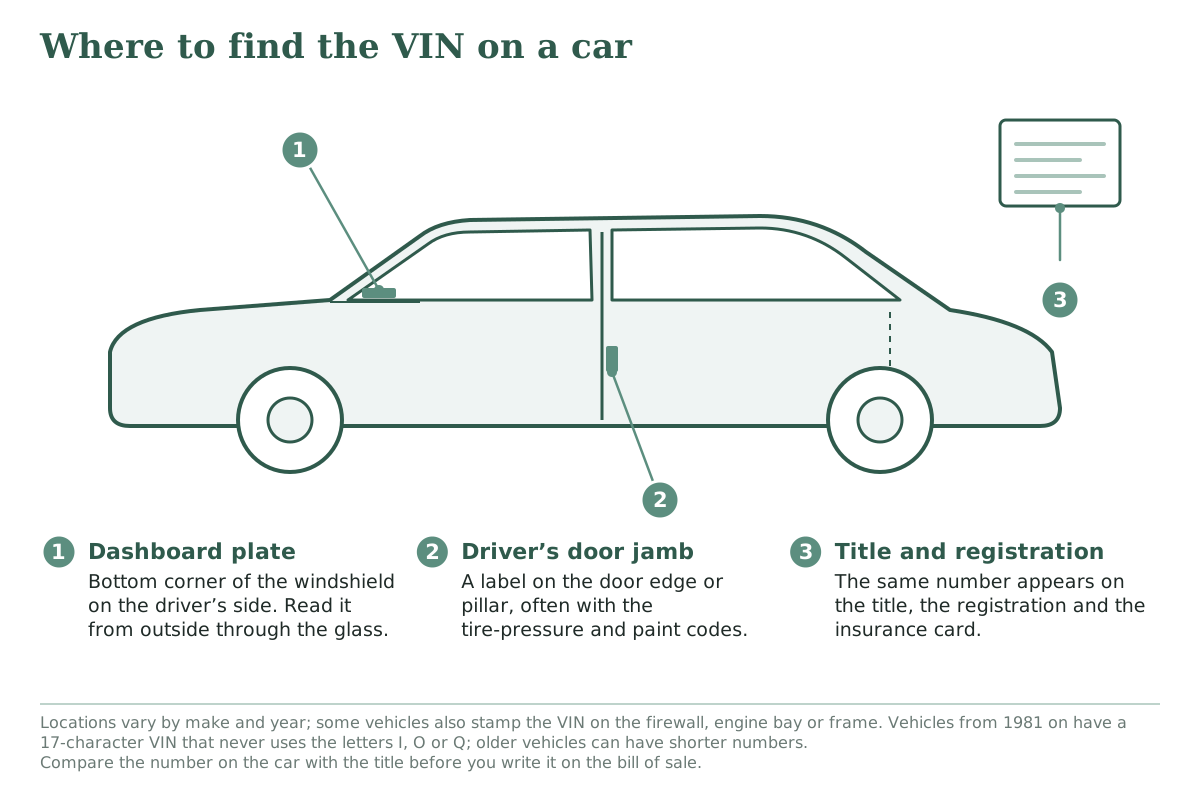
Compare the identifying number on the property with the ownership papers before copying it into your sale record.
Look through the windshield at the driver-side dashboard. Also check the label inside the driver’s door opening. Locations vary, so consult the vehicle’s manual if needed.
Resolve a missing or mismatched number with the agency handling the transfer. Do not guess from an unclear label.
Compare the seller’s name and all co-owners with the ownership document.
Match the VIN or HIN on the property to the papers before copying it.
Record known defects and anything included in the price.
Separate the agreed price, money received and balance still owed.
Resolve any lien and check which title, registration or disclosure signatures are required.
Keep the Sale Record with the Transfer Papers
Keep both signed pages together with a copy of the assigned ownership document and proof of payment. Save any filing receipt separately: a promise in the sale agreement to apply or report the sale does not show that the agency received it.
It is required to show the price if the ownership title has no sale-price space. For a qualifying title-exempt vehicle, RMV uses the previous registration and bill of sale as ownership evidence. Keep a signed sale record for your own files in either case.
The ordinary private-sale instructions call for the parties’ signatures and do not require a notarized bill of sale. Separate correction or special-transaction affidavits may have their own requirements.
An “as is” statement does not remove Massachusetts’s requirement to disclose known defects that affect safety or substantially impair use. Describe those defects in writing and keep a signed copy.
The general title threshold is 14 feet for boats designed for or used with a motor. A smaller motorboat can still require registration. Check the Environmental Police exemptions and ownership checklist.
Yes, the statute exempts trailers with gross weight of 3,000 pounds or less. Registration and ownership evidence still need attention before road use.
After 14 days, continue for
$12.99/month
only if you choose to upgrade.
We use cookies to provide you with the best possible experience. Cookies also help us analyze user behaviour so we can continue to improve our website. View our cookie policy.