Choose a free Utah bill of sale template to record a vehicle, boat or trailer purchase. Include the actual price, any trade-in and the property’s condition.
Use the guidance below to prepare the ownership papers and decide whether plates are included.
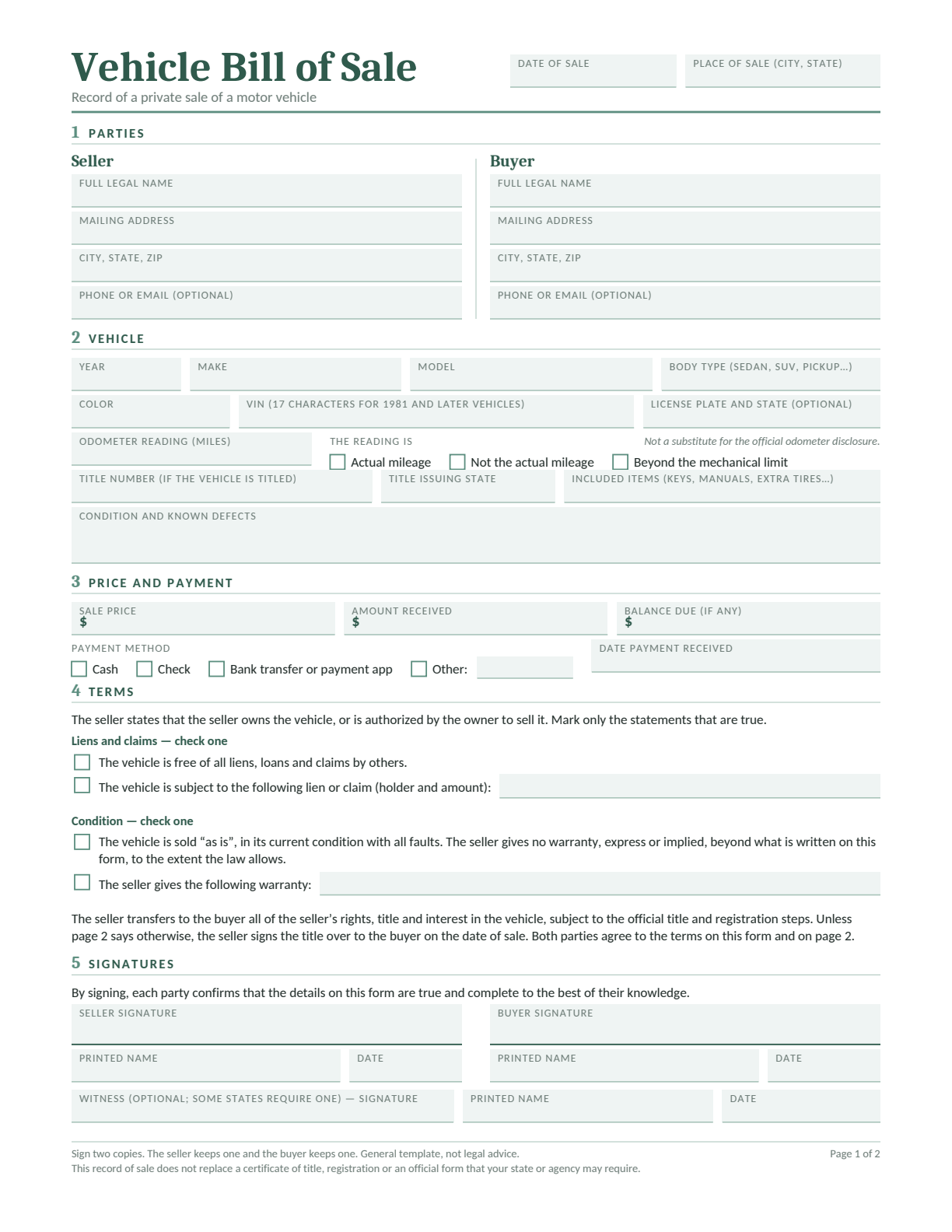
Record the seller and buyer, the vehicle’s VIN and mileage, and the price agreed for the sale. Keep the amount received separate from any remaining balance. Describe known defects and list included keys, documents and equipment.
Edit in Word or Google Docs, type into the fillable PDF, or print the blank PDF to complete by hand.
In Google Docs, sign in and choose Make a copy. Use page 2 for extra terms, then keep both pages together.
A Utah bill of sale records the property sold and the terms of payment. It also gives the buyer evidence of the purchase price when applying for title and registration.
The state offers TC-843, but accepts a handwritten or typed bill with the required information. Use a clear sale record alongside the ownership documents, and state any agreement about plates, included equipment or a remaining balance.
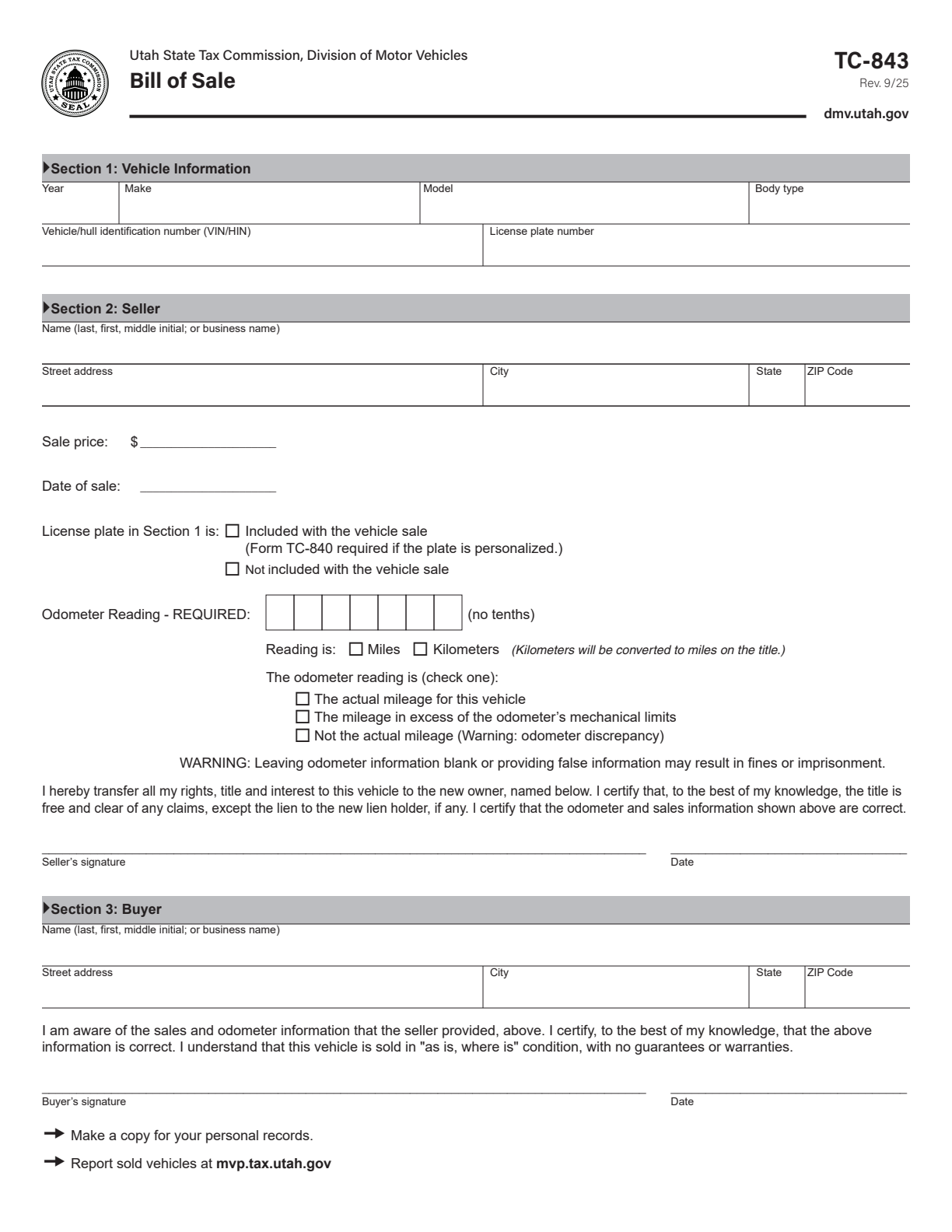
Utah Bill of Sale TC-843
TC-843 provides one state form for recording a sale, with a VIN/HIN field for the property and a specific choice about license plates. It includes an as-is, where-is acknowledgment for the buyer.
What to Fill In
Vehicle or hull: Copy the year, make, model, body type and VIN or HIN from the property and ownership papers. Enter the plate number where applicable.
Seller and sale: Enter the seller’s name and address, sale price and date. Mark whether the plate is included; a personalized plate transfer also needs TC-840.
Odometer: Enter the reading without tenths, choose miles or kilometers and mark the correct mileage-status statement. Read the certification before signing.
Buyer: Enter the buyer’s name and address. The buyer reads the sale, odometer and as-is acknowledgment, then signs and dates. The seller also signs and dates the seller section.
TC-843 has no notary block. Complete any separate title or odometer disclosure needed for the transfer; do not assume a mileage entry here completes every requirement.
Preview of the official form. Rev. 9/25. Open its PDF for the complete form and instructions.
Give the Buyer a Transferable Title
Check the VIN and the seller’s ownership before paying. A Utah title assignment does not need a notary. For co-owners joined by “and,” obtain both signatures; an “or” title allows either owner to sign. Complete the required odometer disclosure on the title or appropriate official form.
Utah requires the seller to deliver the title and registration at handover or within 48 hours afterward. It is better to arrange the papers before exchanging money than rely on a later promise. See Utah’s ownership-transfer rules.
Seller: Settle Plates and Report the Sale
Remove the plates unless their transfer is part of the sale. If the buyer is keeping them, record that agreement and have the buyer apply to DMV for reassignment. Plates retained by the seller must be reassigned or forwarded to DMV within 20 days under the transfer statute.
Report the sale through Utah’s Motor Vehicle Portal or another method listed in DMV’s seller instructions. Keep the bill and a copy of the assigned title with your report confirmation.
Buyer: Arrange Registration Before Driving
Present the endorsed ownership papers and apply for your title and registration before operating the transferred car on a highway. If the documents or an inspection are still being arranged, ask DMV about a temporary permit; the bill of sale is not itself permission to drive.
Bring identification, the sale record, any lien release and the required application and inspection documents. Eligible Utah-titled transfers can use the online person-to-person process described in DMV’s title guidance.
Record the Net Purchase Price
Utah uses a qualifying signed bill to establish the net purchase price for sales tax. Identify any vehicle traded in and its agreed allowance, then show the price after that allowance. An equipment swap or promised labor is not the same as a qualifying vehicle trade-in. Without an acceptable bill, DMV may use fair market value. DMV explains the price and trade-in information to include.
Utah Boat Bill of Sale Templates
For a Utah boat purchase, identify the hull and outboard separately. A motor may need its own title even when it is sold already attached to the boat. Use the bundle form if the deal also includes a trailer.
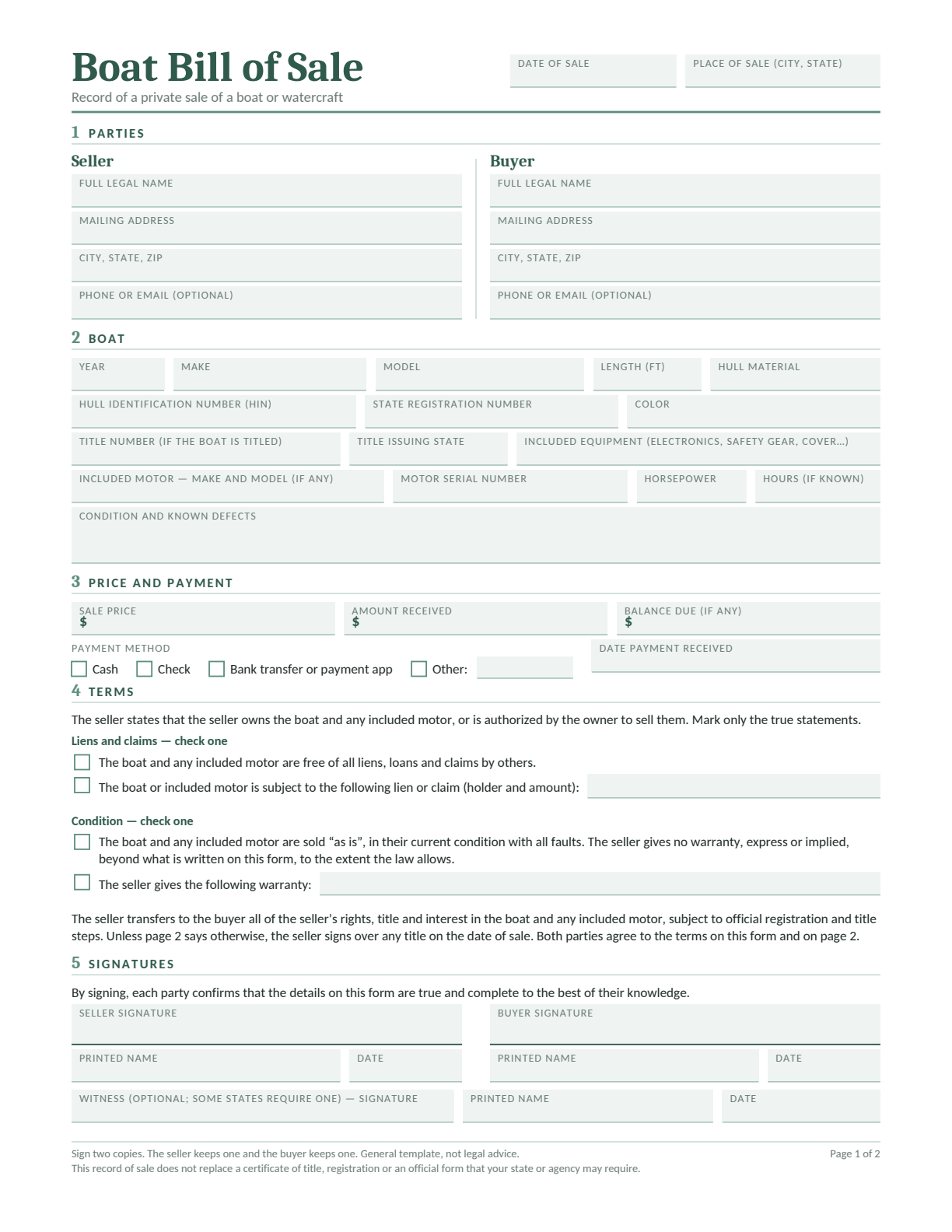
Boat Bill of Sale
Record the boat, included equipment, condition, price and payment.
Utah DMV generally titles watercraft from model year 1985 onward, with exceptions such as canoes and certain inflatable boats. Outboards from 1985 onward with more than 25 horsepower generally need their own titles. Check DMV’s boat and outboard requirements against the actual hull and motor.
Get the assigned titles for each titled item and record the HIN, motor serial number and separate prices. Use the vessel title/registration application TC-656V. A vessel being titled in Utah for the first time generally needs an identification inspection on TC-661.
Register a motorboat or sailboat before use unless it qualifies for an exemption. The vessel registration statute gives the owner 15 days to notify DMV of a transfer; this is a seller notice period, not a 15-day window for the buyer to operate without registration.
Utah Trailer Bill of Sale
Record the trailer’s unladen weight, axle arrangement, VIN and intended use. Utah’s title and registration exemptions are different, so a trailer that does not need registration can still need a title.
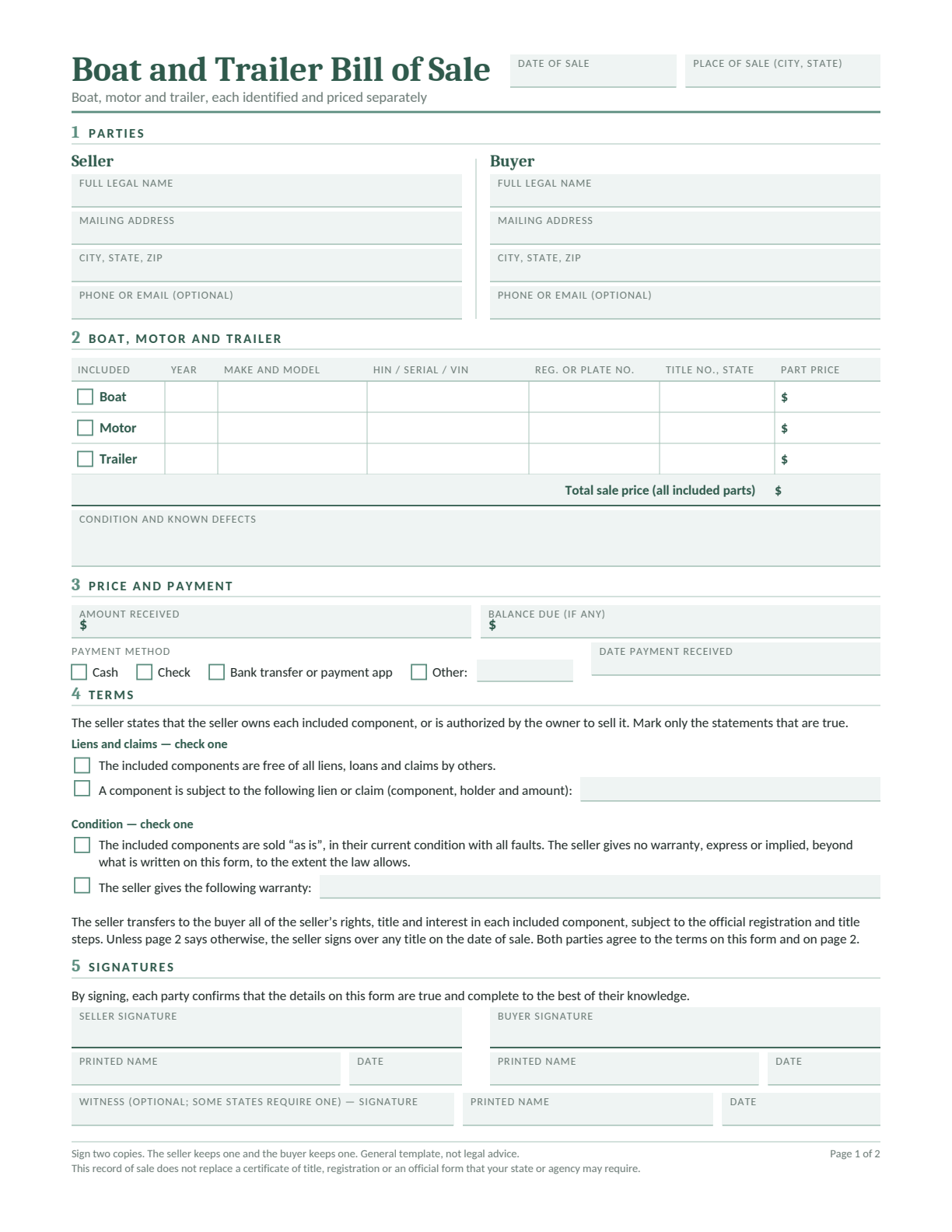
Trailer Bill of Sale
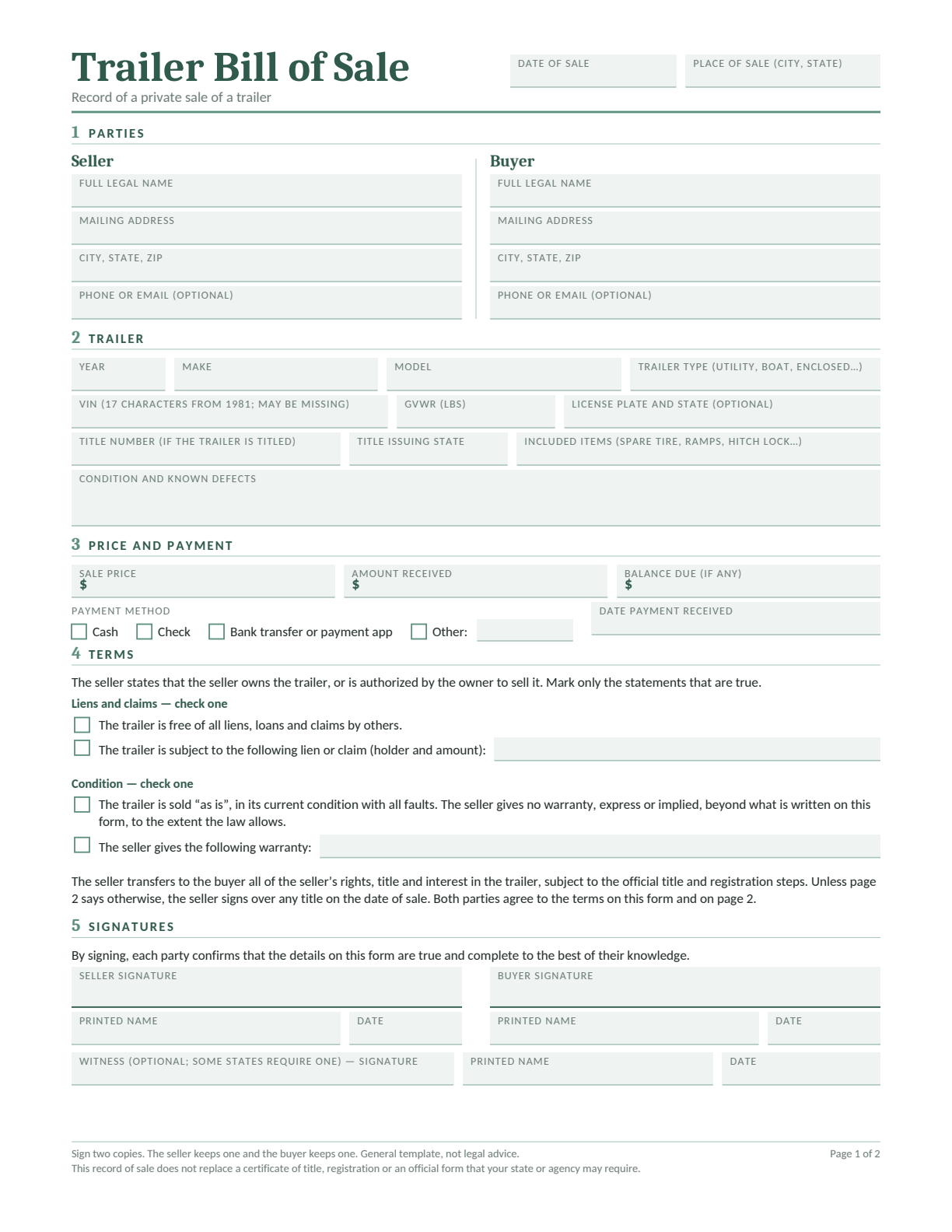
Describe the trailer and included equipment, then record the price, payment and any remaining balance. Use page 2 for extra terms, such as collection arrangements.
Edit in Word or Google Docs, type into the fillable PDF, or print a blank copy. Complete both pages and keep them with the ownership papers.
Utah’s title guidance exempts noncommercial trailers with an unladen weight of 750 pounds or less. A heavier trailer can need a title even when its single-axle configuration qualifies for a registration exemption.
The registration statute separately exempts qualifying trailers of 750 pounds or less shipping weight and certain single-axle trailers. Its single-axle exemption excludes commercial and for-hire trailers, and travel, camping or fifth-wheel trailers of at least 750 pounds GVWR. Check these details rather than relying on axle count alone.
For a homemade trailer, preserve receipts and bills of sale for the frame and other parts. Utah treats these as specially constructed vehicles, requiring an ownership statement, applications and assigned identification process when titling and registration are required.
Completed Utah Bill of Sale Example
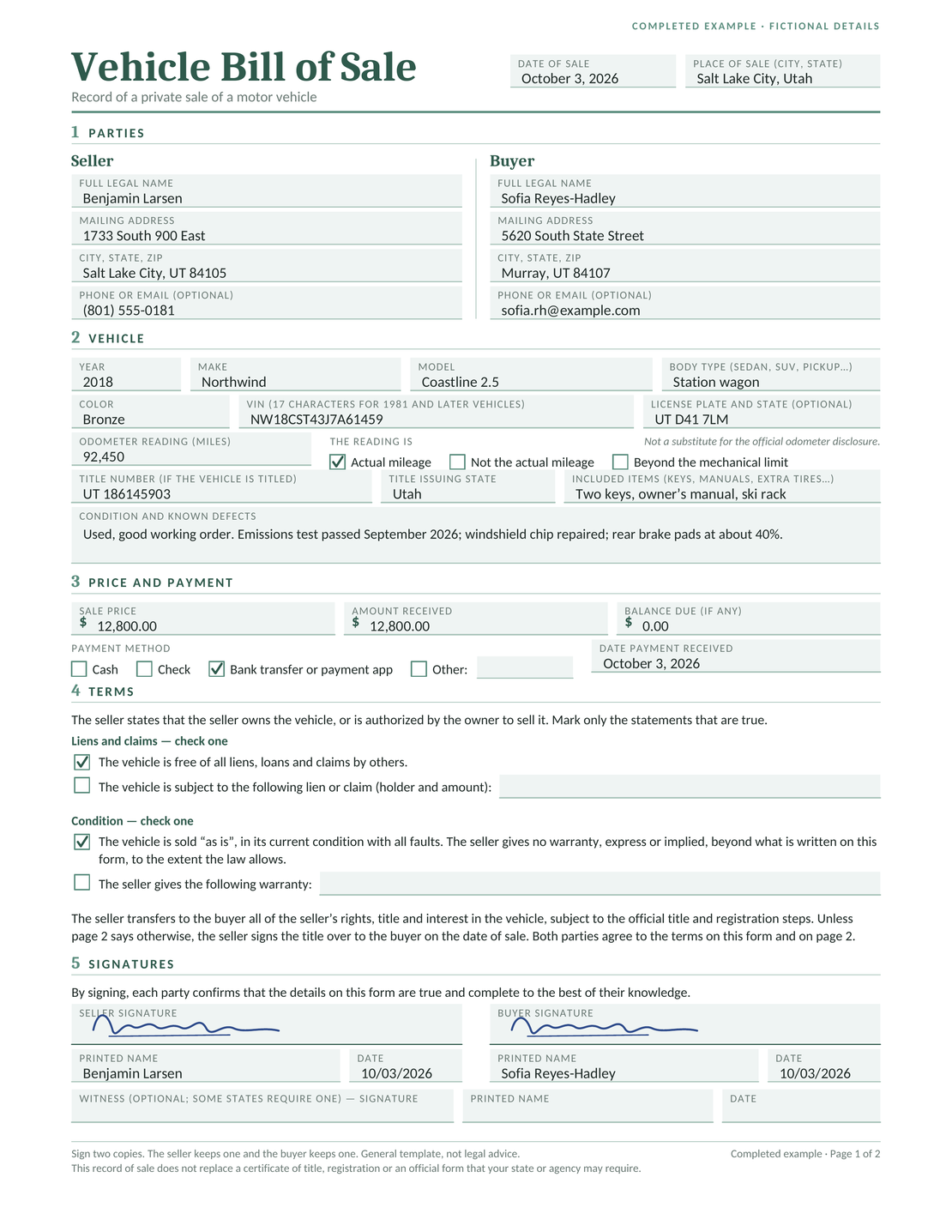
This fictional Salt Lake City sale records Benjamin’s 2018 Coastline wagon sold to Sofia for $12,800, all received with a zero balance. The notes describe a repaired windshield chip and the remaining rear brake-pad wear, and include a ski rack with the car.
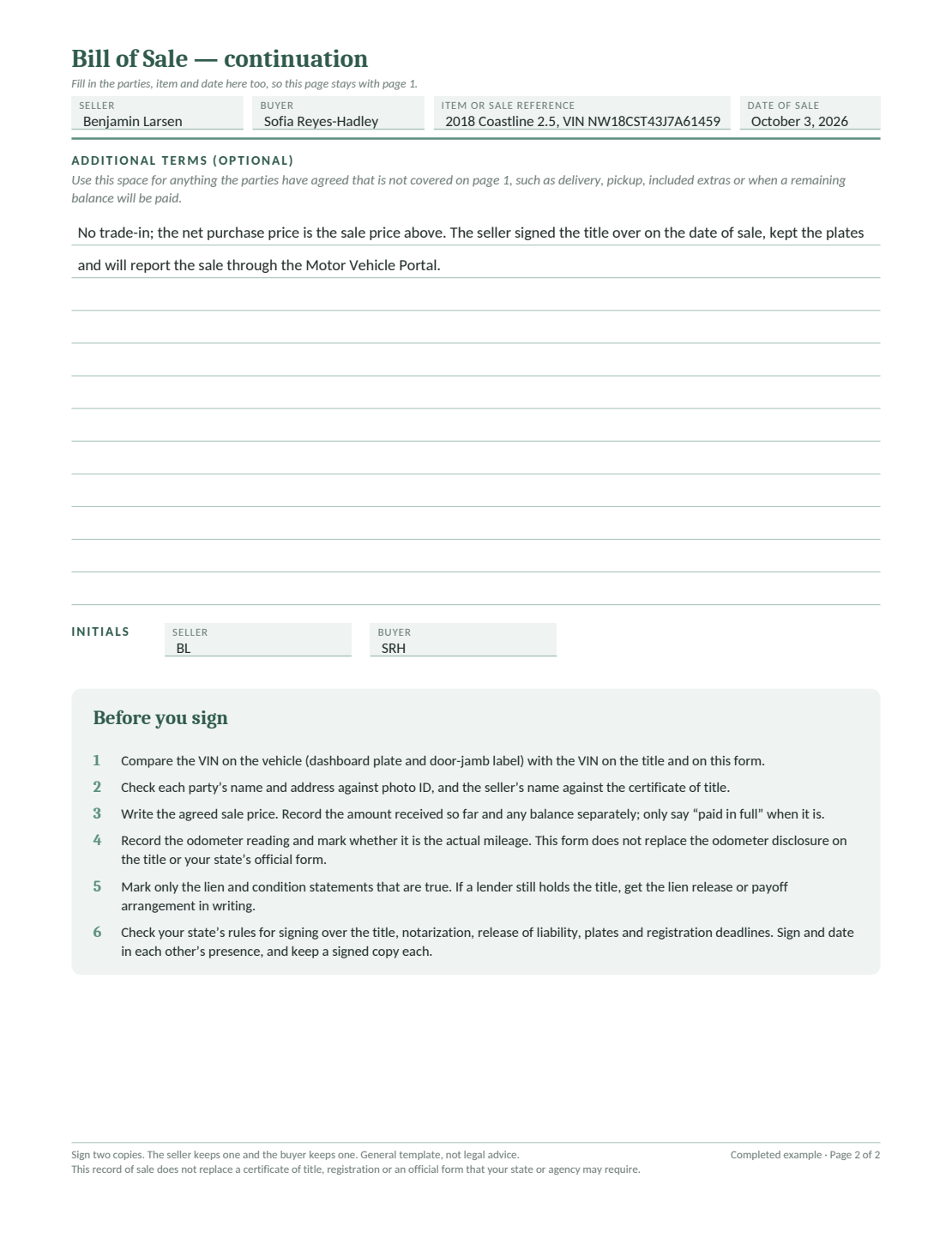
The second page makes clear that there was no trade-in, so the net purchase price equals the stated sale price. It records an assigned title and plates retained by the seller. Reporting the sale through the Motor Vehicle Portal remains a planned step; the sample does not show a submitted report.
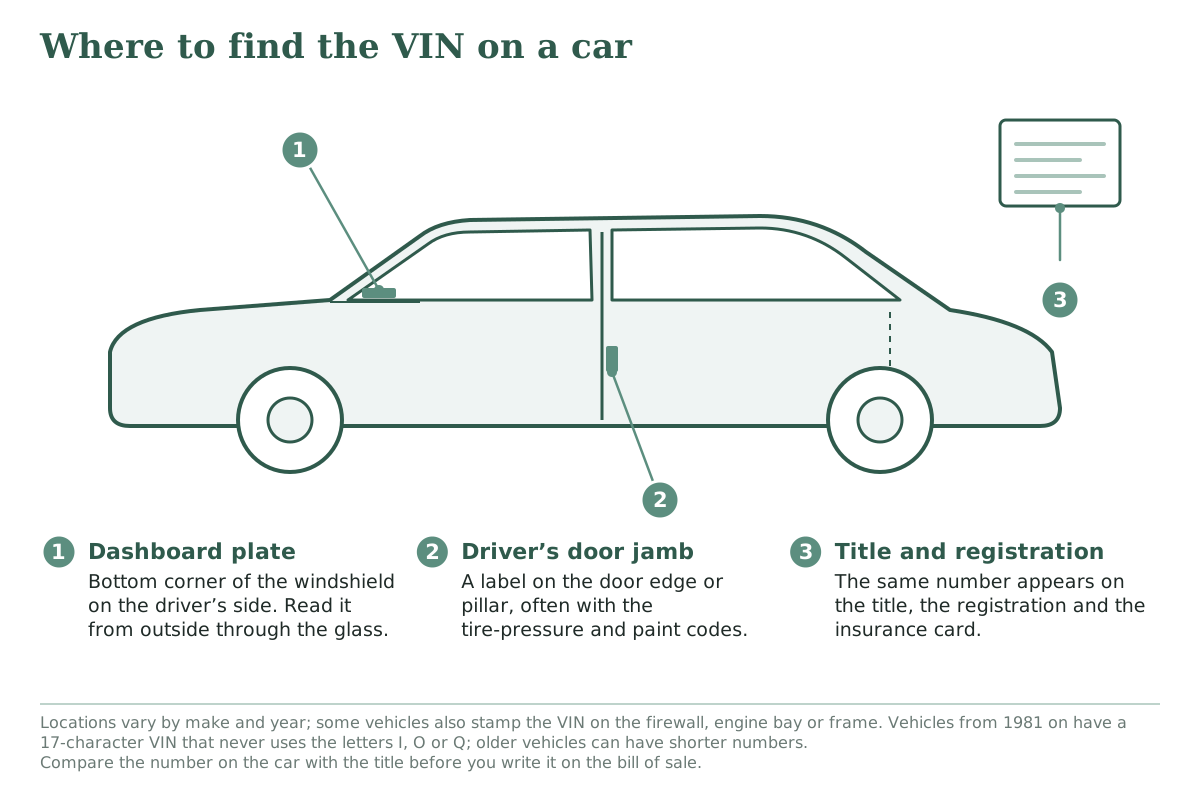
Compare the identifying number on the property with the ownership papers before copying it into your sale record.
Look through the windshield at the driver-side dashboard. Also check the label inside the driver’s door opening. Locations vary, so consult the vehicle’s manual if needed.
Resolve a missing or mismatched number with the agency handling the transfer. Do not guess from an unclear label.
Compare the VIN or HIN with the assigned title and the property itself.
Get signatures from every owner required by the title’s ownership wording.
Identify a vehicle trade-in and allowance separately from other extras.
Agree whether plates are included and who will apply for reassignment.
Check whether an outboard or trailer has its own title to hand over.
An ordinary Utah title assignment does not need notarization. Keep any required odometer disclosure with the ownership paperwork.
Keep the Sale Record with the Transfer Papers
Keep both pages of the signed sale record together with copies of the ownership papers and proof of payment. If a balance remains, record the later payment separately and keep it with the original agreement.
Save confirmations for any sale report, title application or registration request. A promise in the bill of sale describes what the parties agreed; the responsible person still needs to complete that action.
No. Utah accepts a handwritten or typed bill containing the required sale information. TC-843 is an official option; write clearly in ink if completing a paper bill.
No notary is needed for the ordinary Utah title assignment. Make sure all required owners sign and any lien has been released.
Utah allows plates to be included in the transfer. Record the agreement and have the buyer apply for reassignment. Otherwise, the seller removes them.
State that no trade-in is involved and that the net purchase price equals the sale price. Keep any unpaid balance separate; it is not a trade-in allowance.
It can. The single-axle rule concerns registration, while the title exemption is for noncommercial trailers of 750 pounds or less unladen weight. Check the trailer’s weight, type and use.
After 14 days, continue for
$12.99/month
only if you choose to upgrade.
We use cookies to provide you with the best possible experience. Cookies also help us analyze user behaviour so we can continue to improve our website. View our cookie policy.