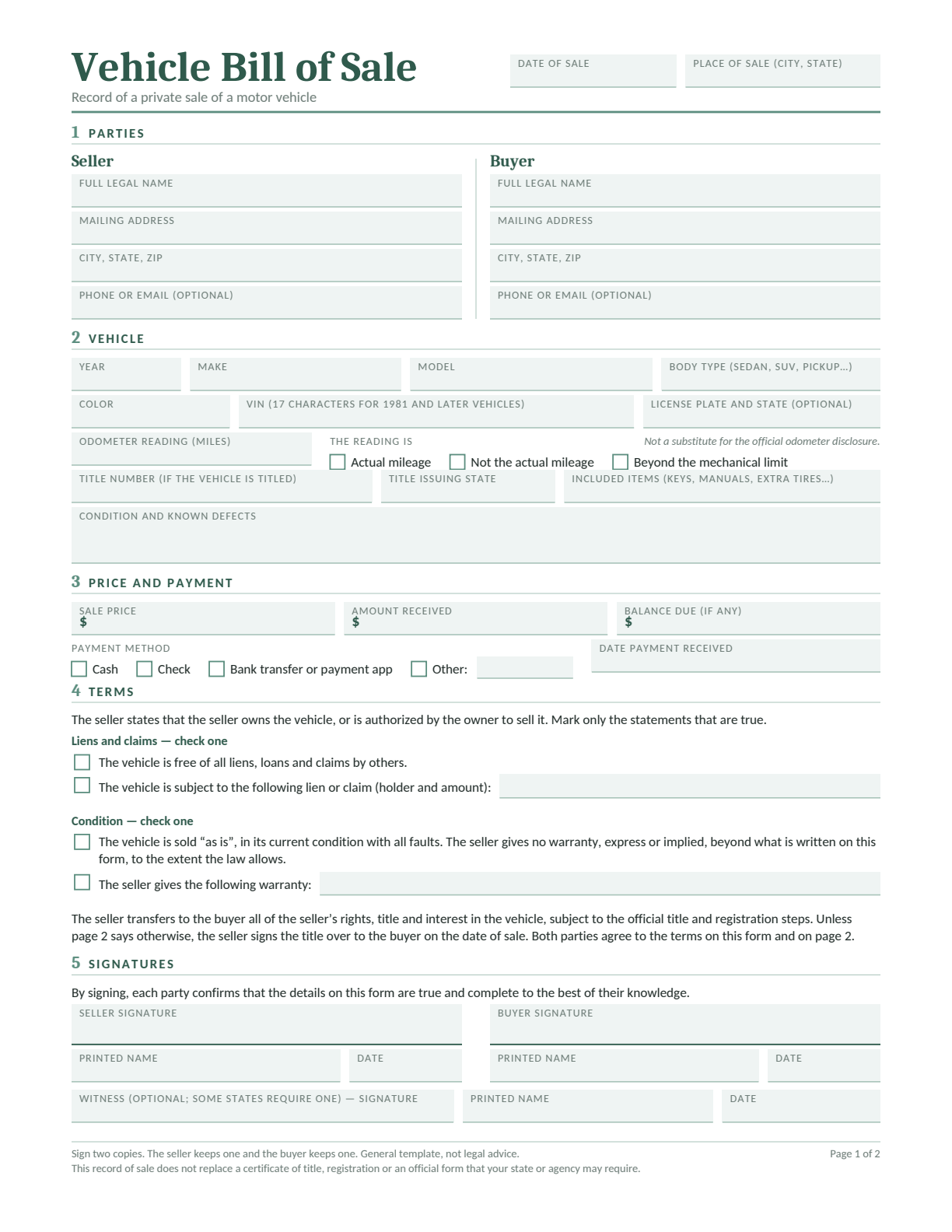
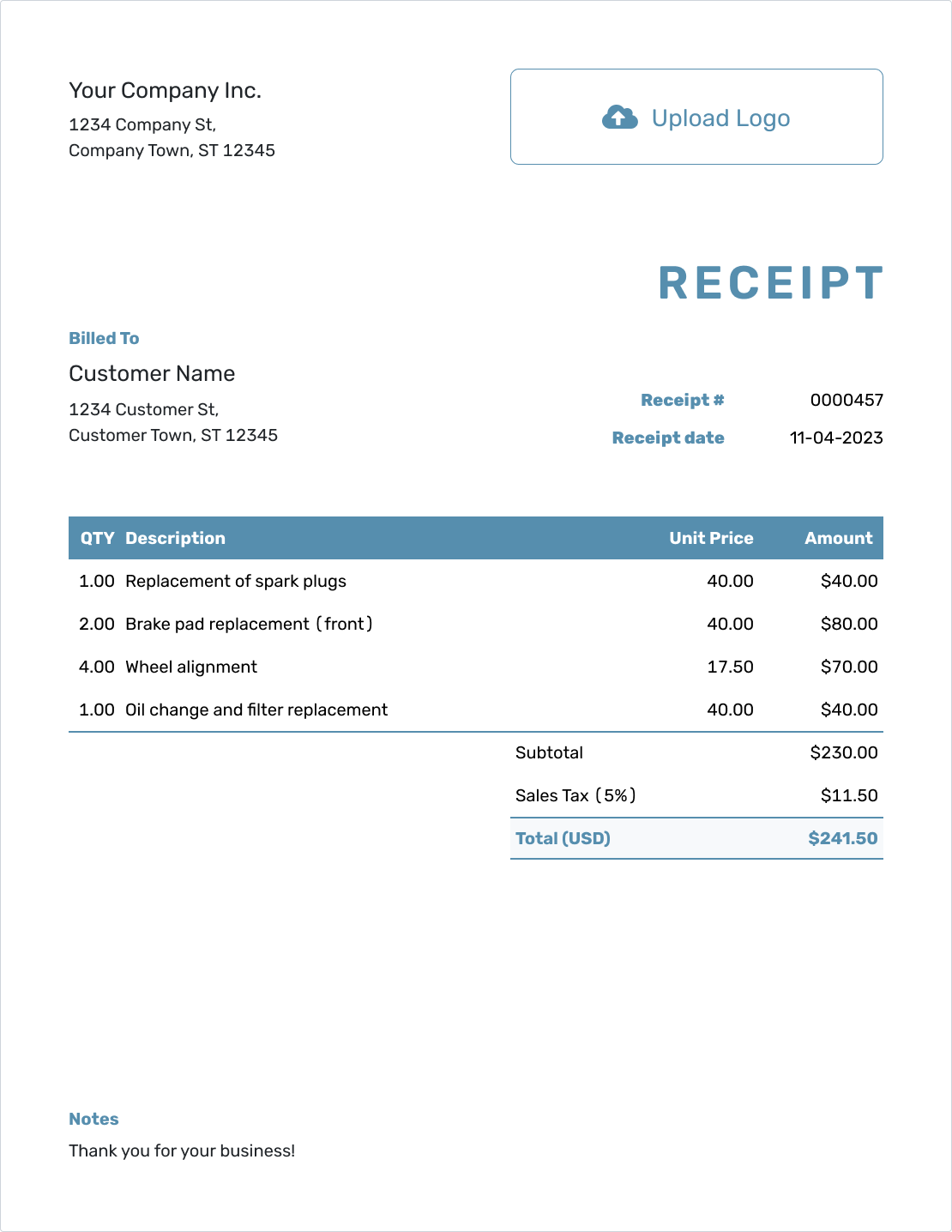
Record the vehicle’s VIN, mileage, price and payment, then describe known defects and included items. Use the second page for a remaining payment, collection date or other agreed terms. Keep both pages with the ownership papers.
Edit in Word or Google Docs, type into the fillable PDF, or print the blank PDF to complete by hand.
In Google Docs, sign in and choose Make a copy. Use page 2 for extra terms, then keep both pages together.
A bill of sale records who sold the property, who bought it, the sale date and the agreed price. Payment fields show how much the seller has received and whether any balance remains. Both people keep a signed copy.
This page covers private vehicle, boat and trailer sales in Maryland. Keep the sale record with the title or registration documents that apply to the property. For furniture, tools or other personal property, see the general bill of sale templates.
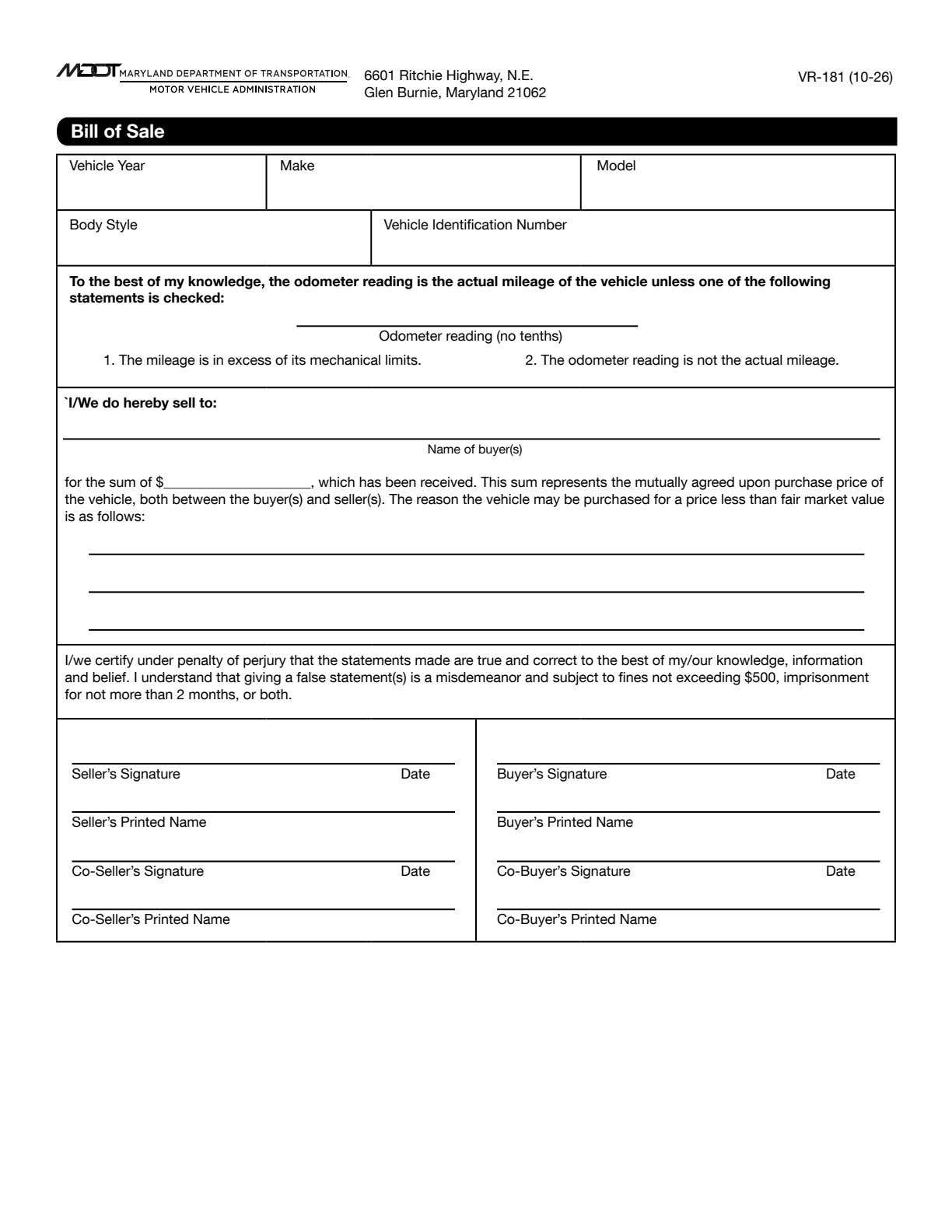
Maryland MVA Bill of Sale — VR-181
Use MVA’s vehicle form when a separate official sale record is needed. It records the agreed price, mileage and the parties’ certifications. The October 2026 revision does not require a notary.
What to Fill In
Vehicle and mileage: Enter the year, make, model, body style and VIN. Write the odometer reading without tenths and mark a mileage exception only when it applies.
Price and explanation: Enter the buyer and amount received. Use the explanation area to describe why the vehicle sold below fair market value, where relevant; do not invent a reason.
Signatures: The buyer and seller print their names, sign and date. Complete the co-buyer and co-seller lines when applicable.
The form’s amount statement says the money has been received. Do not use it to suggest that an unpaid balance has already been paid.
Preview of the official form. 10-26. Open its PDF for the complete form and instructions.
Record the sale and complete the Maryland title
For a titled vehicle, the seller completes the assignment on the title, including the buyer, price, sale date and required odometer disclosure. A bill of sale adds a separate record of the payment, condition and agreed terms; it does not replace that assignment.
Check the title for liens and the owners whose signatures are needed. Complete the buyer’s details, price, date and mileage accurately before handing it over.
MVA’s seller instructions say to remove your plates and return them to MVA. Keep the plate-return receipt and copies of both sides of the assigned title and the signed sale record.
Buyer: arrange title, insurance and inspection
Obtain the assigned title, any required lien release and the sale record. Check the current MVA requirements for titling, registration, insurance and safety inspection before driving.
The seller’s plates do not go with the vehicle. Plan collection around your own valid registration or an applicable temporary registration; signing the bill of sale alone does not authorize road use.
Maryland Boat Bill of Sale Templates
A boat package can include three separately identified items: the hull, motor and road trailer. List each identifier and price allocation so the DNR boat papers and MVA trailer papers can be completed consistently.
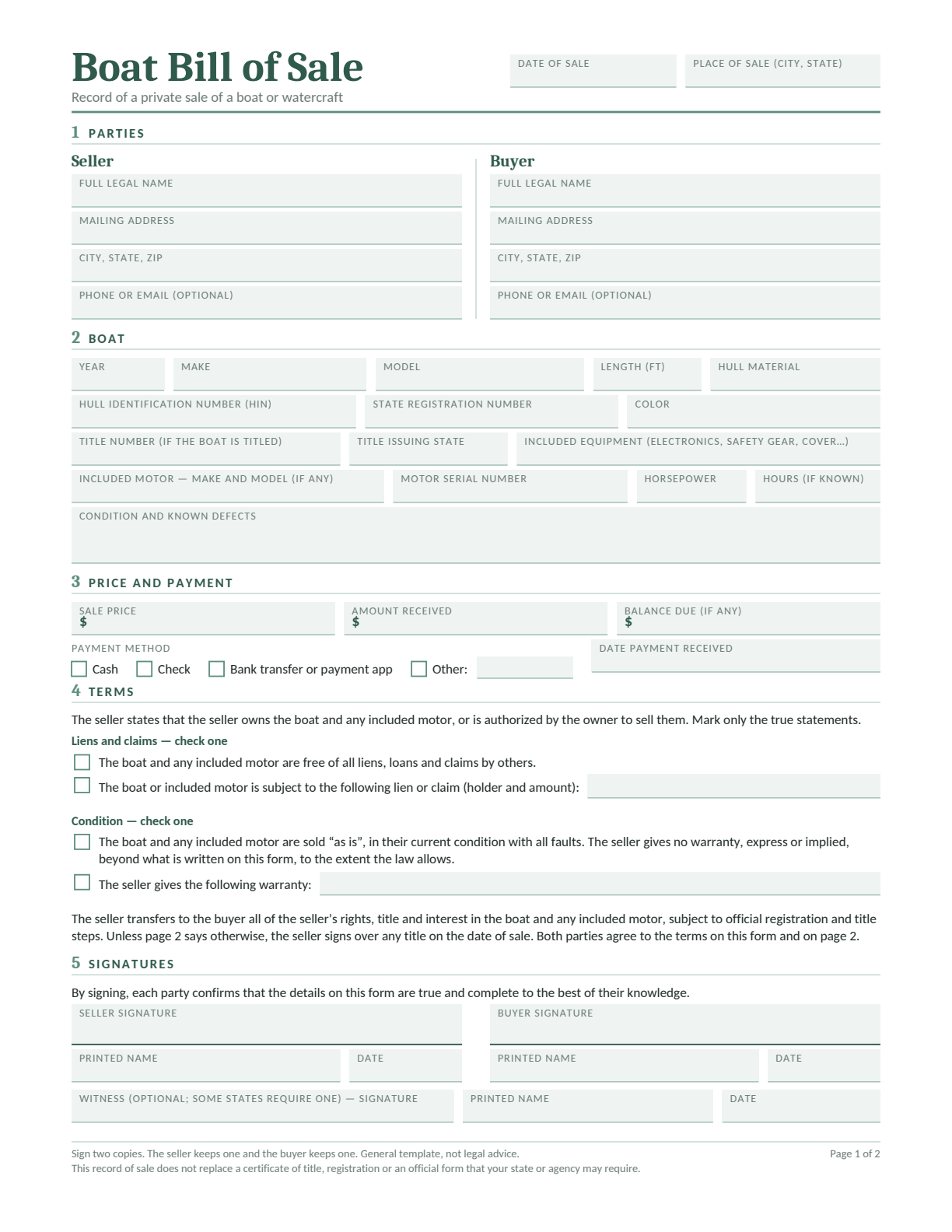
Boat Bill of Sale
Record the boat, included equipment, condition, price and payment.
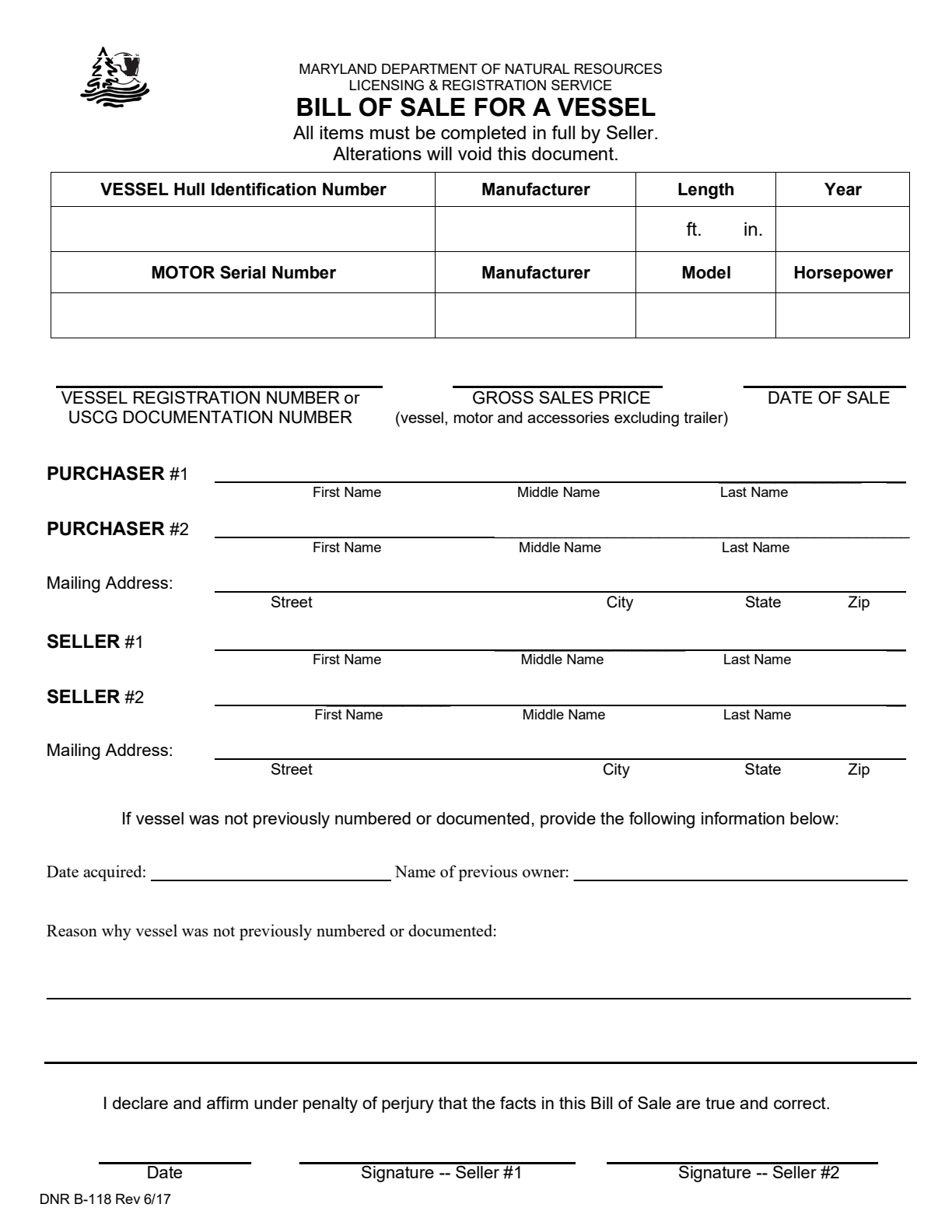
DNR’s vessel form includes the seller’s certification under penalty of perjury. It supplies a certified sale record for the boat application when DNR requires one. The seller must complete all applicable items; alterations void the document.
What to Fill In
Boat and motor: Copy the HIN, manufacturer, length and year, then the motor’s serial number, manufacturer, model and horsepower. Add the vessel registration or USCG documentation number.
Price and parties: Enter the sale date and gross price for the vessel, motor and accessories, excluding the trailer. Identify each purchaser and seller and their mailing addresses.
History and certification: If the vessel was not previously numbered or documented, complete that history section. Each seller signs the certification and dates the form.
Preview of the official form. 6/17. Open its PDF for the complete form and instructions.
Use DNR’s ownership checklist for the boat
A mechanically propelled vessel used principally in Maryland generally needs DNR registration. A Maryland purchase intended principally for Maryland waters must be registered within 30 days of purchase to avoid penalties and interest.
For a Maryland-titled boat, obtain the properly assigned original title and any lien release. DNR requires an original certified or notarized bill of sale if the buyer’s name, date or price is missing from the title assignment. For a boat from a non-titling state, supply the previous registration and an original certified or notarized bill of sale with the application.
The DNR registration guide explains which application and ownership documents fit each history. Its certified-sale option is satisfied by the required perjury statement, as included on B-118; it is not a direction to notarize every boat sale.
Maryland Trailer Bill of Sale
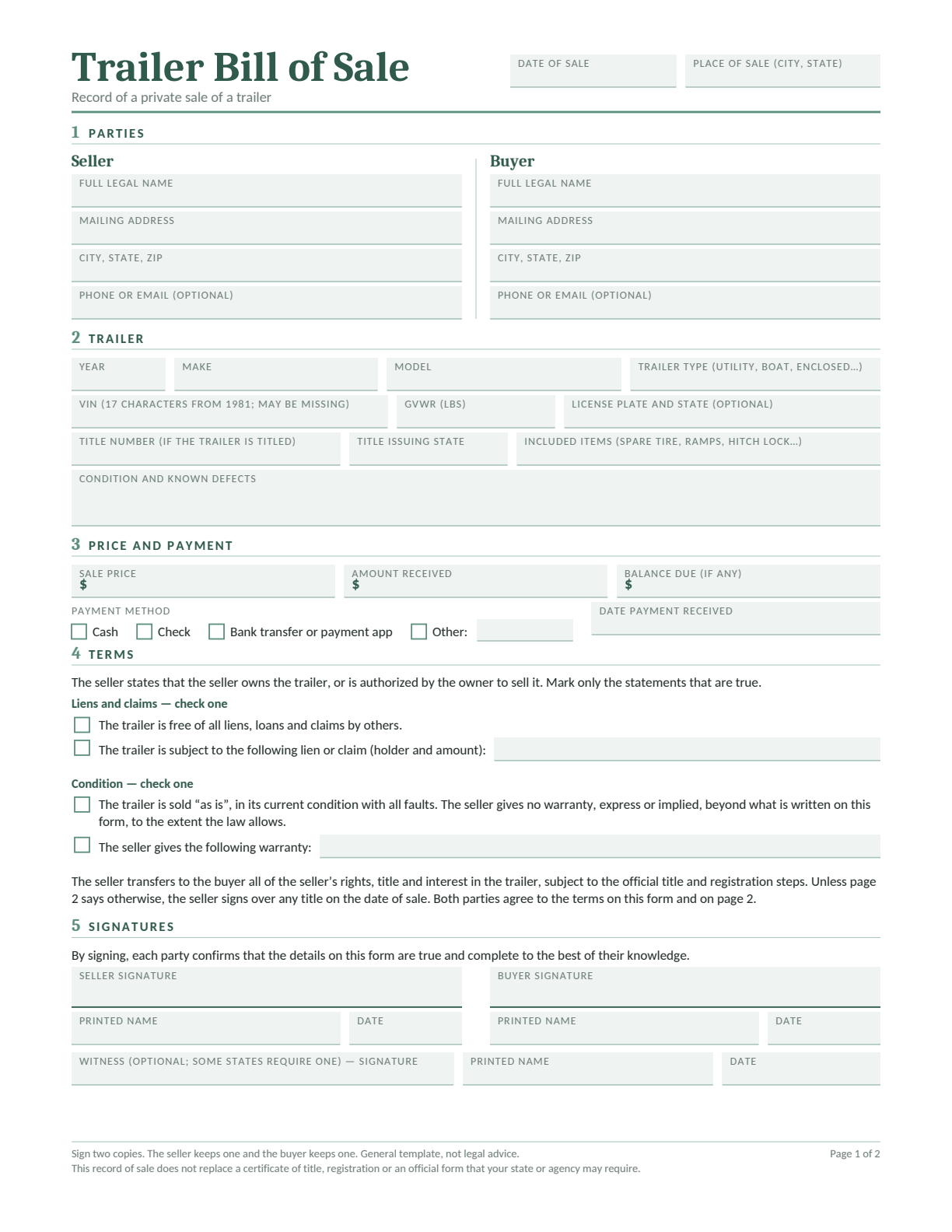
Use the trailer’s own VIN and manufacturer’s rated weight. Keep its price separate from the boat price: DNR’s B-118 specifically excludes the trailer from its gross-sales-price field.
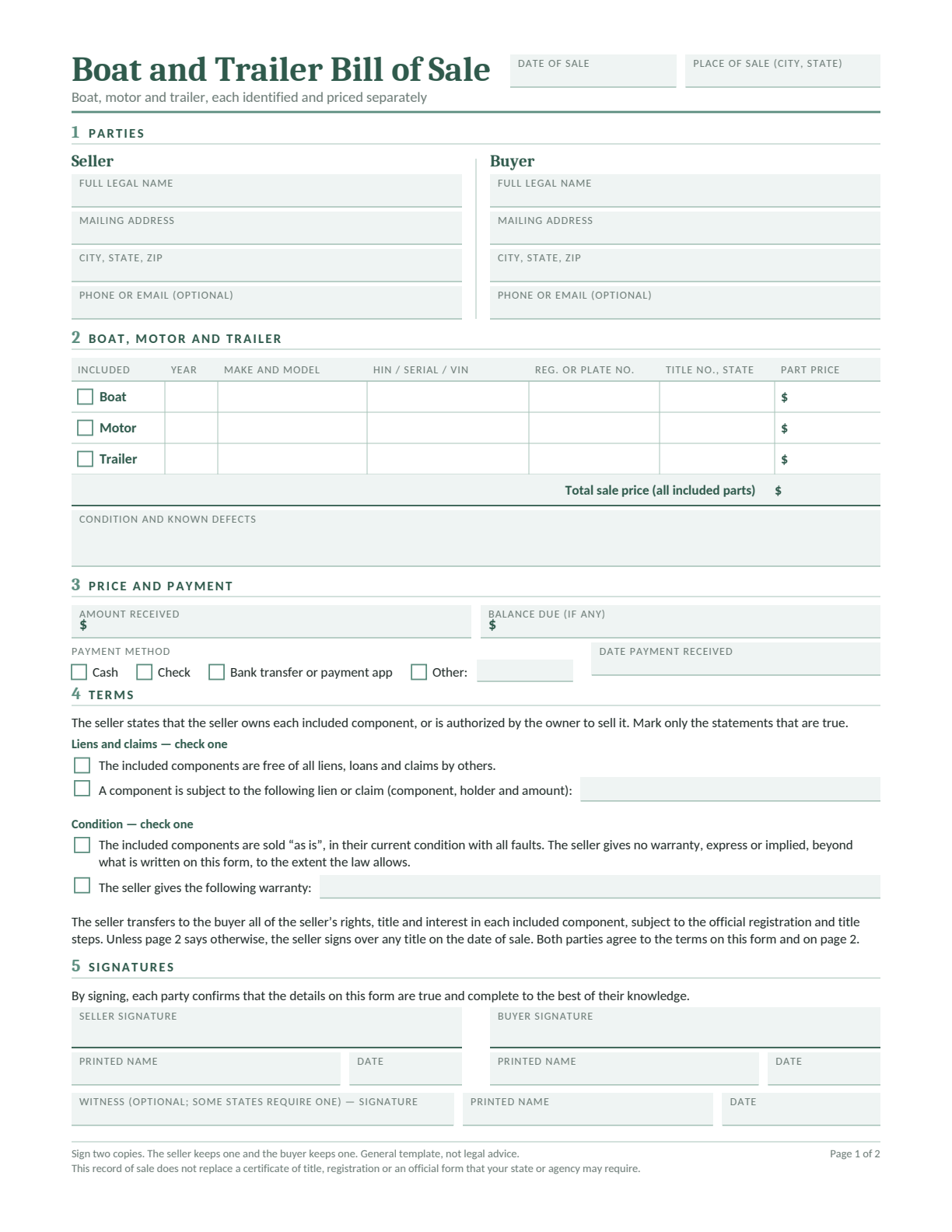
Trailer Bill of Sale
Describe the trailer and included equipment, then record the price, payment and any remaining balance. Use page 2 for extra terms, such as collection arrangements.
Edit in Word or Google Docs, type into the fillable PDF, or print a blank copy. Complete both pages and keep them with the ownership papers.
Maryland’s title exemption covers a trailer rated by its manufacturer at 2,500 pounds gross vehicle weight or less, except a camping trailer. The exemption concerns the title; it does not by itself remove registration requirements.
Use the MVA trailer guide for the title and registration application. Bring the assigned title when required, or the applicable ownership evidence for an exempt trailer. An unmarked or homemade trailer needs its ownership and identification issues resolved with MVA.
Completed Maryland Bill of Sale Example
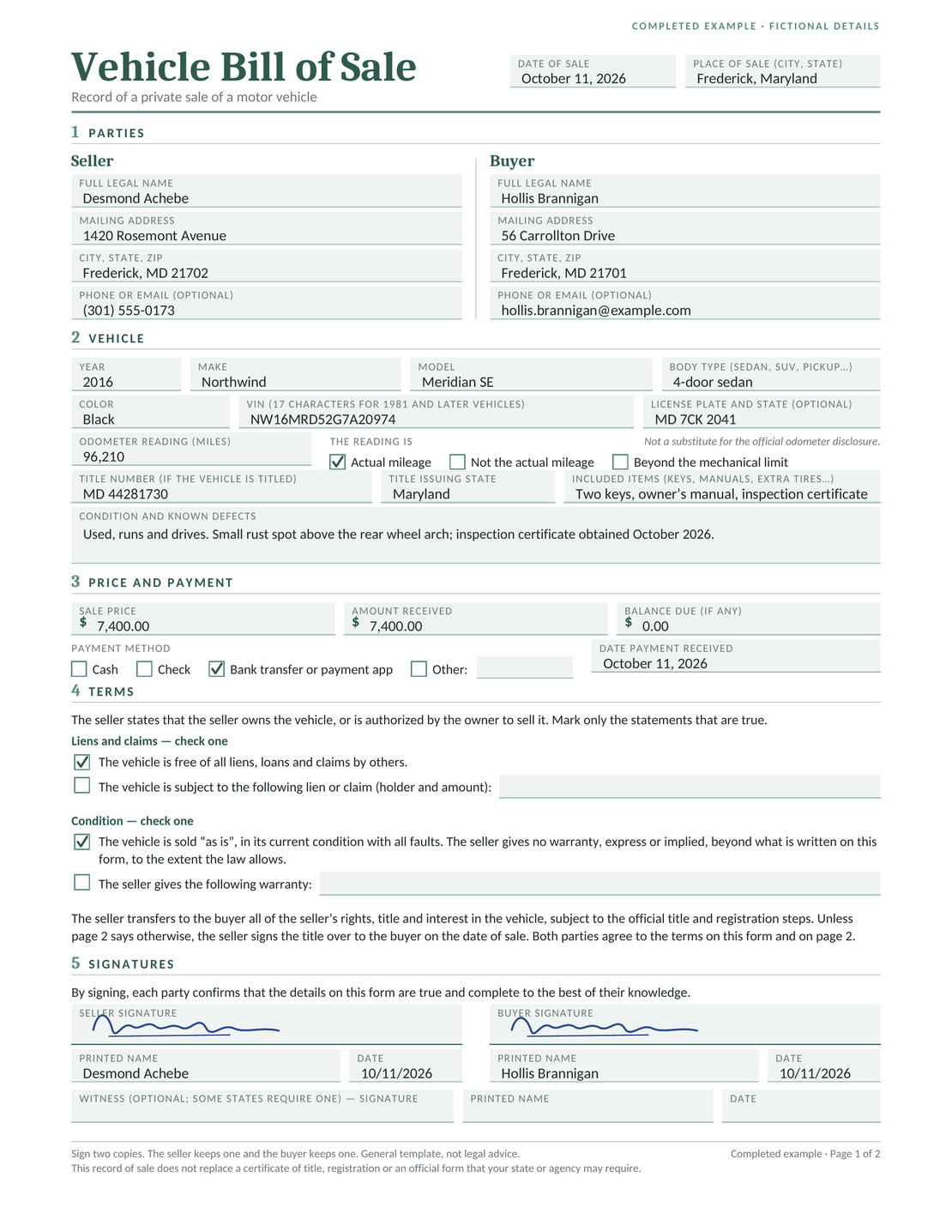
This fictional example shows Desmond Achebe selling Hollis Brannigan a black 2016 Northwind Meridian SE in Frederick on October 11, 2026. The price is $7,400, all received, leaving a $0 balance.
The car has 96,210 miles and a small rust spot above the rear wheel arch. The agreement includes two keys, the owner’s manual and an October 2026 safety inspection certificate, making clear what Hollis receives with the car.
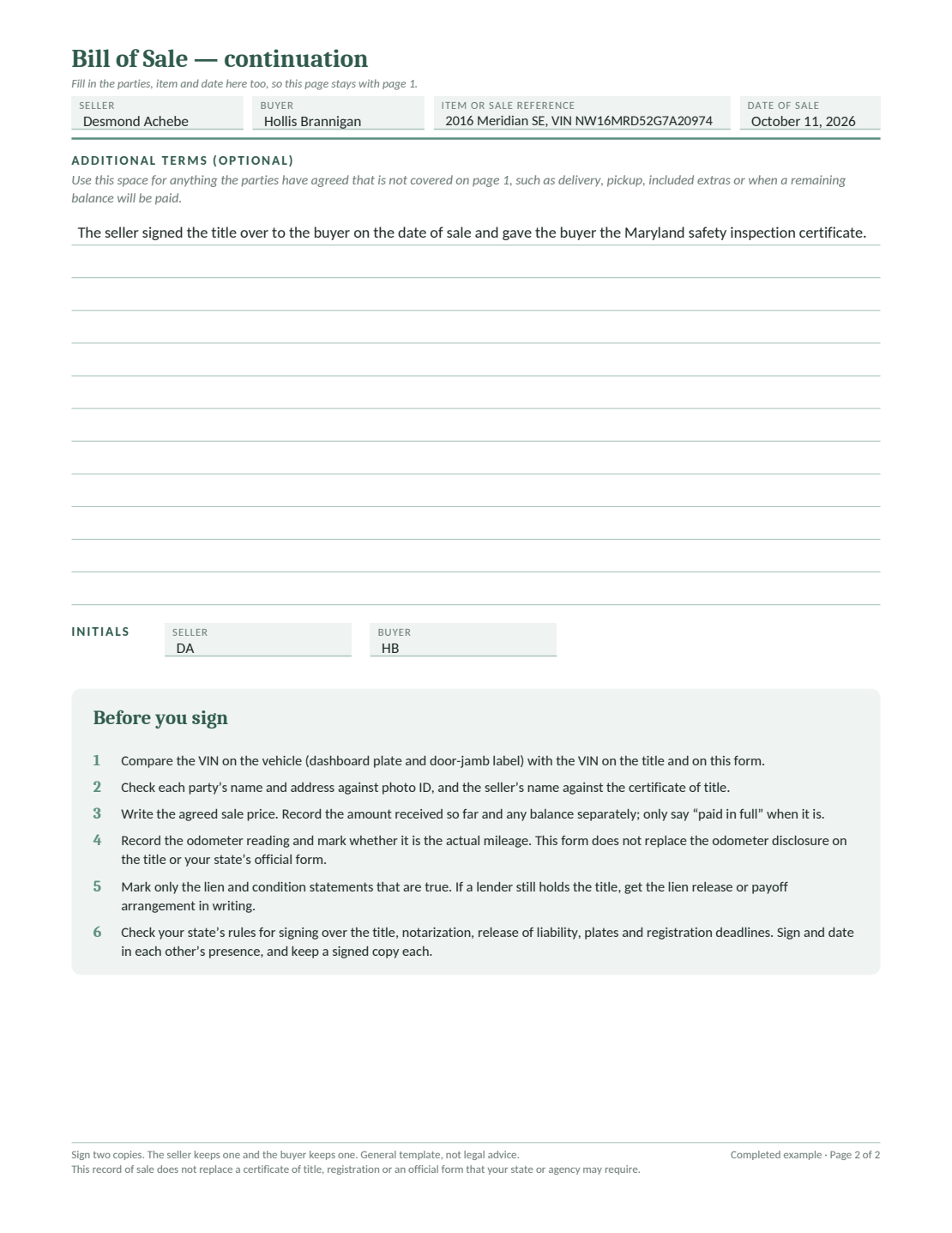
Page 2 records the seller’s title assignment and delivery of the inspection certificate. Those handover details do not show that MVA has issued a new title or registration to the buyer.
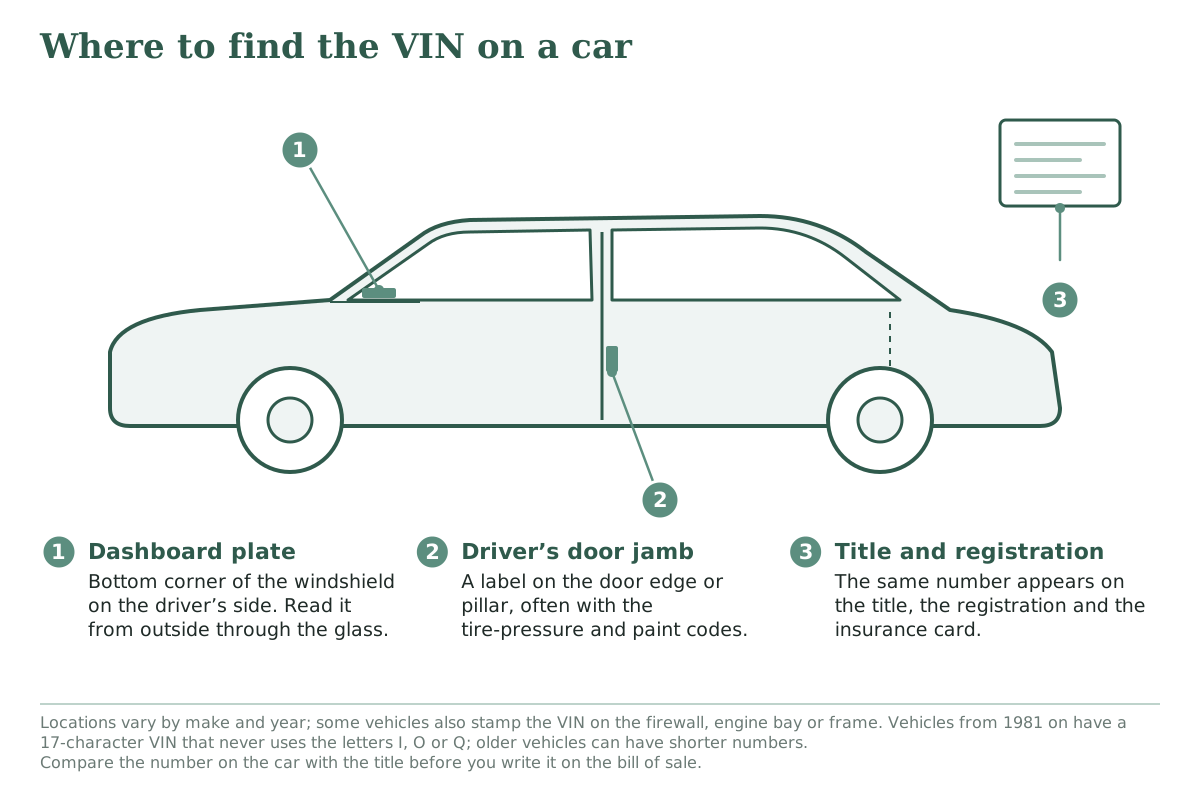
Compare the identifying number on the property with the ownership papers before copying it into your sale record.
Look through the windshield at the driver-side dashboard. Also check the label inside the driver’s door opening. Locations vary, so consult the vehicle’s manual if needed.
Resolve a missing or mismatched number with the agency handling the transfer. Do not guess from an unclear label.
Compare the seller’s name and all co-owners with the ownership document.
Match the VIN or HIN on the property to the papers before copying it.
Record known defects and anything included in the price.
Separate the agreed price, money received and balance still owed.
Resolve any lien and check which title, registration or disclosure signatures are required.
Keep the Sale Record with the Transfer Papers
Keep both signed pages together with a copy of the assigned ownership document and proof of payment. Save any filing receipt separately: a promise in the sale agreement to apply or report the sale does not show that the agency received it.
The statutory requirement for certain used-vehicle transfers was repealed effective October 1, 2026. Current MVA form VR-181 has buyer and seller certifications and no notary block. Use the current form rather than an older notarization instruction.
No. Obtain the seller’s properly completed title assignment and resolve any recorded lien. The sale record supports the transaction but does not replace the ownership document.
No. Remove the seller’s plates before collection. The seller should follow MVA’s return process and keep the receipt; the buyer needs their own valid registration arrangements.
DNR uses this term for a sale record containing its required declaration under penalty of perjury. Official B-118 includes the declaration. Follow DNR’s checklist for the vessel’s title and registration history.
A non-camping trailer with a manufacturer-rated gross vehicle weight of 2,500 pounds or less is title-exempt. Registration is a separate question handled by MVA.
After 14 days, continue for
$12.99/month
only if you choose to upgrade.
We use cookies to provide you with the best possible experience. Cookies also help us analyze user behaviour so we can continue to improve our website. View our cookie policy.