Notarized Bill of Sale
Know what needs notarizing before you sign.
Check whether your sale needs a notarized bill of sale, a notarized title or another form. Bring the right documents and identification so you can complete the required signing steps.
Use the state examples and appointment checklist below.
Document the sale and agreed terms. Give both seller and buyer a signed copy.
What Is a Notarized Bill of Sale?
A notarized bill of sale is a sale document with a notary’s completed certificate for one or more signatures. The notary checks the signer’s identity and carries out the required procedure, such as witnessing a signature or taking an acknowledgment.
Notarization does not prove that the seller owns the item, that payment was made or that every statement is true. Seller and buyer still need to check the sale details, ownership records and payment.
A notary requirement for a title does not automatically apply to a separate bill of sale. For example, North Carolina DMV requires notarization when transferring a North Carolina title. Check the instructions for each document you need.
Does Your Bill of Sale Need to Be Notarized?
Start with the agency that will receive your paperwork. Find the instructions for your type of item, then check which document and signatures need notarization. These examples show why the answer can differ even within one state.
| Sale or Transfer | What Needs Notarization | Where to Check |
|---|---|---|
| Car with a North Carolina title | The North Carolina title transfer must be notarized. For an out-of-state title, follow the issuing state’s rules. | NC DMV title requirements |
| Privately sold boat with a North Carolina title | The seller’s signature on the title assignment must be notarized. An out-of-state title follows the issuing state’s notarization requirements. | NC Wildlife transfer instructions |
| Privately sold, registered but non-titled boat in North Carolina | The seller’s signature on the bill of sale must be notarized. For a boat from a non-titling state, also provide a copy of the seller’s registration card. A lost title is a different situation. | NC Wildlife non-titled vessel instructions |
| Used vehicle transfer in Louisiana | OMV accepts notarization on the bill of sale, invoice or title. A separate bill of sale is not required when the title assignment includes the sale price. Follow OMV’s instructions for other permitted procedures. | Louisiana OMV used-vehicle requirements |
| Vehicle paperwork in Fremont County, Colorado | Newer Colorado titles do not require notarization. For an older Colorado title with a notary space, the county accepts notarization or Form DR 2445 alongside the signed title. A required bill of sale must be notarized or include the county’s stated perjury clause. | Fremont County instructions — check your own county’s requirements. |
For another location, use the state chooser and official sources. Check the current form before arranging an appointment.
Who Needs to Sign in Front of the Notary?
The person whose signature needs notarization must follow the required notarial procedure. That may be the seller alone, or more than one signer. Do not assume both seller and buyer need to attend just because both sign the sale record.
Acknowledgment
The signer appears before the notary and acknowledges signing the document. An existing signature may be acceptable; the signer still needs to appear and complete the acknowledgment.
Jurat or Sworn Statement
The signer signs in front of the notary and takes an oath or affirmation that the statement is true. A jurat is different from simply acknowledging a signature.
Idaho’s notary guidance explains these different acts. Follow the applicable form and local rules. If separate witnesses are required, ask who can serve and whether they need to attend; a notary does not automatically fill a separate witness role.
See an Official Bill of Sale with a Notary Section
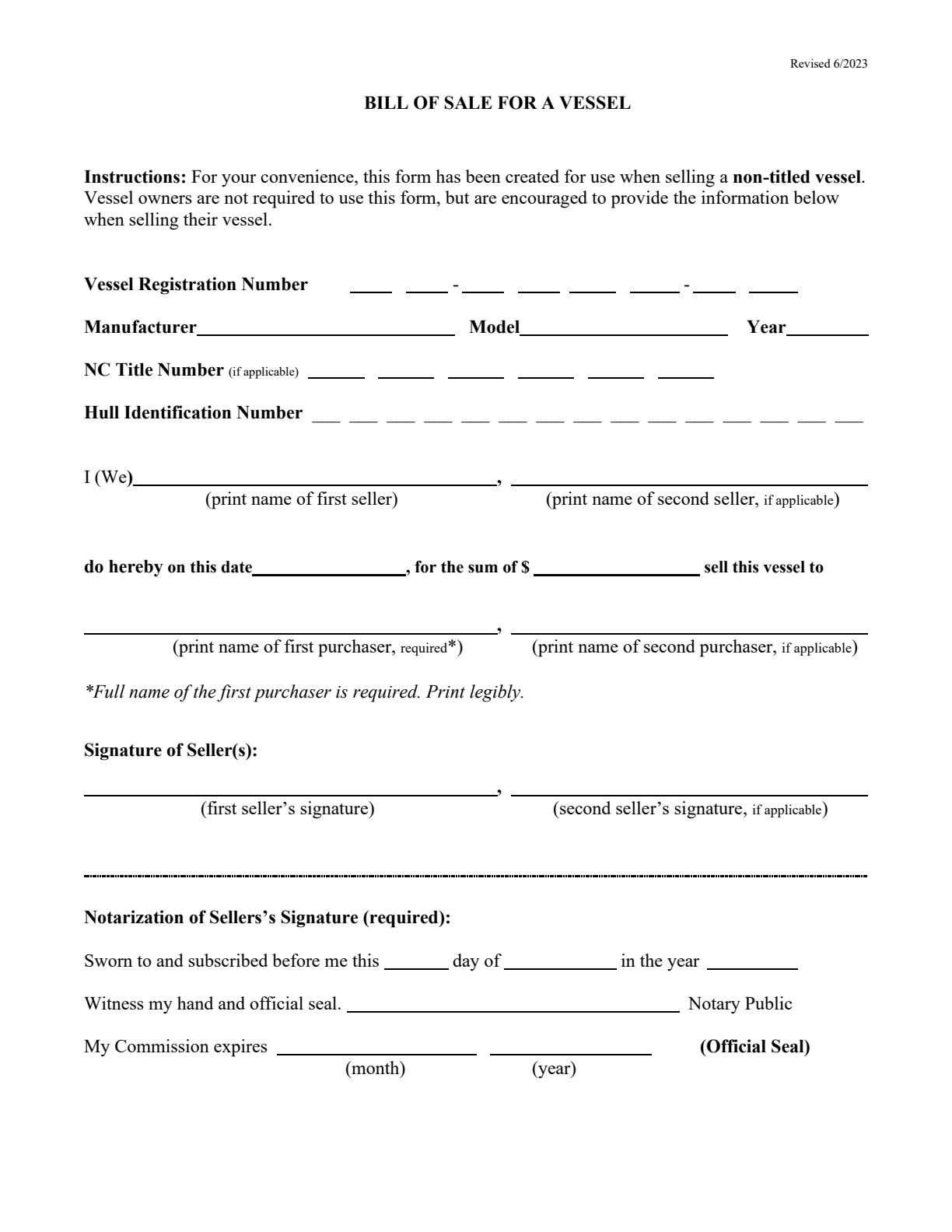
This North Carolina Wildlife Resources Commission form shows a bill of sale with a required notary section. It is for a non-titled vessel, not a general form for every boat or vehicle sale.
How to Fill In This Form
- Identify the vessel. Enter its registration number, manufacturer, year and hull identification number.
- Record the sale. Add the seller and buyer names, sale date and price.
- Arrange the seller’s signing. The form requires notarized seller signatures and uses sworn-statement wording. Follow the notary’s instructions for signing and the oath or affirmation.
- Leave the notary section to the notary. Do not fill in the notary’s certificate, signature, commission details or seal.
NC Wildlife provides this form as an option. Another bill of sale must still meet its required information and seller-signature notarization rules for the applicable non-titled vessel transfer.
Open the Official Vessel Form (PDF)
For a titled boat or a missing title, follow the separate title-transfer instructions.
A Sale Record and a Notarized Title Are Different
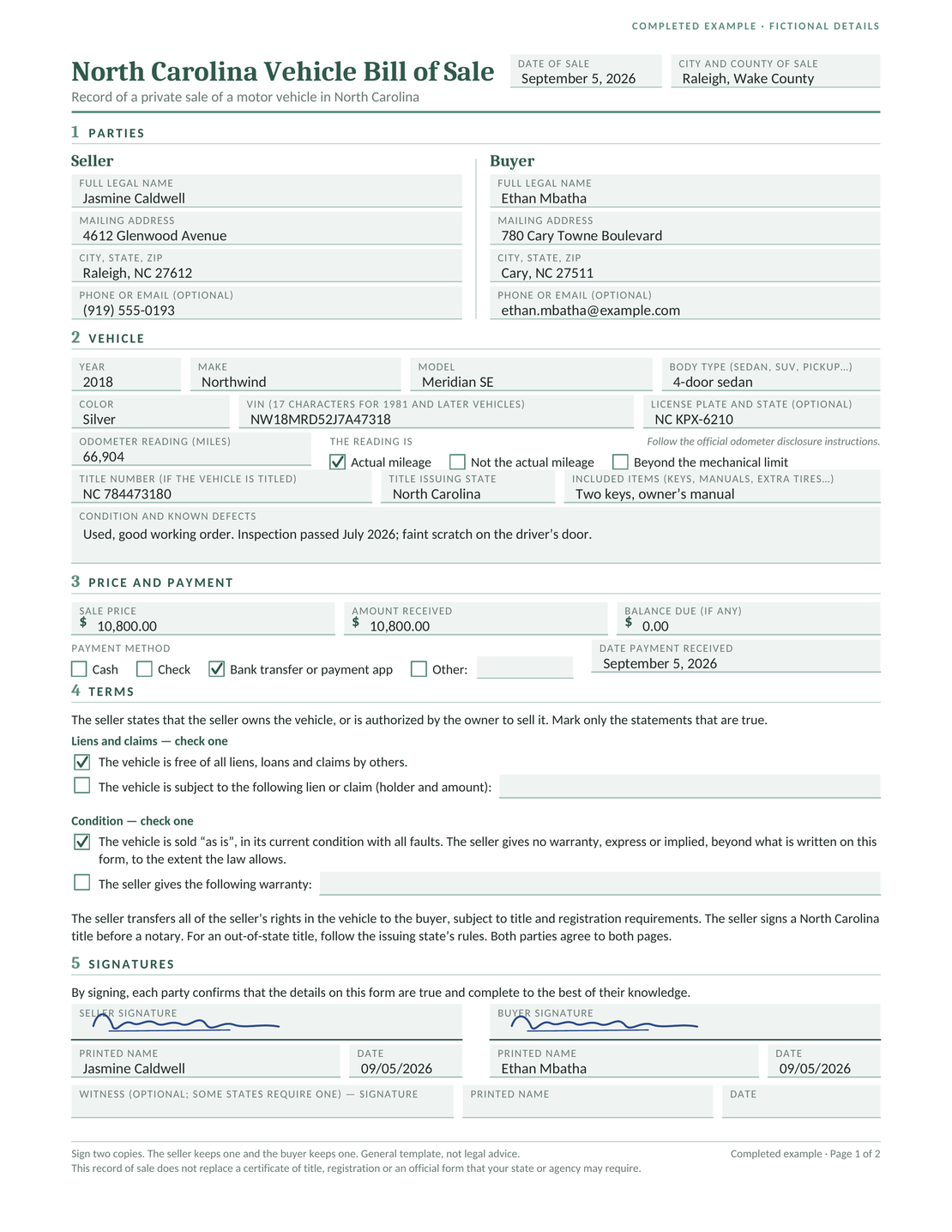
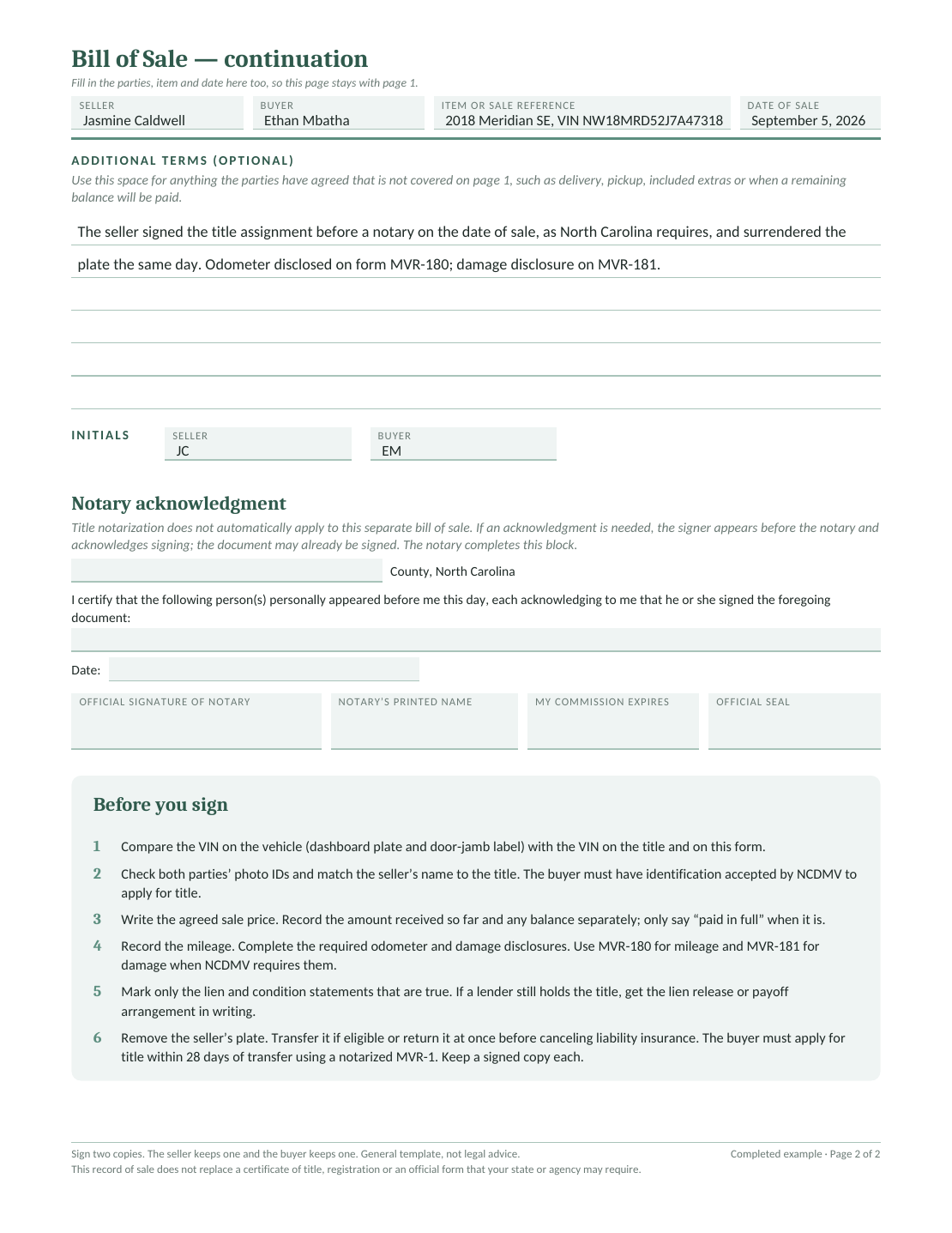
In this fictional North Carolina example, Jasmine Caldwell sells Ethan Mbatha a silver 2018 Northwind Meridian SE for $10,800 by bank transfer. The sale record identifies the car, payment and agreed terms. Page 2 records that the title assignment was signed before a notary.
The bill of sale’s own notary certificate is blank. This is a completed sale record with a blank notary section, not an example of completed notarization.
About This Example
Names, identifying details and signatures are fictional. Use the filled-in sale fields as an illustration, not as instructions for every transaction. Follow the current requirements above.
This is general information, not legal advice. See our Terms and Conditions.
Prepare the Sale Details Before Your Appointment
Get help recording the item, price, payment and agreed terms so the sale document is ready to review.
How to Prepare for a Notary Appointment
Contact the notary before you travel. Confirm the documents, people, identification and fee so you can complete the appointment in one visit.
- Check the receiving agency’s instructions. Identify the document, required signatures and any specified notarial act or certificate.
- Fill in the sale details. Complete the names, item description, identifying numbers, price, payment and agreed terms. Bring every attached page.
- Confirm who must attend and what ID to bring. Ask the notary which identification they can accept and whether separate witnesses are needed. Check the total fee, including any travel charge.
- Review the document before signing. Resolve missing details and disagreements with the other party. Bring the required title or official forms as well as the bill of sale.
- Follow the required signing procedure. Sign, acknowledge a signature or take an oath or affirmation as required. Leave the certificate and seal to the notary.
Which Notary Certificate Should You Use?
Use the certificate required by the receiving agency or included on its form. If the document has no certificate and the instructions do not identify the required act, ask the agency or an attorney before your appointment.
The Colorado Notary Handbook explains that a notary cannot choose the notarial act for you. An acknowledgment and a jurat do different jobs, so adding any notary block you find online may not meet the requirement.
Idaho’s official certificate examples show how the wording differs. They help explain the acts; they are not a universal certificate to copy onto every bill of sale.
Check the Sale Details Before Signing
The notary’s identity check does not replace your review of the agreement. Seller and buyer should confirm the details while any mistakes can still be resolved.
- Names match the parties and required ownership records.
- The item and its identifying number match what is being sold.
- Price, payment received and any unpaid balance are recorded separately.
- Condition, liens, promises and attached terms reflect the actual agreement.
Do not leave missing sale terms for the notary to decide. If you need advice about ownership, liability or the agreement itself, get that advice before signing.
Keep Your Copies and Finish the Transfer
Seller and buyer should each keep a complete signed copy, including any attached pages and completed notary certificate. Check whether the receiving agency needs an original before handing over the paperwork.
Keep payment evidence with your sale record. For titled or registered property, complete the required title, registration and seller-notification steps as well. Notarizing a signature does not complete those steps.
Official Forms and Instructions
Choose your state for sale and transfer instructions. For notary procedures, also check the rules where the notarization will take place.
- Alabama
- Alaska
- Arizona
- Arkansas
- California
- Colorado
- Connecticut
- Delaware
- Florida
- Georgia
- Hawaii
- Idaho
- Illinois
- Indiana
- Iowa
- Kansas
- Kentucky
- Louisiana
- Maine
- Maryland
- Massachusetts
- Michigan
- Minnesota
- Mississippi
- Missouri
- Montana
- Nebraska
- Nevada
- New Hampshire
- New Jersey
- New Mexico
- New York
- North Carolina
- North Dakota
- Ohio
- Oklahoma
- Oregon
- Pennsylvania
- Rhode Island
- South Carolina
- South Dakota
- Tennessee
- Texas
- Utah
- Vermont
- Virginia
- Washington
- West Virginia
- Wisconsin
- Wyoming
- North Carolina DMV: vehicle title requirements
- North Carolina Wildlife: vessel registration and titling
- Louisiana OMV: used-vehicle title and registration
- Fremont County, Colorado: motor vehicle instructions
- Idaho Secretary of State: notarial acts and certificates
- Colorado Secretary of State: Notary Handbook
- California Secretary of State: Notary Public Handbook
Sources reviewed . Each state or county example applies to the transaction named.
Notarized Bill of Sale Questions
It depends on the transaction and the receiving agency’s requirements. A title may need notarization even when a separate bill of sale does not. Check the title, bill of sale and other required forms individually; the state examples above show several different rules.
For an acknowledgment, an existing signature may be acceptable, but the signer still needs to appear before the notary and acknowledge it. A jurat requires signing in the notary’s presence and an oath or affirmation. Tell the notary that the document is already signed and confirm the required procedure before your appointment.
Fees depend on the location, service and number of notarial acts. Ask for the total before booking, including any travel or additional service charge. Your state’s notary office can explain its fee rules.
Do not add a random certificate just to make the document look official. First find out which act and wording the receiving agency requires. If no requirement is given, ask the recipient or an attorney which act is needed; the notary cannot make that choice for you.
Only the people required for the particular notarial act and any separate witness requirement need to attend. Some forms require the seller’s signature to be notarized; others may require more signers. Confirm this from the form and with the notary before arranging the appointment.
Get Ready for the Notary Appointment
Check the paperwork before you go so the appointment can focus on the required signing steps.
- Confirm which document and signatures need notarization.
- Complete the sale details and gather the required ID.
- Follow the signing procedure and keep complete copies.