Odometer Disclosure Statement
Record the mileage on the right document
Complete the mileage disclosure your vehicle transfer requires. Record the odometer reading and its status so the buyer knows whether it reflects the vehicle’s actual mileage.
Start with the title, then use the official state instructions below if you need a separate form.
Document the sale and agreed terms. Give both seller and buyer a signed copy.
What Is an Odometer Disclosure Statement?
An odometer disclosure records the mileage displayed when a vehicle changes owners and the seller’s statement about whether it is accurate. It identifies the vehicle, seller, buyer and transfer date. The seller signs the certification, and the buyer signs an acknowledgment.
For an ordinary transfer, the disclosure normally belongs on the title or an official document allowed for that situation. Under 49 CFR § 580.5, a seller named on the title generally makes the disclosure there. A separate sheet with similar fields is not automatically accepted.
Check the Title First
The disclosure is often on the title itself. Check its mileage section before choosing a separate document.
A car bill of sale records the transaction. Its mileage entry does not replace the required disclosure.
Where to Get the Official Odometer Form
Check the title’s disclosure section first. If you need another document, use the one the agency accepts for your transfer. The state examples below explain three different approaches.
- Alabama
- Alaska
- Arizona
- Arkansas
- California
- Colorado
- Connecticut
- Delaware
- Florida
- Georgia
- Hawaii
- Idaho
- Illinois
- Indiana
- Iowa
- Kansas
- Kentucky
- Louisiana
- Maine
- Maryland
- Massachusetts
- Michigan
- Minnesota
- Mississippi
- Missouri
- Montana
- Nebraska
- Nevada
- New Hampshire
- New Jersey
- New Mexico
- New York
- North Carolina
- North Dakota
- Ohio
- Oklahoma
- Oregon
- Pennsylvania
- Rhode Island
- South Carolina
- South Dakota
- Tennessee
- Texas
- Utah
- Vermont
- Virginia
- Washington
- West Virginia
- Wisconsin
- Wyoming
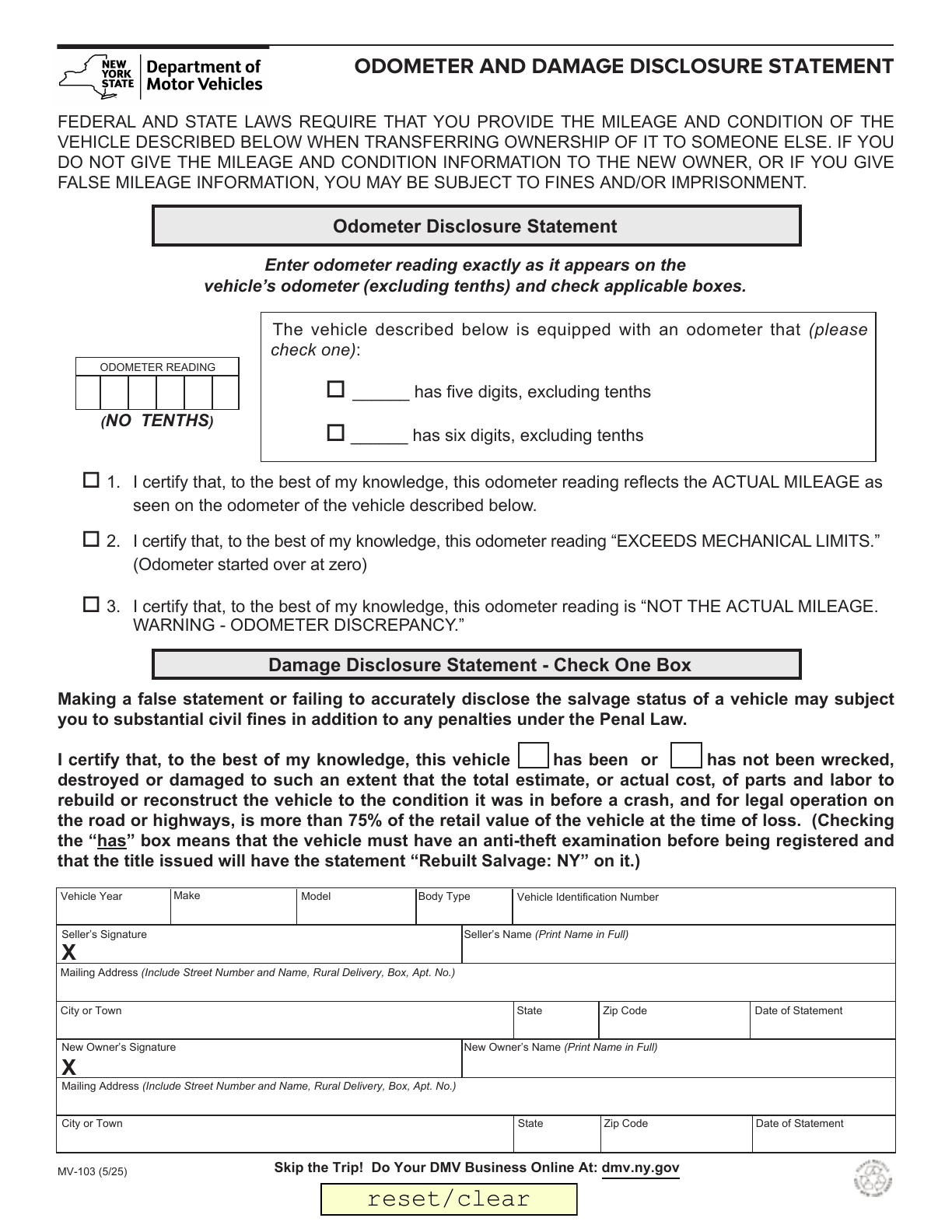
New York: Odometer and Damage Disclosure, MV-103
New York provides MV-103 when the title or dealer’s certificate lacks the required disclosure section. It is a New York form, so check the DMV title instructions before using it.
Check Both Disclosure Sections
The form covers mileage and damage separately. Read the instructions for each section; the mileage exemption rules do not decide whether the damage disclosure applies.
Match the vehicle details to the title, record the reading without tenths and complete the truthful mileage statement. Seller and buyer then complete their required details and signatures.
California: Get REG 262 From DMV When Required
California uses the Vehicle/Vessel Transfer and Reassignment Form, REG 262, in specified situations. These include an unavailable title, a title without a compliant mileage-disclosure section and certain disclosure errors.
REG 262 is printed on security paper and is not available as an online download. Obtain the original through DMV. Use the REG 262 instructions and DMV’s guidance on obtaining the form. The form does not remove the other title-transfer requirements.
Texas: Complete the Title’s Disclosure
Texas directs a private seller to provide a properly signed title showing the sale date and odometer reading, along with the signed title application. Its former standalone Form VTR-40 was discontinued in 2011.
Follow the TxDMV buying and selling instructions. The Texas title manual, Chapter 15 (PDF), explains the disclosure rules and special situations.
For another state, use the state chooser above or the USAGov motor vehicle agency directory. If the title comes from another state, ask the agency processing the transfer which document it accepts.
When Is an Odometer Disclosure Required?
Federal rules generally require disclosure when ownership of a nonexempt motor vehicle changes. The age exemption uses the model year, not the number of years the seller has owned the vehicle.
| Model Year | Federal Age Exemption | Example |
|---|---|---|
| 2010 or earlier | At least 10 years after January 1 of the model year. | A 2010 vehicle is age-exempt for a transfer in 2026. |
| 2011 or later | At least 20 years after January 1 of the model year. | A 2011 vehicle first becomes age-exempt on January 1, 2031. |
A 2011 car sold in 2026 still needs disclosure unless another exemption applies. The older 10-year rule does not apply to it. See 49 CFR § 580.17 and NHTSA’s model-year explanation.
Other Federal Exemptions
These include vehicles with a gross vehicle weight rating over 16,000 pounds and vehicles that are not self-propelled, such as trailers. Use the manufacturer’s weight rating, not the vehicle’s weight on the day of the sale. A rating of exactly 16,000 pounds does not meet this exemption.
Section 580.17 also lists limited manufacturer and new-vehicle exceptions. Check the state’s title instructions even when a federal exemption applies. “Exempt” describes the disclosure requirement; it does not confirm that the displayed mileage is accurate or complete the title transfer.
How to Complete an Odometer Disclosure
Have the vehicle and title available so you can check the reading and vehicle details together.
- Check whether disclosure is required. Confirm the model year, any other exemption and the state’s instructions.
- Use the correct document. Complete the title’s mileage section or obtain the official form required for your situation.
- Read the odometer at the transfer. Enter the displayed reading without tenths. If it uses kilometers, follow the agency’s instructions for recording the unit.
- Add the details and mileage status. Match the VIN and vehicle description to the title, then enter the parties, transfer date and truthful certification.
- Review and sign. The seller signs the certification and the buyer signs the acknowledgment. The buyer makes a copy available to the seller; both should keep a copy of the completed record.
What Goes on the Disclosure?
Follow the labels on the title or official form. The federal disclosure includes the following details:
- The reading at transfer, without tenths of a mile.
- The transfer date and seller’s and buyer’s printed names and current addresses.
- The vehicle’s year, make, model, body type and VIN.
- The seller’s statement about the mileage status.
- The seller’s signature and the buyer’s signed acknowledgment.
Keep the document’s federal warning about incomplete or false disclosure intact. The content and signature requirements appear in 49 CFR § 580.5(c)–(f).
Which Mileage Status Fits?
The reading and its status answer different questions: what does the odometer display, and what does that number tell the buyer? Follow the wording on the actual form; it may not use three separate checkboxes.
| Mileage Status | What It Means | Example |
|---|---|---|
| Actual mileage | The seller certifies, to the best of their knowledge, that the reading reflects the vehicle’s mileage. | The seller believes the displayed 72,418 miles is the vehicle’s actual mileage. |
| Exceeds mechanical limits | The odometer has passed the highest number it can display and rolled over. High mileage alone does not mean this applies. | A five-digit odometer has passed 99,999 and now shows 12,345. |
| Not actual mileage | The display is invalid or the seller knows it differs from actual mileage beyond a calibration error. The disclosure carries a discrepancy warning. | A replacement odometer shows less than the vehicle has actually traveled. |
Do not choose “actual mileage” just because a number appears on the dashboard. If the odometer was replaced or the records do not agree, check what happened and follow the agency’s instructions before certifying the mileage.
Example: Leave Out the Tenths of a Mile
72,418.6 on the Odometer → 72,418 on the Form
If the odometer shows 72,418.6 miles, enter 72,418 in a disclosure field that excludes tenths. Leave out the decimal part; do not round the reading up.
The seller still needs to choose the truthful mileage statement, and both parties complete their required details and signatures. This example shows how to enter the number, not how to decide its accuracy.
Copying that number onto a bill of sale does not supply the certification or signatures required for the official mileage record.
Check the Reading Before You Sign
Compare the odometer with the title and available service or inspection records. NHTSA recommends these checks to help buyers spot possible odometer fraud.
- Match the VIN to the vehicle being transferred.
- Resolve unexplained mileage differences before certifying the reading.
- Check the date, names, addresses and mileage statement.
- Leave a blank or incomplete disclosure unsigned.
If you make a mistake, ask the agency which replacement form and explanation it requires before crossing out or overwriting an entry. California’s mileage-error instructions show how the correction depends on the document.
About This Guide
This is general information, not legal advice. Use the document and signing procedure the agency requires for your transfer. See the official instructions and our Terms and Conditions.
Keep the Disclosure With the Transfer Records
Keep a copy of the signed disclosure with the sale record. The buyer should submit the required title and registration paperwork by the agency’s deadline. The seller should complete any separate sale or transfer notice.
The mileage disclosure does not finish the ownership transfer. Use the car title transfer guide to check the other documents, including any lien release.
Official Forms and Instructions
Use these sources for the federal rules and the state examples above. The official-form section includes the New York form preview and a state chooser.
- 49 CFR § 580.4 — Security of title and reassignment documents.
- 49 CFR § 580.5 — Disclosure contents, mileage statements and signatures.
- 49 CFR § 580.17 — Federal exemptions.
- NHTSA: Odometer Disclosure Requirements — The model-year change to the age exemption.
- NHTSA: Odometer Fraud — Mileage and vehicle-history checks.
- California DMV: REG 262 Instructions — When to use the form and how to address errors.
- New York DMV: Certificate of Title — Mileage and damage disclosures.
- TxDMV: Motor Vehicle Title Manual (PDF) — Chapter 15 covers odometer disclosure.
Sources reviewed .
Odometer Disclosure Questions
Often the title already contains the required section. Use it according to the agency’s instructions. A separate official form may be needed for a missing disclosure section, an unavailable title or another specified situation.
A mileage entry alone does not replace a required odometer disclosure. Complete the title or official document your state requires, including the mileage statement and signatures. The bill of sale can keep a separate record of the transaction.
The federal 10-year age rule applies to model years 2010 and earlier. Model years 2011 and later use a 20-year period measured from January 1 of the model year. A 2011 car first becomes age-exempt on January 1, 2031. Check other exemptions and the state’s title instructions too.
For an ordinary private sale requiring federal disclosure, the seller signs the certification and the buyer signs the acknowledgment. Both supply their printed names and other required details. Follow the agency’s instructions for co-owners or anyone signing under a power of attorney.
Check the document and state instructions before signing. Federal rules specify the disclosure signatures, while state title paperwork may have additional requirements. A notary requirement on one document does not automatically apply to every document used in the sale.
Do not assume a PDF with matching fields will be accepted. Use the title or the official document the agency requires. Federal rules include security requirements for titles and reassignment documents, and California’s REG 262 is issued on security paper.
Get the Right Disclosure Before You Sign
Check your state agency’s instructions so you can complete the document it accepts.
- Confirm whether disclosure is required.
- Use the title or required official form.
- Check the reading and signing instructions.