How to Transfer a Car Title
Know what to sign and where to submit it
Transfer the car’s ownership record to the buyer’s name. The seller completes the title’s transfer section, and the buyer applies for the new title.
Follow the steps below to check the signatures, gather the supporting forms and find your state’s filing deadline.
Document the sale and agreed terms. Give both seller and buyer a signed copy.
Start With the Title and the State Instructions
A car title transfer updates the state’s ownership record. In a typical private sale, the seller fills in the title’s assignment section, which identifies the new owner. The buyer then submits that title with an application and the other required documents.
A car bill of sale records the transaction: the people, vehicle, price and agreed terms. It may be part of the paperwork, but it does not replace a required title assignment or application.
About This Guide
This guide covers an ordinary private sale of a titled passenger car. Gifts, inherited vehicles, dealer sales and title problems can require different steps. This is general information, not legal advice. Follow the official forms and instructions and see our Terms and Conditions.
How to Transfer a Car Title in Six Steps
Read the title and the agency’s instructions before either person signs. Check both the existing title’s requirements and those of the state where the buyer will apply.
- Match the owner and vehicle. Compare the seller’s identification with the title and match the VIN on the car to the document. Resolve any mismatch first.
- Arrange any lien release. If a lender has an interest in the car, confirm the payoff and release process. Find out whether the title is paper or electronic.
- Gather the required forms. Check the buyer’s application, mileage disclosure and any inspection or other supporting documents. Arrange a notary if required.
- Complete the title assignment. Enter the buyer and sale details in the labeled spaces. Review the entries together, then follow the signing instructions for each person.
- Submit the buyer’s application. Send or bring the assigned title, application, supporting documents and required fees or taxes to the correct office by the deadline.
- Complete the seller’s reporting. File any required sale or transfer notice and follow the plate instructions. The seller’s deadline may be earlier than the buyer’s.
If possible, arrange for the paperwork to be checked at the filing office. TxDMV recommends that seller and buyer visit the county tax office together so a representative can review the documents before submission.
Where Do You Sign a Car Title?
Look for the seller’s assignment or transfer section and any buyer signature area. Read both sides of the title first. A lienholder release and a dealer reassignment section serve different purposes, so do not choose a space just because it has a signature line.
Enter the Seller and Buyer Details
Use the owners’ names as shown on the title and the buyer’s legal name and address. If two owners are listed, ask the issuing agency whose signatures are needed. Someone signing for an estate, business or another person must have the required evidence of authority.
Record the Date, Price and Mileage
Enter the sale or delivery date requested by the form. Add the actual selling price wherever the title or application asks for it. On the bill of sale, keep the price separate from the amount received and any balance due, so the payment record is clear.
Read the odometer and complete the required mileage disclosure. Use the title or official document specified for the transfer; a mileage entry on a general bill of sale does not automatically replace it. Follow the form’s instructions if the reading is not the actual mileage or the odometer has passed its limits.
The federal disclosure requirements and exemptions depend on the vehicle. Model year 2011 and newer vehicles follow a 20-year age rule; 2010 and older vehicles retain the earlier 10-year rule. See NHTSA’s explanation and the odometer disclosure guide rather than assuming every car over 10 years old is exempt.
Check Each Signature and Notary Requirement
Complete the buyer’s details before handing over the title. Sign only where your role is identified and leave the notary’s certificate for the notary. If notarization is required, arrange it before signing so you can follow the correct procedure.
Check the application separately from the title assignment. For example, North Carolina requires notarization of an assignment on a North Carolina title, while its MVR-1 title application has its own notarization requirement. Completing one does not complete the other.
If There Is a Loan or an Electronic Title
Ask the lender for the payoff amount, payment instructions and lien-release process before arranging the handover. Confirm who will receive the title or release document and what the buyer must submit. Paying off the loan and updating the title record are separate steps.
Texas has different procedures for paper and electronic lien releases. A note in the bill of sale saying “loan paid” does not replace the evidence the agency requires.
If the title is electronic, follow the agency’s electronic-transfer or paper-title procedure. Do not promise that the buyer can leave with a paper title until you have confirmed how it will be issued or transferred.
Check the Details Before You Sign
Review the title and application together while seller and buyer can still correct missing information.
- Match the VIN, owner names and buyer details to the car and people involved.
- Check co-owner signatures, lien releases, disclosures and notarization.
- Use the actual price and date, and fill in all required buyer and sale details.
- Read any title brands or restrictions, such as salvage, and ask how they affect the transfer.
- Keep copies of the completed documents before handing over originals.
If the Title Is Missing or Contains a Mistake
Pause the ordinary transfer process if the title is lost, damaged, assigned to someone else or contains incorrect details. Ask the issuing agency which replacement or correction procedure applies. A new bill of sale does not correct the title itself; the Bill of Sale vs. Title guide explains their different roles.
Do not erase an entry or use correction fluid. New York DMV rejects titles with cross-outs, alterations or erasures. Other states have their own correction procedures, so ask before making a change.
Keep a Record of the Sale
Choose a free car bill of sale template in Word, Google Docs or PDF. Record the agreed terms and keep it with the title-transfer paperwork.
Example: Match the Sale Record to the Title Paperwork
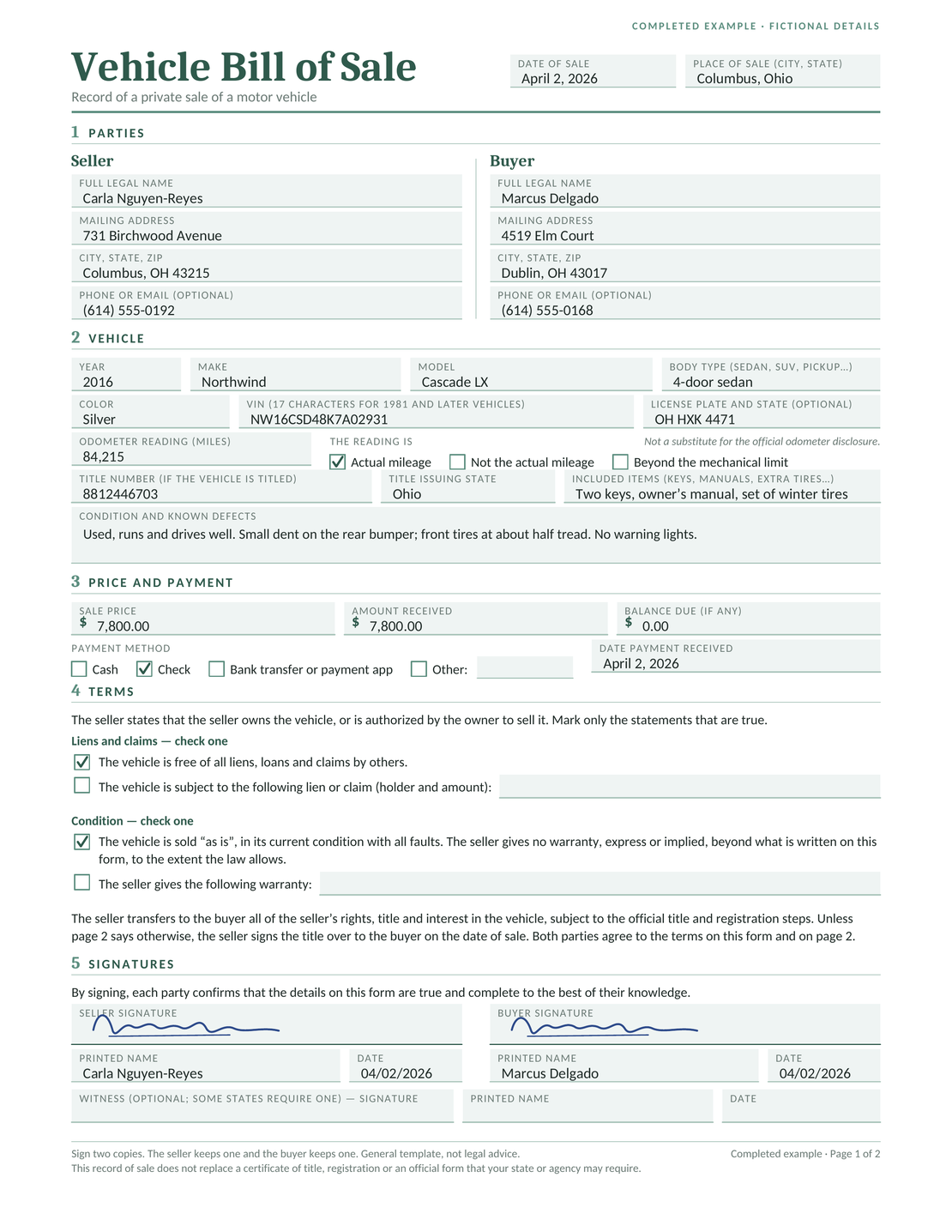
Carla Nguyen-Reyes sells Marcus Delgado a silver 2016 Northwind Cascade LX in Columbus, Ohio, on April 2, 2026. Their bill of sale records a price of $7,800, payment of $7,800 by check and no balance due.
The seller and buyer names, vehicle details, title reference and sale date should agree with the transfer paperwork. The example records 84,215 miles as actual mileage. That mileage still needs to be disclosed through the required title or official disclosure process.
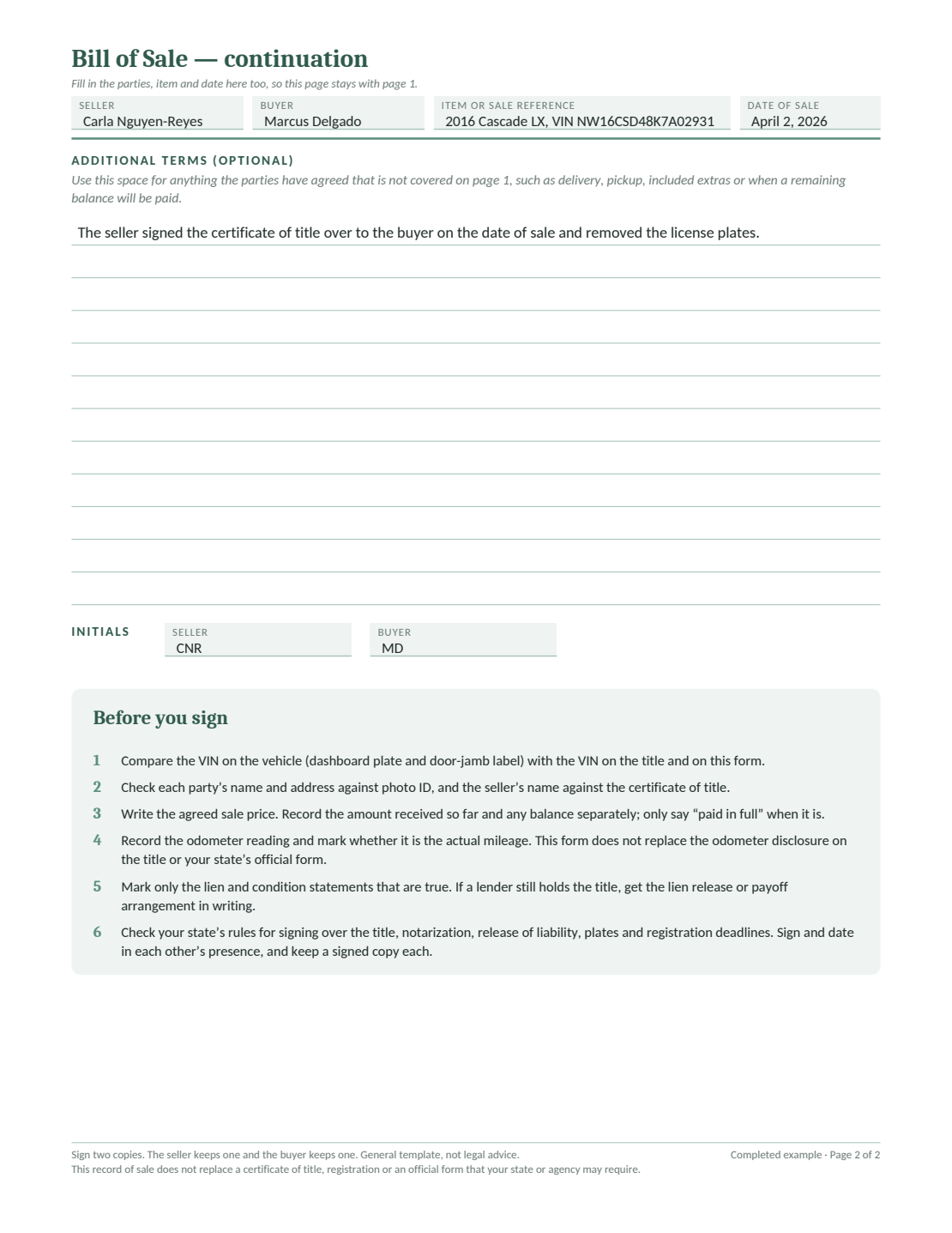
Page 2 says that Carla signed the title over to Marcus. It records that step; it does not show a title assignment or prove that a new title has been issued. For an Ohio paper title, Carla also needs the required notarization of her assignment signature, and Marcus must complete the buyer’s application.
About This Example
The names, car details and signatures are fictional. The checked lien and as-is statements describe this example only. Use statements that are true for your sale. This is a bill of sale example, not an official certificate of title.
Page 1: Sale Details
Page 2: Additional Terms
After Signing: What Each Person Needs to Do
Signing the title is one part of the transfer. The buyer’s application and the seller’s reporting are separate tasks.
Buyer: Apply for the New Title
Submit the assigned title, application, supporting documents and required payment to the correct office. Check the current fees, appointment options and filing deadline, then keep your receipt.
When the new title arrives, check the owner name, VIN and lien information. Complete any registration, insurance, inspection and plate requirements before driving.
Seller: Report the Transfer
File any required sale or transfer notice yourself and save the confirmation. Keep copies of the completed title and bill of sale. Do not rely on the buyer’s promise to finish your reporting.
Follow the state’s instructions for retaining, transferring or returning plates. Confirm the registration and insurance sequence with the agency and your insurer.
If the Car Is Going to Another State
Follow the issuing state’s instructions for assigning the existing title and the buyer’s state requirements for the new title. The receiving state may ask for extra evidence. For example, Ohio requires a VIN inspection for an out-of-state title. This checks vehicle identity; it is not a mechanical inspection.
Arrange lawful collection before the handover. A title-filing deadline does not give the buyer permission to drive during that period. Insurance, registration, a temporary permit or transport may need to be arranged separately.
Car Title Transfer Deadlines by State
These examples cover ordinary private car sales. The buyer’s application and seller’s notice have separate deadlines, and some states count business days while others count calendar days.
A filing deadline tells you when to apply, not when the new title will arrive. Use the linked official instructions for your transaction.
| State | Buyer’s Timing | Seller’s Action | Official Instructions |
|---|---|---|---|
| California | Apply to transfer ownership within 10 days after purchase. | Submit the Notice of Transfer and Release of Liability within 5 calendar days after the sale or transfer and delivery of possession. | California DMV title transfers. See the separate seller-notice instructions. |
| Florida | File the title application within 30 days after delivery. | Notify the department within 30 days after the sale or transfer with delivery of possession. | See §319.23(6)(a) for the buyer and §319.22(2)(b) for the seller. These are separate filings. |
| North Carolina | Submit the title application within 28 days after transfer. | Have the assignment on a North Carolina title notarized. Out-of-state titles follow the originating state’s requirements. | §20-73 deadline; NCDMV title instructions and required forms, including MVR-1. |
| Ohio | File the title application within 30 days after assignment or delivery. | For an Ohio paper title, complete the ownership assignment and have the seller’s signature notarized. | Ohio BMV title instructions. Clerk of Courts title offices issue titles. See also Ohio’s application deadline. |
| Texas | Submit the title application within 30 days after the sale. | File a Vehicle Transfer Notification within 30 days for the parking-ticket and toll protection described by TxDMV. | TxDMV buying and selling guide. Bring the signed title, completed Form 130-U (PDF) and applicable supporting documents. |
| Washington | Apply for the new title within 15 calendar days after delivery. | File the report of sale within 5 business days after the sale or transfer. | RCW 46.12.650 covers the deadlines and transfer documents. Calendar days and business days differ. |
For another state, open the state chooser below. Confirm the required documents, current fees and any county office requirements before submitting the application.
See the Texas Title Application
Texas uses Form 130-U, the Application for Texas Title and/or Registration. It is separate from the title the seller assigns to the buyer. This example is specific to Texas; other states use their own forms.
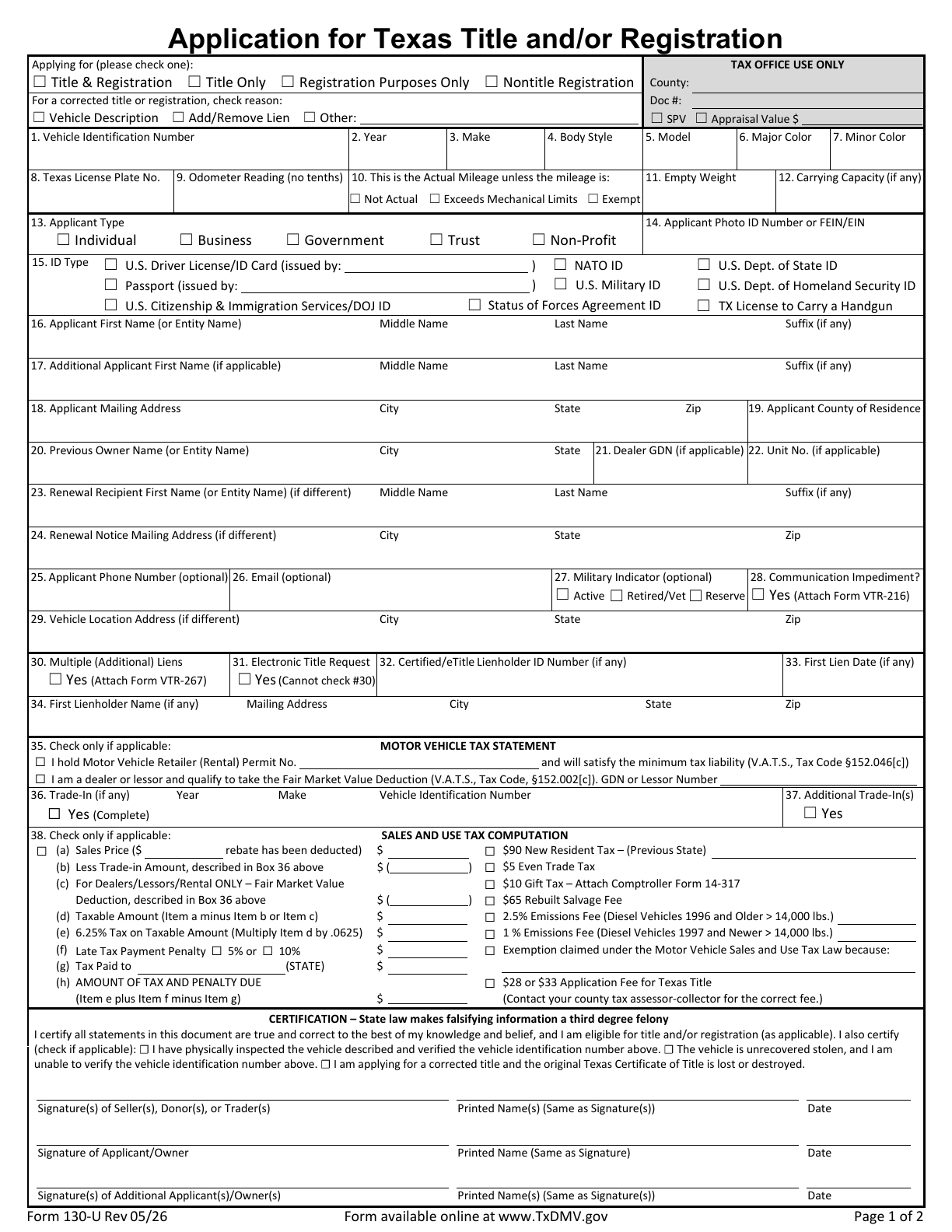
Use the Current Agency Form
Check the vehicle details against the title, enter the applicant and seller information, and complete the sections that apply to the transaction. Read the instructions on page 2 of the PDF before signing.
Bring the signed title, completed application and required supporting documents to the county tax office. The application does not replace a missing title or required lien release.
Official Forms and Instructions
Choose your state to find its official forms and transfer instructions. The deadline table above links to the rules for each of its six examples.
- Alabama
- Alaska
- Arizona
- Arkansas
- California
- Colorado
- Connecticut
- Delaware
- Florida
- Georgia
- Hawaii
- Idaho
- Illinois
- Indiana
- Iowa
- Kansas
- Kentucky
- Louisiana
- Maine
- Maryland
- Massachusetts
- Michigan
- Minnesota
- Mississippi
- Missouri
- Montana
- Nebraska
- Nevada
- New Hampshire
- New Jersey
- New Mexico
- New York
- North Carolina
- North Dakota
- Ohio
- Oklahoma
- Oregon
- Pennsylvania
- Rhode Island
- South Carolina
- South Dakota
- Tennessee
- Texas
- Utah
- Vermont
- Virginia
- Washington
- West Virginia
- Wisconsin
- Wyoming
- New York DMV: Buy, Sell or Transfer Vehicle Ownership — Ownership documents, proof of sale and the buyer’s application.
- TxDMV: Add or Remove a Lien — Paper-title and electronic lien-release procedures.
- NCDMV: Vehicle Titles — Assignment details and notarization requirements.
- Ohio BMV: Vehicle Titles — Paper and electronic titles, application and inspection requirements.
- NHTSA: Odometer Disclosure Requirements — The federal age-exemption rules.
Sources reviewed .
Car Title Transfer Questions
Use the seller or buyer signature area identified on the title. Read both sides, complete the required names and sale details, and check any notary requirements before signing. The lienholder release and dealer reassignment sections serve different purposes.
For an ordinary sale of a titled car, a bill of sale does not replace the assigned title. If the title is missing, ask the issuing agency about its replacement or other approved process before completing the sale. Vehicles exempt from titling have different rules.
It depends on the title and state. Ohio requires notarization of the seller’s signature on a paper-title assignment. North Carolina requires notarization for an assignment on a North Carolina title and follows the issuing state’s requirements for an out-of-state title. Check the buyer’s application separately: North Carolina and Ohio also have application notarization requirements.
Contact the lender before arranging the handover. Confirm the payoff amount, how payment will reach the lender, how the lien will be released and who will receive the title or release document. A payment receipt or bill of sale does not replace the lien-release evidence the agency requires.
The deadline depends on the state and transaction. California gives a private-sale buyer 10 days after purchase to apply for the transfer; Texas requires the title application within 30 days after sale. Seller reporting has separate deadlines. Use the state table and official instructions, and allow separately for processing time.
Follow the issuing state’s instructions for assigning the existing title and the buyer’s state requirements for the new title and registration. The receiving state may also require a VIN inspection, emissions documents or other evidence. Arrange the documents and lawful transport before collecting the car.
Stop and ask the issuing title agency how to correct that error. Do not use correction fluid, erase entries or add your own signature area. The agency may require a correction statement or replacement title. A new bill of sale does not correct the title itself.
Get the Transfer Paperwork Ready
Check your state’s instructions before the handover so seller and buyer know what to sign and submit.
- Confirm the title and any lien release.
- Complete the required signatures and disclosures.
- Check each person’s filing deadline.