Document the sale and agreed terms. Give both seller and buyer a signed copy.
Download Your Vehicle Payment Agreement
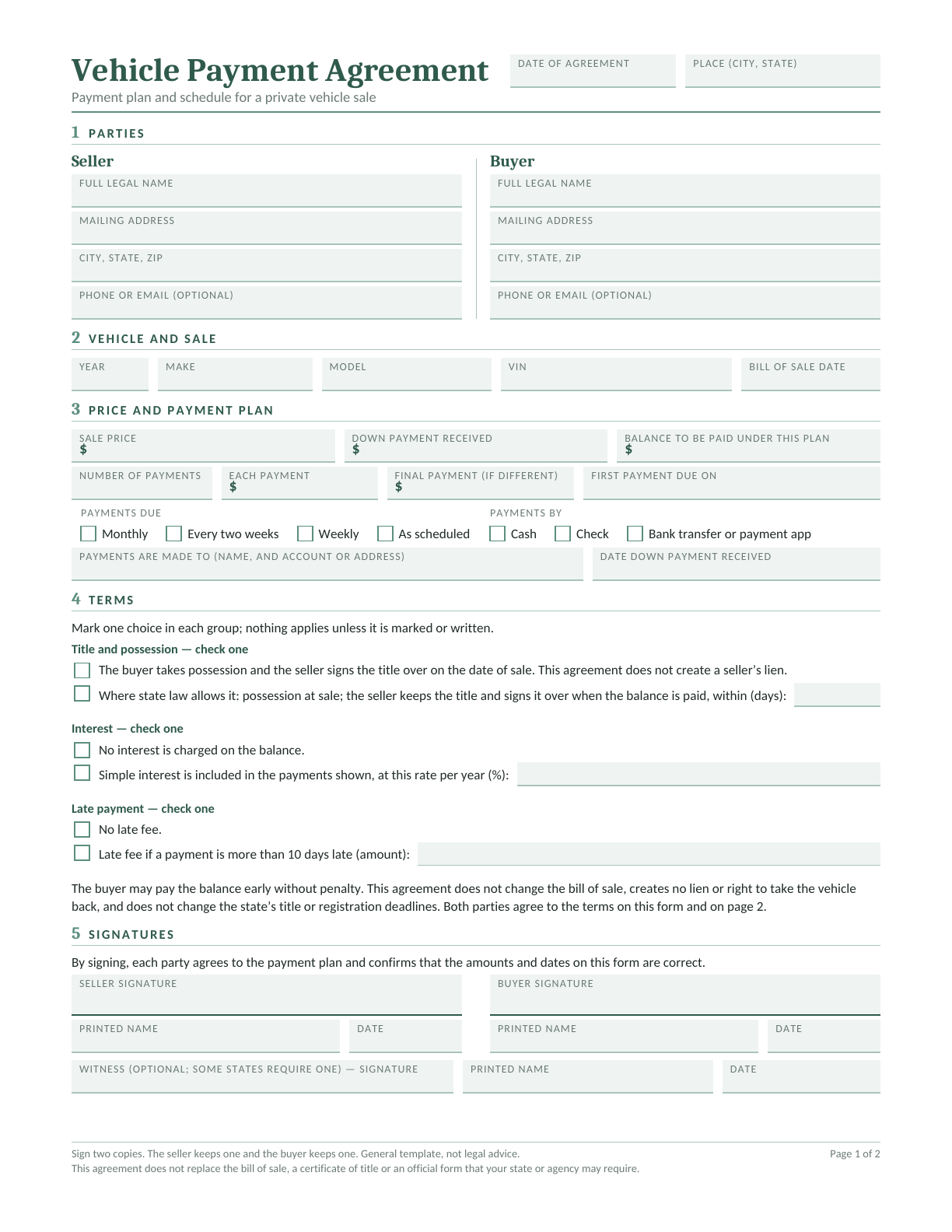
Use this two-page template to record a payment plan for a private vehicle sale. Page 1 sets out the amounts and terms. Page 2 has a schedule with space to record each payment when it arrives.
Vehicle Payment Agreement
Choose Word or Google Docs to edit the wording. Use the fillable PDF to type into the fields, or print the blank PDF to complete by hand.
In Google Docs, sign in and choose Make a copy to save your own version. Review both pages and any financing terms before signing.
A vehicle payment agreement records the buyer’s promise to pay an unpaid part of the vehicle price. It identifies the seller, buyer and vehicle, then sets out how much is due and when.
It is useful when payments continue after handover. A deposit followed by full payment at handover is a different arrangement; our car purchase agreement template covers that planned sale.
About This Template
This is a general template, not legal advice or an official transfer form. It does not create a lien or a right to take the vehicle back. Have interest, fees and any separate security arrangements reviewed for your sale, and follow the official title instructions. See our Terms and Conditions.
How to Fill In Your Payment Agreement
Work through both pages together. Keep the agreed schedule separate from the record of money actually received.
Identify the parties and vehicle. Enter names and contact details. Copy the VIN from the vehicle and title, and use the same vehicle details and sale date on the related documents.
Enter the starting amounts. Record the price, down payment actually received and unpaid balance. Complete the receipt date only after the payment arrives.
Set the installments. Enter the number of payments, amounts, frequency and first due date. List every due date on page 2, including a different final amount if needed.
Complete the payment instructions and terms. Name the payee and payment method. Review the title, interest and late-fee choices before marking them; a printed option is not proof that it is suitable for your state.
Review and sign the same version. Repeat the parties, vehicle and agreement date on page 2. Check the totals and any additional terms, then keep a complete signed copy each.
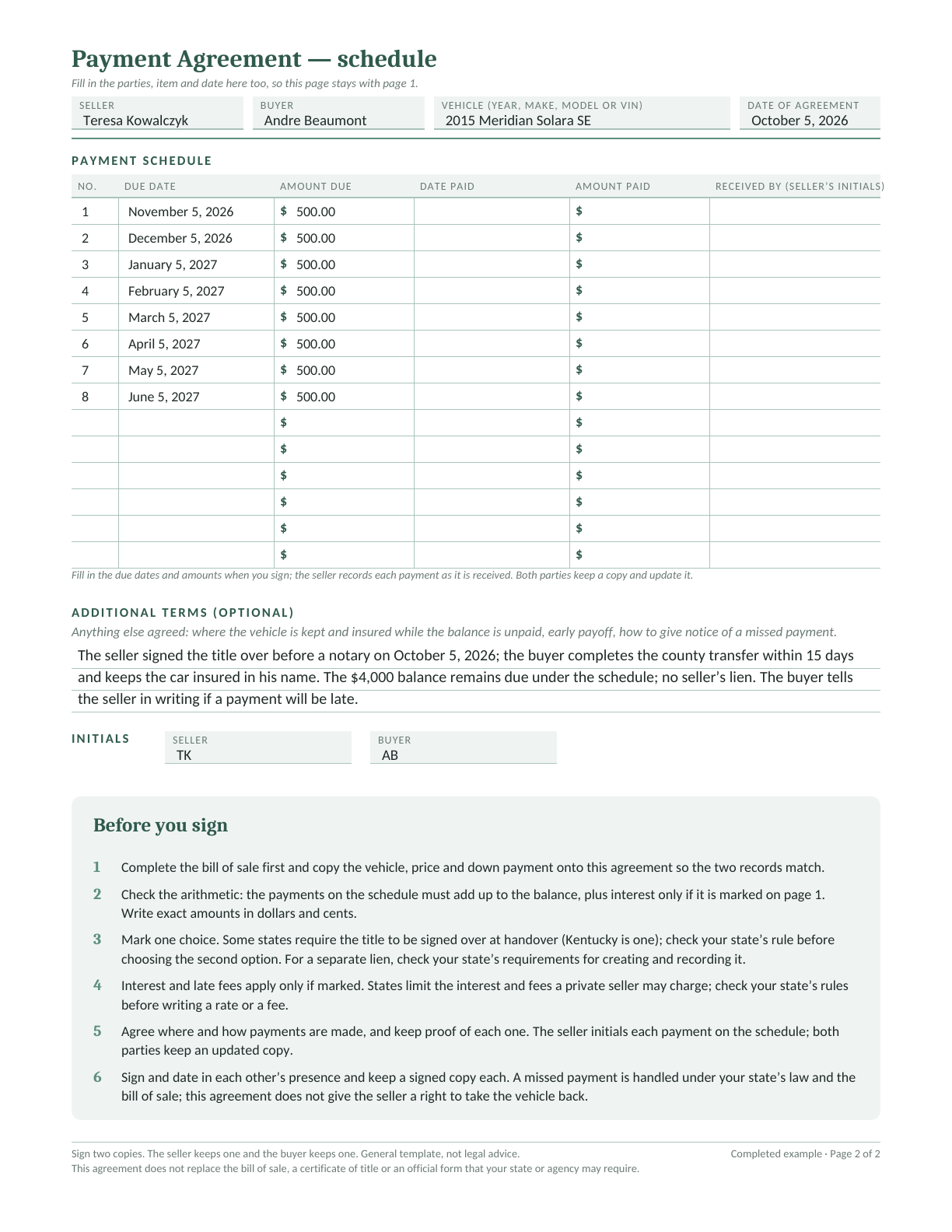
The schedule has 14 rows. Leave “Date paid,” “Amount paid” and the seller’s receipt initials blank for future installments. Fill them in when the seller receives the money.
See a Completed Vehicle Payment Agreement
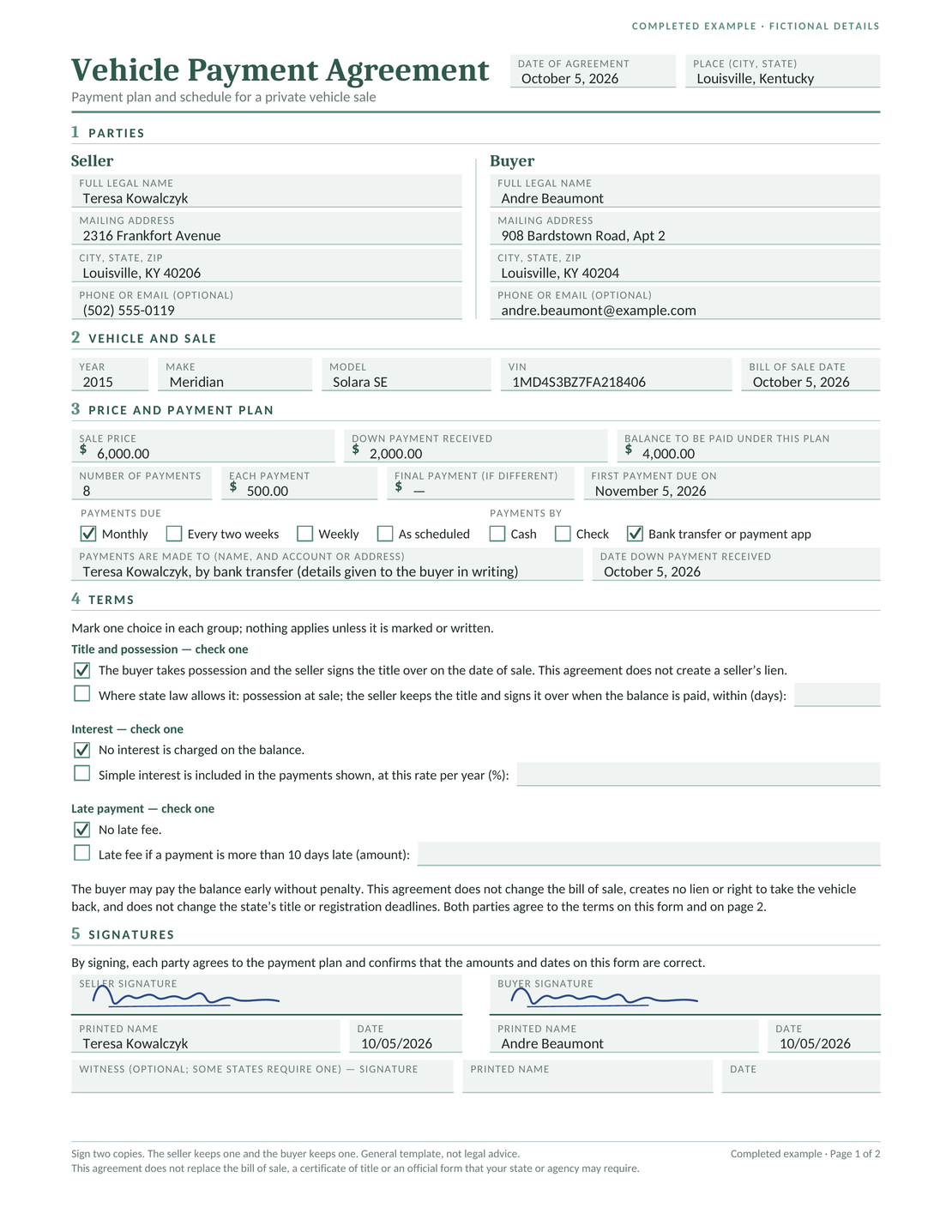
In this fictional example, Teresa Kowalczyk sells Andre Beaumont a 2015 Meridian Solara SE in Louisville, Kentucky, on October 5, 2026. The price is $6,000. Teresa receives a $2,000 down payment, leaving $4,000 to be paid in eight monthly installments of $500.
The example uses no interest or late fee. Title and possession pass at the sale, with no seller’s lien. Page 2 lists the due dates; the payment-received fields are blank. All names, vehicle details and signatures are fictional.
The example’s starting balance is $6,000 − $2,000 = $4,000. Dividing that balance into eight payments gives $500 per payment. The down payment is already counted, so it does not belong in the installment total again.
Each balance below assumes that payment and all earlier installments are received in full. The table shows the plan, not proof of payment.
Payment
Due Date
Amount Due
Balance If Paid
1
November 5, 2026
$500.00
$3,500.00
2
December 5, 2026
$500.00
$3,000.00
3
January 5, 2027
$500.00
$2,500.00
4
February 5, 2027
$500.00
$2,000.00
5
March 5, 2027
$500.00
$1,500.00
6
April 5, 2027
$500.00
$1,000.00
7
May 5, 2027
$500.00
$500.00
8
June 5, 2027
$500.00
$0.00
Eight payments of $500 total $4,000. With the $2,000 down payment, that covers the $6,000 price. At signing, the actual unpaid balance is still $4,000.
Payment Schedule Calculator
Choose the figure you know. Enter the number of payments to find the amount due each time, or enter a payment amount to see how many payments you’ll need.
Your payment estimate
Regular payment
starting .
The final payment is .
Starting balance
Interest
Installment totalExcludes the down payment
Payment schedule
No.
Due date
Amount due
Interest
Principal
Balance left
How the estimate works
The calculator rounds each payment to the nearest cent. If you enter an interest rate, it applies to the unpaid balance each period. When the balance and interest due are less than your chosen payment, the last payment covers just that amount.
This estimate is general information. Check your agreement, applicable limits on charges and required credit disclosures. Ask your lender for a payoff amount. Record actual payments as you receive them.
Keep the Sale Record and Payment Plan Together
The documents have different jobs. Use matching names, vehicle details and amounts so seller and buyer can follow the same transaction.
Document
What It Records
Payment agreement
The unpaid amount, installment dates and agreed payment terms.
Bill of sale
The sale, including its price and the payment status at that time. Do not mark it paid in full while a balance remains.
Payment record
Each amount actually received, its date and method, and the balance still owed.
Title and agency forms
The official ownership, lien, transfer and registration information required by the state.
Need a Bill of Sale With a Payment Schedule?
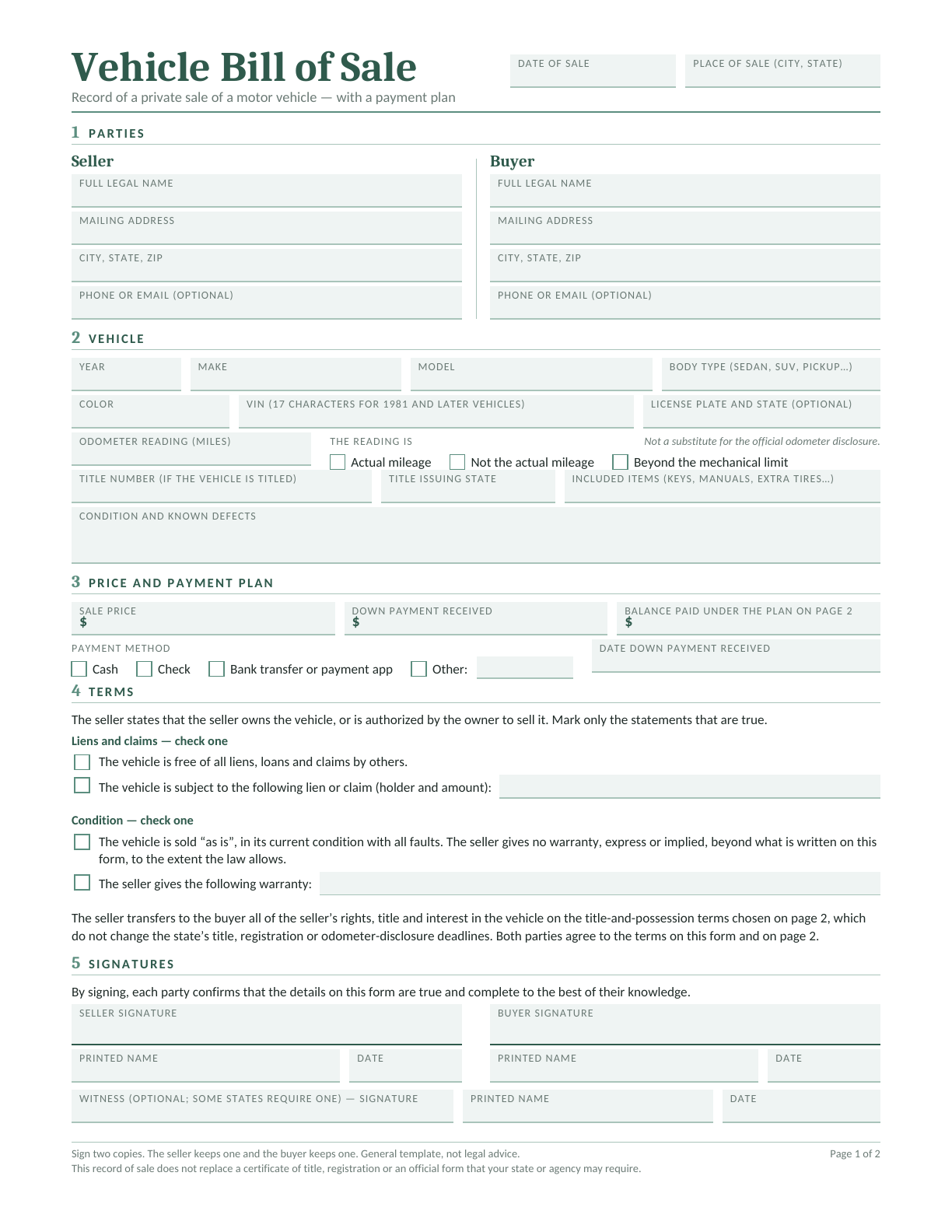
This separate two-page template records the vehicle sale and includes a schedule. If you also use the payment agreement above, check that the amounts and terms match. Neither form replaces required title paperwork.
Vehicle Bill of Sale With Payment Plan
Use the sale record with its attached schedule. Choose an editable Word or Google Docs copy, a fillable PDF or a blank PDF to print.
Installment dates describe when money is due. They do not decide when the title must be transferred, how a lien is recorded or when registration is required.
Title and Possession
Check the state’s process before choosing a title option. Holding the paper title is not a substitute for a properly arranged security interest and any required filings. Agree when the buyer receives the vehicle and how insurance, plates and registration will be handled.
Interest and Late Fees
Do not add a charge just because the template has a field for it. Check the allowed rate, calculation and any required disclosures. The printed 10-day late-fee option is a proposed term, not a nationwide grace period.
For the Kentucky example above, Kentucky law requires the applicable title documents to be assigned and delivered at transfer. The state’s titling instructions give the 15-day transfer deadline and notarization requirements. Later payments do not postpone those steps.
Federal credit rules have coverage tests; the number of installments or a zero-interest choice does not settle every requirement. Have the financing terms reviewed for the transaction before either party signs.
Read the agreement, schedule and sale record together. Resolve any difference between them before committing.
Match the seller, buyer, vehicle and sale details on every page.
Check the price, down payment received and starting balance.
Make the scheduled payments add up to the agreed amount.
Review title, interest, fees and any separate security arrangements.
Confirm the payee, payment method and how receipt will be acknowledged.
Complete the signing requirements and keep the same signed pages each.
This template allows early payment without a penalty. If you change that or any other term, have the revised agreement checked rather than assuming the original form covers the change.
Record Payments as They Arrive
When the seller receives an installment, enter the date and actual amount paid and add the receipt initials. Keep proof of the payment and give the buyer an updated record.
If only part of an installment arrives, record that amount. For example, a $300 payment against a $500 installment leaves $200 of that installment unpaid. Do not mark the full $500 as received.
Keep written, dated copies of any agreed change to the schedule. When the balance is paid, confirm it in writing and complete any required lien-release steps for a separately recorded lien.
If a Payment Is Missed
Compare the due date with the payment record and contact the other party. Check the agreement and applicable law before adding fees, demanding the whole balance or trying to recover the vehicle. This template does not give the seller an automatic repossession right; the FTC explains why contract terms and state rules matter.
Choose a state for its official forms and transfer instructions. Check financing terms separately; a title agency’s instructions do not approve a private payment agreement.
Yes. Record the price, amount received and balance owed on the sale record, and keep the payment terms consistent with the agreement and schedule. Our separate bill of sale with payment plan includes a schedule. Do not mark the price paid in full while a balance remains.
Do not assume so. The template makes that option conditional on state law. Check transfer deadlines and any security-interest and title-filing requirements before choosing it; simply holding the paper title does not settle those questions.
The template includes a no-interest choice, and the example uses it. Record the arrangement you agree to and check any financing rules that apply. If interest is charged, review the rate, calculation, payment allocation and required disclosures before signing.
This template does not create a lien or give the seller that right. Any separate security arrangement and remedy depends on its terms and applicable law. Get legal advice before attempting repossession or adding an automatic take-back clause.
Adjust the final installment so the total is exact. For example, five payments of $833.33 and one of $833.35 total $5,000 with no interest. The main example divides evenly into eight $500 payments, so its final payment is unchanged.
After 14 days, continue for
$12.99/month
only if you choose to upgrade.
We use cookies to provide you with the best possible experience. Cookies also help us analyze user behaviour so we can continue to improve our website. View our cookie policy.