Agree on the price, deposit and inspection terms before completing your car sale. Give seller and buyer a shared record of what they have agreed to do.
Edit in Word or Google Docs, fill in a PDF, or print a blank copy.
Document the sale and agreed terms. Give both seller and buyer a signed copy.
Download Your Car Purchase Agreement Template
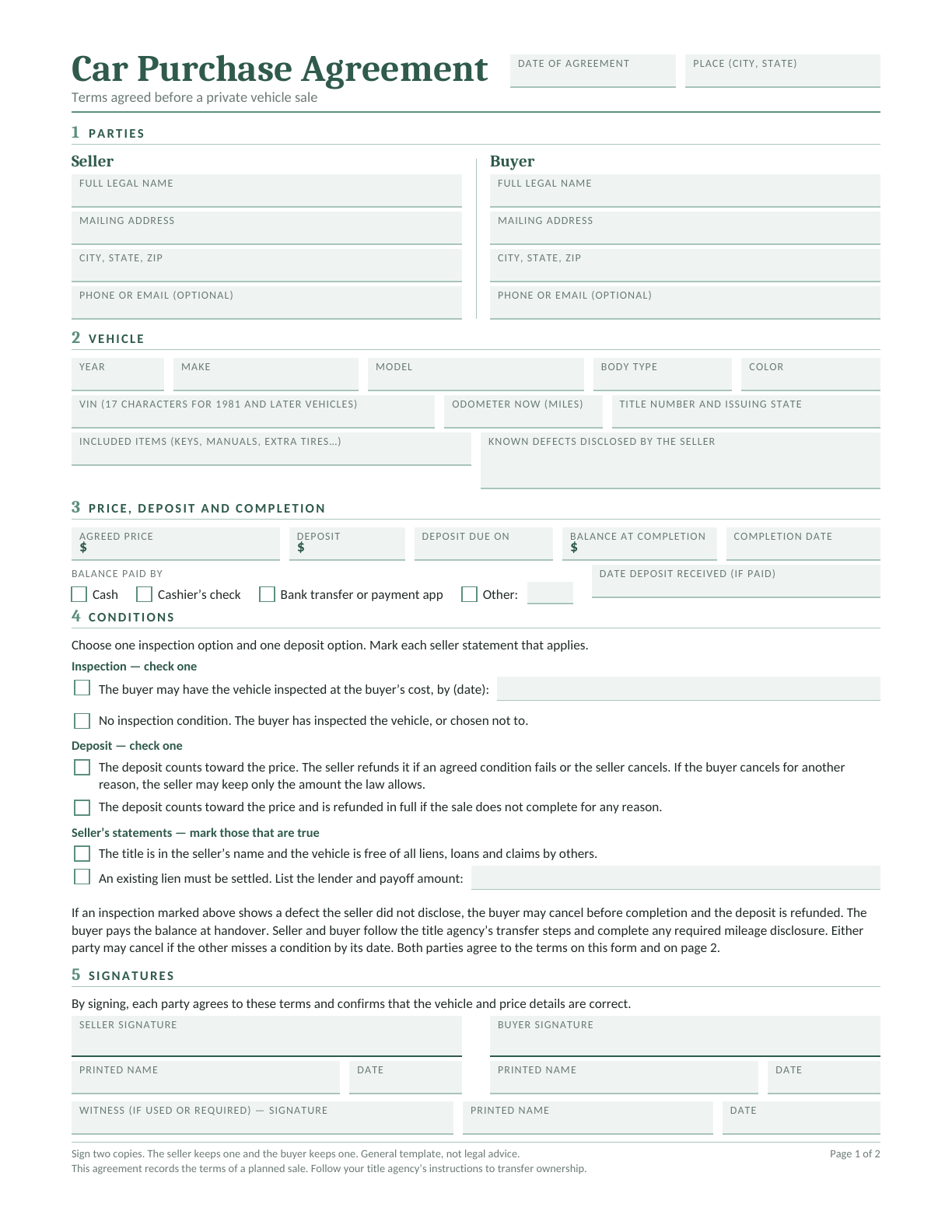
Use this two-page template for a private sale where the buyer will pay the remaining price at handover. Page 1 records the car and agreed terms. Page 2 has room for additional terms and a checklist to review before signing.
Car Purchase Agreement
Choose Word or Google Docs to edit the wording. Use the fillable PDF to type into the fields, or print the blank PDF to complete by hand.
In Google Docs, sign in and choose Make a copy to save your own version. Review both pages before signing.
A car purchase agreement is a contract that sets out what the seller and buyer agree to do. This template is for a planned private sale: it records the price, any deposit, conditions and the date you expect to complete the purchase.
It is useful when there is something to finish before the keys change hands, such as an inspection or an agreed repair. Signing the agreement does not mean that money has been received or that the sale is complete.
When you complete the transaction, use a car bill of sale to record the sale and payment. Follow the separate title-transfer and disclosure requirements too.
About This Template
This is a general template, not legal advice or an official title-transfer form. Check the official instructions for your sale, and get legal advice if you need help with deposit, cancellation or financing terms. See our Terms and Conditions.
How to Fill In Your Car Purchase Agreement
Complete the template together while there is time to check the car and settle any open terms.
Identify the seller, buyer and car. Enter names and contact details. Compare the VIN on the car with the title, and record the model, mileage, included items and known defects.
Set out the price and payment dates. Enter the agreed price, any deposit and the balance due at completion. Fill in “Date deposit received” only after the money arrives.
Choose the conditions. Read the inspection and deposit options before selecting them. Record deadlines and complete only the seller’s statements that are true.
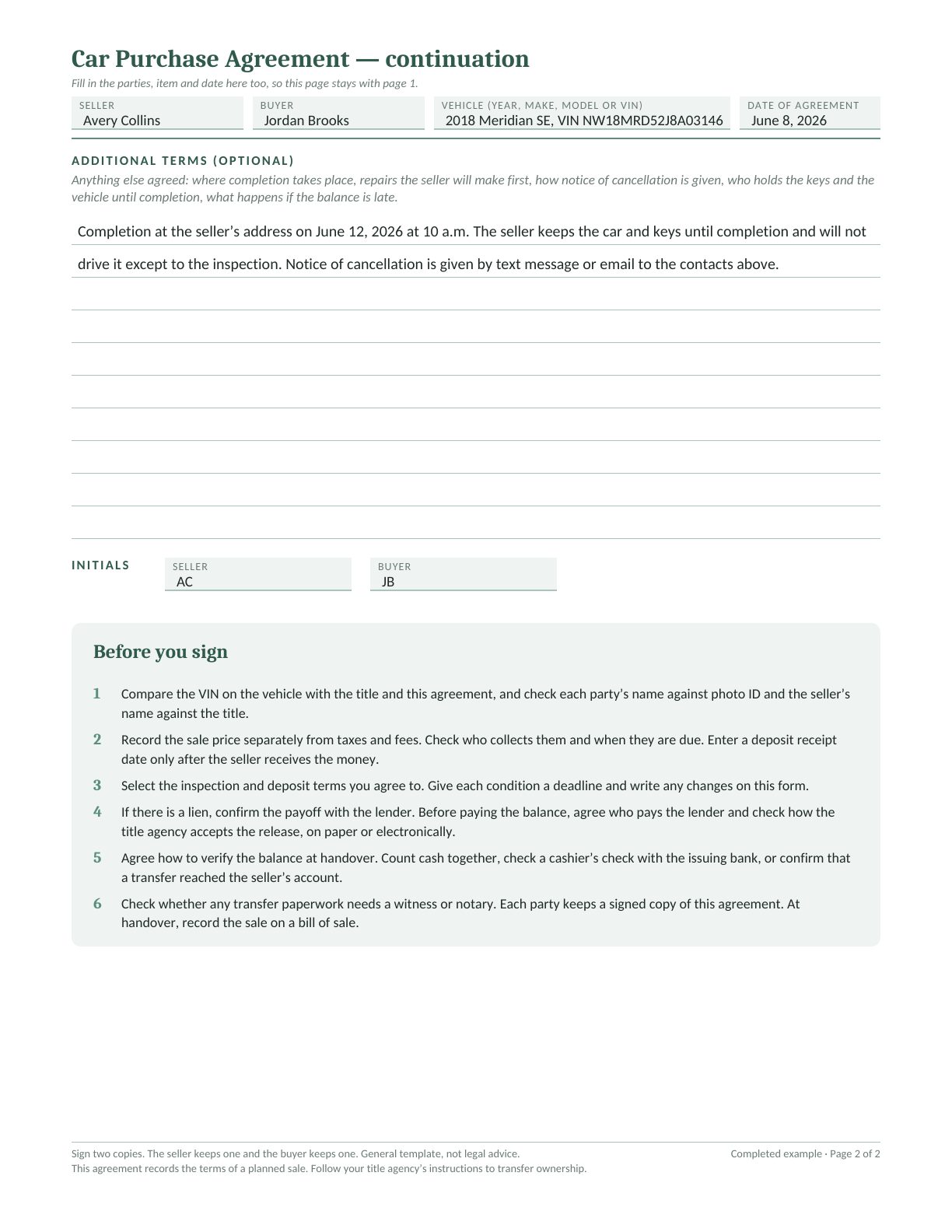
Add the handover arrangements. Use page 2 for the place and time, promised repairs and how you will give any cancellation notice. Repeat the parties, car and agreement date so the pages stay together.
Review and sign. Resolve blank or conflicting terms, check the signing requirements and sign the same version. Keep a complete signed copy each, including page 2.
See a Completed Car Purchase Agreement
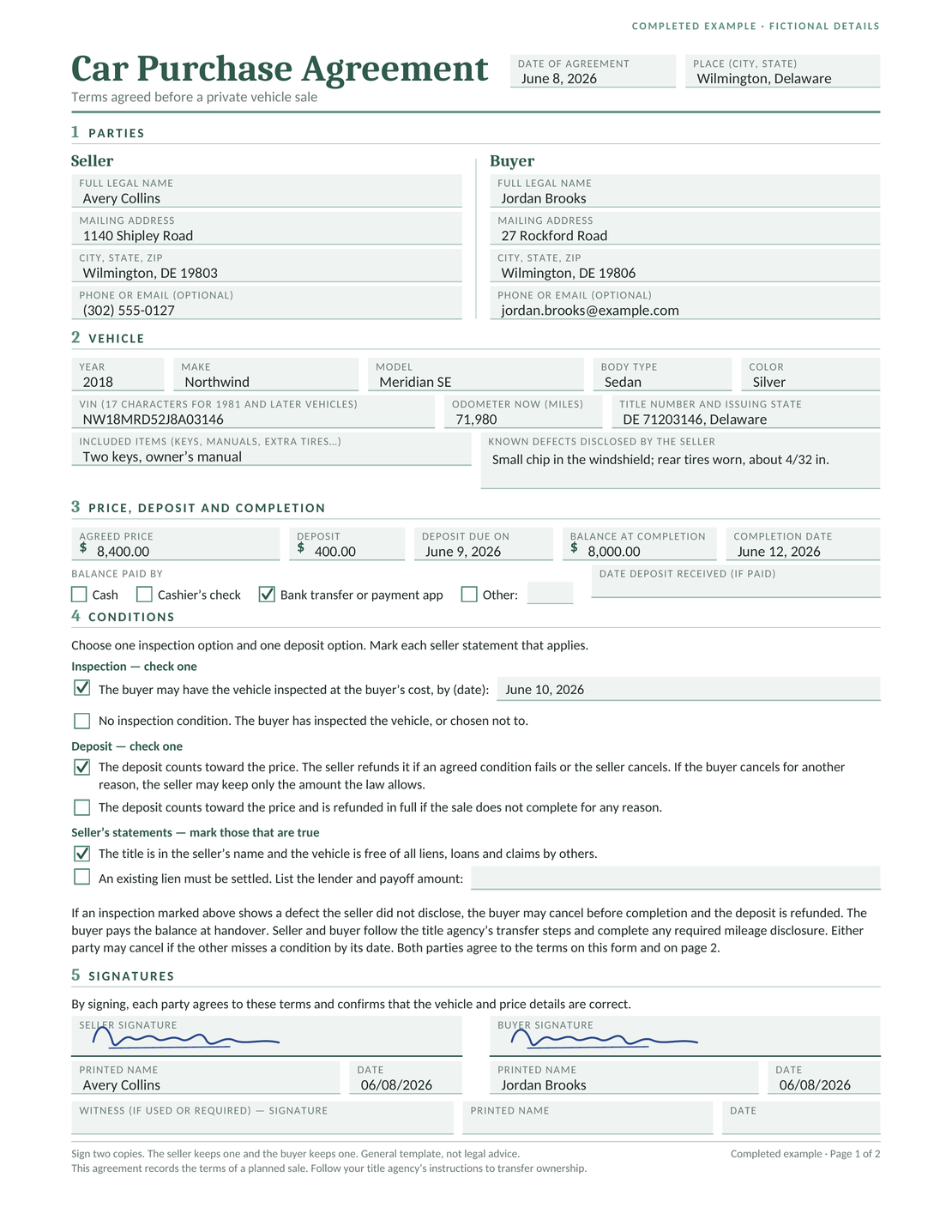
In this fictional example, Avery Collins and Jordan Brooks agree on an $8,400 price for a silver 2018 Northwind Meridian SE in Wilmington, Delaware. They sign on June 8, 2026, with an inspection and payment still to follow.
The $400 deposit is due on June 9. Its receipt date is blank, so the example does not show it as paid. Page 2 records the planned handover and how to give notice. All names, vehicle details and signatures are examples.
Keep the Agreed Price Separate From Payments Received
The example sets dates for the deposit, inspection and handover. Those dates describe the plan; they do not confirm that a payment or inspection has happened.
Item
Amount or Deadline
What the Example Records
Agreed price
$8,400
The price for the car. State taxes and agency fees are separate in this example.
Deposit
$400 due June 9
A planned payment, credited toward the price when received. No receipt date is entered.
Inspection
By June 10
At the buyer’s cost. The selected inspection condition lets the buyer cancel before completion if it reveals an undisclosed defect.
Balance at completion
$8,000 on June 12
The remaining price if the $400 deposit has been received and credited.
Handover
June 12 at 10 a.m.
At the seller’s address. The seller keeps the car and keys until completion.
$400 + $8,000 = $8,400. If the deposit has not arrived, the unpaid price is still $8,400. Record each payment’s actual amount, date and method when it is received.
What to Check Before You Agree
Use the records and the car itself to check the details. A description in an advertisement is a starting point, not proof that everything matches.
Seller and ownership: Compare the seller’s identity with the title, and resolve any co-owner, lien or authority-to-sell questions.
Vehicle: Match the VIN, model and title details. Note any title brands, such as salvage or flood.
Condition: Record known defects, included items and specific repair promises. Arrange an independent inspection when needed.
Money: Agree on the price, deposit, deadlines and payment method. Check taxes and transfer fees with the state agency.
Completion: Set a time and place for payment, paperwork and handover, with a clear next step if a condition is not met.
A vehicle history report can show title and brand history. It does not replace an independent inspection of the car’s current condition.
Agree on Inspection and Deposit Terms
“Subject to inspection” leaves important questions unanswered. Record who arranges and pays for the inspection, its deadline, what result allows cancellation and how the buyer must give notice.
Inspection Result
In the example, the buyer may cancel before completion if the agreed inspection finds a defect the seller did not disclose. Read your chosen condition to check when you can cancel and what happens to the deposit.
Deposit Refund
In the example, the buyer gets the deposit back if an agreed condition fails or the seller cancels. If the buyer cancels for another reason, the seller may keep only the amount the law allows.
If a refund is agreed, write when and how it will be returned. If you later agree on a repair, new price or extension, record the change and give both parties the same updated terms.
Do not assume you have three days to cancel. The FTC’s Cooling-Off Rule covers certain transactions and has exclusions. Cancellation rights depend on the sale, agreement and applicable law.
If a Lender Is Still Owed Money
Confirm the payoff and accepted lien-release process with the lender and title agency before agreeing on final payment and handover. A seller’s promise to pay the loan later is not a lien release.
A deposit followed by full payment at handover is different from installments after the buyer takes the car. For that arrangement, use the vehicle payment agreement guide and have the payment and transfer terms reviewed. A payment schedule alone does not establish a right to repossess the car.
At handover, check which conditions have been met and verify the payment received. Record the actual sale date and payment on the bill of sale, and keep it with the agreement.
Follow the title agency’s process for the vehicle, including any lien release and required odometer disclosure. The mileage field in this agreement does not replace that disclosure. Use our car title transfer guide to check the other paperwork.
Before the buyer drives away, confirm insurance and any required plates or permits. A purchase agreement alone does not complete registration. For example, Nevada DMV says a bill of sale alone is not acceptable proof of ownership for registration.
Keep the Agreement With the Sale Record
Seller and buyer should each keep the signed agreement, attachments, inspection report, written changes, bill of sale and proof of payment. Together, these explain what was agreed and what happened.
The buyer should complete the required title, registration and tax steps. The seller should submit any required sale or transfer notice. Check the state’s deadlines and plate instructions, and coordinate insurance changes with those steps.
This template records terms for a planned sale, including conditions still to be met. Our car bill of sale records the sale and payment. Their content and timing matter more than the names alone; neither replaces required title-transfer paperwork.
That depends on the agreed terms and applicable law. Read the deposit options before choosing one, and record what happens if an inspection condition fails, the buyer cancels or the seller cannot complete. Do not assume a deposit is automatically refundable or that a retention clause is always enforceable.
Check the inspection condition, including its deadline and notice requirements. The selected condition in our example allows cancellation before completion for an undisclosed defect. For your sale, record any agreed repair, price change, extension or cancellation and keep the inspection report.
Yes. It sets out commitments between seller and buyer. Signing does not guarantee that every clause is valid or enforceable in your circumstances. Read the whole agreement, resolve conflicting terms and get legal advice when needed before committing.
That is outside this template’s intended arrangement, which plans full payment at handover. Installments after handover need separately reviewed payment and transfer terms. A schedule of payments does not by itself create a lien or a right to repossess the car.
After 14 days, continue for
$12.99/month
only if you choose to upgrade.
We use cookies to provide you with the best possible experience. Cookies also help us analyze user behaviour so we can continue to improve our website. View our cookie policy.